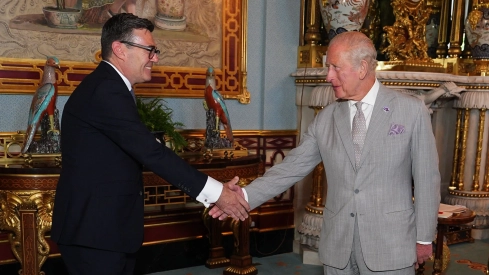
Andy Burnham is now Prime Minister of the United Kingdom. King Charles III tasked him this Monday with forming a Government after accepting Keir Starmer's resignation, closing a Labour handover that brings the former Mayor of Greater Manchester to 10 Downing Street.
Burnham arrived accompanied by his wife, Marie-France van Heel, and delivered his first speech in front of the official residence. He did so without papers or the usual lectern, before family, collaborators, and government workers. His first intervention was marked by the recognition of citizen fatigue and the promise to restore political stability after a decade of continuous changes.
"I know people who are fed up with politics. I listen to them and I want to be honest. We have not been good enough and we have to do better," he stated. Burnham becomes the seventh prime minister since 2016, a succession that began with the 'Brexit' crisis and has turned Downing Street into a revolving door for conservatives and Labour.
The new head of Government avoided presenting his arrival as an internal celebration of the Labour Party. He spoke of a "moment for reflection" and asked his generation of politicians to live up to a country where trust in institutions has been deteriorating for years.
"The United Kingdom needs to show the world that it can regain its stability," he defended. His proposal involves modifying both the political and economic models, with deep decentralization, greater public intervention in essential services, and a reindustrialization strategy to recover activity outside London.
Let’s bring back hope. pic.twitter.com/Z6OCOPXp00
— Andy Burnham (@andyburnham) July 20, 2026
A break with four decades of economic policy
Burnham placed the origin of many British problems in the changes initiated during the eighties. Without directly mentioning Margaret Thatcher, he criticized that political power remained concentrated in Westminster while much of the economic power passed into private hands.
"The United Kingdom made some wrong decisions," he stated. Among them, he cited political centralization, the privatization of essential sectors, and the deindustrialization of entire regions that have not yet managed to recover.
The diagnosis connects with the discourse he has built during his nine years at the head of Greater Manchester. From there, he defended that London concentrates too many decisions and resources, and made the devolution of powers one of the axes of the so-called 'Manchesterism'.
Now he intends to take that model to the whole country. The Government will transfer decision-making capacity to cities, regions and local administrations, especially in housing, transport, training and economic development. Burnham believes that growth will have a better chance of reaching the entire territory when local institutions can decide on their needs.
He has also promised to return stronger public control to essential services to make them affordable. The approach may include water, transport, energy and housing, although details will be pending the economic plan he will present in the coming months.
Reindustrialization will occupy another central place. Burnham wants to use public procurement to favor British companies, create stable jobs and rebuild part of the productive capacity lost in former industrial areas.
Immediate measures for the cost of living
The new prime minister will present this Tuesday his first measures to alleviate pressure on households and will also explain how he plans to finance them. During the speech, he avoided specifying whether they will include tax cuts, energy aid or changes in transport fares.
The economic urgency explains much of his rise. British inflation stood at 2.8% in May and transport prices have continued to grow strongly. GDP advanced 0.1% that same month, while accumulated growth during the previous three months reached 0.7%.
The economy thus maintains a moderate expansion that is still insufficient to reverse the deterioration of public services or rapidly improve the standard of living. Burnham will need to combine his social promises with public accounts subject to strict limits and with the commitment to increase investment in defense.
The new leader has assured that he will respect the fiscal rules and international obligations assumed by the United Kingdom. His formula for reducing social spending involves making it easier for more people to work, improving technical education, strengthening mental health care and building public housing.
"We will help more young people find employment by changing the education system and offering them more support," he announced. The situation of those who remain out of work and training has become one of the country's main economic concerns.
Burnham also promised to build more municipal housing. Rising rents, lack of supply, and difficulties in building social housing keep numerous families stuck and increase the cost of public aid.
His first order will be to combat homelessness
The first concrete measure came as soon as he walked through the door of Downing Street. Burnham has launched a national program to reduce long-term homelessness, initially backed by an additional 340 million pounds.
The money will allow for the acquisition or habilitation of 1,200 homes and provide intensive support to at least 3,000 people. The execution will primarily fall on city councils, metropolitan mayors, health services, and local organizations, with funding and coordination from the central government.
"For too long we have been told that ending people sleeping on the streets would take decades or was even impossible. I do not accept that," Burnham said. "It is something a government can solve when it decides to do so. Today I have made that decision."
The program will begin by identifying people who have been living on the streets the longest and offering them stable accommodation along with health, social, and psychological care. The strategy aims to intervene before personal situations enter a chain of emergencies, hospitalizations, or police actions.
Downing Street estimates that a year of life on the street can cost public services more than 20,000 pounds per person, compared to about 1,400 when a preventive intervention works. The government argues that guaranteeing housing and support is also more sustainable for public accounts.
The initiative revives one of Burnham's main banners during his time as mayor. Greater Manchester initially managed to reduce the number of people sleeping on the streets, although the data worsened again in recent years due to housing, inflation, and the increase in situations of exclusion.
The new prime minister will now have to demonstrate that his local experience can be transferred to the entire United Kingdom. The next steps of the program will be announced before autumn and will form part of a broader strategy for the next five years.
A country plan for the next decade
Before the end of the year, Burnham will present a ten-year plan to transform the economy, public services, and territorial organization. His intention is to offer a direction that survives internal party changes and allows progress to be measured over more than one legislative term.
The project will include greater collaboration between the Government, municipalities, trade unions, businesses, and social organizations. Burnham wants politics to be more focused on solving everyday problems and less conditioned by the constant disputes of Westminster.
"We will transfer power from here to every postcode in the country," he promised. The phrase summarizes the main difference he wants to make compared to the traditional British model, one of the most centralized in Europe.
His plan will also have to clarify how far the promised public control will go. The situation of Thames Water, on the verge of a possible state intervention, will be one of the first tests. The Government will have to decide whether to temporarily take over the company and how to deal with its enormous debt.
Another pending decision affects oil and gas operations in the North Sea. Burnham is considering relaxing the restrictions approved during Starmer's tenure to lower energy costs, create jobs, and increase revenue, a possibility that has already provoked protests from environmental groups.
Starmer bids farewell with a defense of his legacy
Just over an hour earlier, Keir Starmer had appeared in the same place to formally announce the end of his term. The outgoing prime minister defended that he leaves a United Kingdom "stronger and fairer" than the one he received after fourteen years of conservative governments.
"My job is done," he stated at the beginning of a speech in which he recalled that he took control of the Labour Party after the 2019 defeat, rebuilt its electoral position, and achieved a large parliamentary majority in July 2024.
Starmer claimed the reduction of healthcare waiting lists, the fall in immigration, progress against child poverty, and the strengthening of defense. He also dedicated a significant part of his farewell to British support for Ukraine and the need to protect the country's unity against those who try to divide it.
The departure comes after less than two years at the head of the Government. The poor Labour results in local and regional elections, the fall in the polls, and the loss of confidence within the parliamentary group ended up forcing his resignation.
Starmer offered his full support to Burnham and asked that the handover be interpreted as a collective effort. "Politics will always be a team sport," he said before thanking his family, civil servants, and Labour Party workers for their support.
"I leave with dignity, with a smile, and proud of everything we have achieved," he concluded. He then went to Buckingham Palace to present his resignation to Charles III and officially close his term.
Farage's threat accompanies the handover
Burnham arrives in Government with a broad parliamentary majority, but the support he has received comes from the Labour Party and not from new general elections. The British system allows the leader of the majority party to become prime minister without immediately calling for elections.
Elections can wait until 2029, although the new leader will have the power to bring them forward. During his first weeks, he will have to decide whether to seek his own mandate soon or take advantage of the majority achieved by Starmer to develop his program.
The rise of the far-right Reform UK will condition much of that decision. The party of ultra Nigel Farage has grown among former Labour voters in industrial areas and has made immigration, the cost of living, and the deterioration of public services its main arguments.
Burnham returned to Parliament after clearly defeating Reform UK in Makerfield, a working-class constituency in the northwest where he managed to mobilize progressive voters and recover part of the electorate that had abandoned Labour.
His arrival at Downing Street largely responds to the hope of repeating that formula across the country. The new prime minister has promised a recognizably Labour agenda and has refused to compete with Farage through greater radicalization against immigration.
Foreign policy will initially maintain greater continuity. Burnham has backed support for Ukraine, commitments to NATO, and the relationship with the United States. He also advocates a gradual approach to the European Union, although he rules out reopening the debate on entry into the single market or the customs union for now.
The first day ends with the new head of government forming his cabinet and preparing the economic measures he will announce this Tuesday. Burnham has already issued his first order within number 10. Local councils must begin to locate housing and identify those who have been sleeping on British streets the longest.
