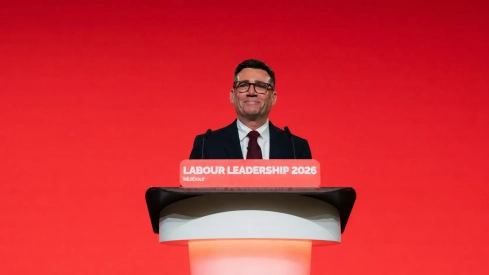
Andy Burnham has been proclaimed this Friday as the new leader of the Labour Party and is now one step away from becoming Prime Minister of the United Kingdom. The former mayor of Greater Manchester will arrive at 10 Downing Street on Monday with the promise of initiating the deepest political change of the last four decades.
Burnham has received the support of 379 of the 403 Labour MPs and 23 affiliated organizations, including trade unions and socialist societies. His only remaining path is the constitutional protocol that will culminate on Monday, when Keir Starmer formally presents his resignation to King Charles III.
"I am ready," Burnham proclaimed during the extraordinary congress held at the London headquarters of the Trades Union Congress. The new leader has presented his arrival as an opportunity to restore hope to working communities that feel abandoned by Westminster.
Five commitments to open a new stage
Burnham's speech has been structured around five major promises. The first consists of ending the internal divisions that have worn down the Labour Party in recent years and building a team in which its different sensibilities can coexist.
The new leader has promised to respect militants with different opinions and to move away from the expulsions and sanctions used during internal struggles. His future cabinet, still in preparation, must reflect "all parts" of the party and the different communities of the country.
Burnham has also advocated for a policy less focused on confrontations and more oriented towards solving concrete problems. His intention is to seek agreements with other parties on long-term issues, especially the reform of social care, housing, and territorial decentralization.
The third commitment marks the ideological shift he wants to bring to the Government. "We will win by being ourselves," he stated before assuring that Labour will stop imitating conservatives, environmentalists, and populists. "We will not try to be greener than the Greens or more reformist than Reform," he summarized.
The remaining two promises place territory at the center of his project. Burnham wants to represent the north and south of England, Scotland, Wales, and Northern Ireland and transfer powers from Westminster and Whitehall to cities and regions.
A break with four decades of neoliberalism
The new Labour leader has located the origin of a good part of British problems in the transformations initiated during the 1980s. Burnham believes that political power became concentrated in London while economic power passed into private hands during Margaret Thatcher's governments.
His criticism extends to the privatization of essential services such as water, energy, transport, and housing. According to Burnham, this model left citizens exposed to increasingly higher prices and emptied numerous industrial towns and cities of economic capacity.
"The country gave up control of the essential," he stated. The next prime minister argues that recovering greater public capacity over these sectors will allow prices to be contained, reduce pressure on public spending, and improve the standard of living.
The proposal comes amid the crisis at Thames Water, the largest British water supply company, which is trying to avoid state intervention after accumulating a debt of nearly £20 billion. Burnham had already advocated for the company to return to public control.
The Labour leader has avoided promising a general nationalization of all privatized services. His model combines public intervention, business investment, and regional management, following the formula he applied during his time leading Greater Manchester.
A leader favorable to businesses and public control
Burnham has insisted that he will be a leader favorable to business activity, especially to small and medium-sized companies that sustain the economy of neighborhoods and cities. His project seeks to reindustrialize regions and recover stable jobs linked to new productive sectors.
The so-called "Manchesterism" combines public and private resources to improve transport, build housing, and regenerate industrial areas. During his time as mayor, Burnham integrated Greater Manchester's buses into the public Bee Network and limited the fragmentation caused by decades of liberalization.
He also wants to strengthen technical and vocational education to offer young people a real alternative to university. More than one million Britons aged between 16 and 24 are currently out of employment, education, and training, approximately one in seven young people.
The next Government will have to convert that agenda into fundable measures. The International Monetary Fund has asked the United Kingdom for prudence in the face of any new increase in spending and has recommended maintaining the path of deficit reduction.
Burnham assures that he will respect fiscal rules and that his economic policy will be responsible. The unknown is how he will simultaneously finance social care, public housing, reindustrialization, and the improvement of essential services.
Social care moves to the front line
After his proclamation, Burnham has traveled to Gravesend, in the county of Kent, where he has placed care for the elderly and dependents among his immediate priorities. The future prime minister has defined the care system as "broken" and unfair to families with fewer resources.
His involvement also has a personal component. Burnham has explained on several occasions the difficulties his family experienced in caring for his father, who suffers from Alzheimer's. This Friday he assured that he is willing to spend a considerable part of his political capital to push through the reform.
Around two million elderly people in England live with some unmet care need. One in ten people over 65 can face expenses exceeding £100,000 throughout their lives, due to a system that forces many families to deplete their savings.
Burnham wants to study the creation of a universal care service and accelerate the review commissioned to Baroness Louise Casey, whose final report was scheduled for 2028. The next prime minister could ask for her conclusions to be ready before the end of 2026.
Funding remains open. In the past, he proposed replacing inheritance tax with a national contribution for care, although he later suggested other formulas for taxing wealth. Any broad reform will require several billion additional pounds each year.
Housing, cost of living, and public services
The new Government inherits an economy struggling to grow and a population punished by the rising cost of energy, food, and housing. Burnham has promised that making life more affordable will be one of the first objectives of his mandate.
The Labour Executive committed in 2024 to build 1.5 million homes in England during the legislature. To achieve this, it would need to reach an average of 300,000 homes each year, while in the twelve months prior to March 2026, some 204,000 were completed.
Burnham proposes the largest municipal housing program since the post-war period and more capacity for local councils to build social housing. Housing policy will be part of his devolution strategy, along with transport and the regeneration of urban centers.
The National Health Service, social care, and the benefits system complete the list of urgent issues. Annual spending on sickness and disability benefits for people of working age is around £58 billion and could reach £78 billion by 2030.
Burnham wants to reduce that bill by facilitating a return to the labor market and avoiding general cuts. His margin will be narrow after the rebellion of Labour MPs that forced Starmer to withdraw part of his benefits reform.
The mission to stop ultra-leader Nigel Farage
Burnham's arrival also responds to Labour's fear of the growth of the far-right Reform UK. Nigel Farage's far-right party has topped several polls for months and managed to snatch hundreds of councilors from Labour in the local elections in May.
Burnham regained his seat in the House of Commons by clearly defeating Reform UK in Makerfield. The Labour candidate secured 24,937 votes compared to the 15,696 obtained by the populist aspirant in an industrial constituency where Brexit had broad support. That victory finally convinced the MPs who were looking for a replacement for Starmer. No leader gathered the necessary support to compete and Burnham remained as the sole candidate for the primaries.
Farage defined him this Friday as "the great chameleon of British politics" and called his speech empty. The leader of Reform UK demands immediate general elections, considering that the new prime minister lacks a direct mandate from the citizens.
Burnham has avoided announcing an early election. The current Labour majority allows the legislature to be extended until 2029, although the new leader will have to face pressure from the opposition to become prime minister through an internal handover.
From "King of the North" to Downing Street
Born in Aintree, near Liverpool, in 1970, Burnham grew up in a working-class family and joined the Labour Party at 15. He studied English Literature at Cambridge and entered the House of Commons in 2001.
He held different responsibilities in the governments of Tony Blair and Gordon Brown, including the Culture and Health portfolios. He tried to lead the party in 2010 and 2015, when he was defeated first by Ed Miliband and then by Jeremy Corbyn.
In 2017, he left Westminster to become mayor of Greater Manchester. From that position, he built an image of an approachable politician, a defender of regional investment, and a critic of decisions made from London.
His confrontation with Boris Johnson during the pandemic ultimately projected him as the "king of the north." Burnham accused the Conservative Government of imposing harsher restrictions on Greater Manchester without offering sufficient economic compensation for its workers and businesses.
He also played a prominent role in the fight of the families of the 97 Hillsborough victims. He pushed for the reopening of the investigation and advocated for a law that obliges public authorities to act with transparency after major tragedies.
Continuity with Starmer and change of course
Burnham has thanked Keir Starmer for bringing the government back to Labour after 14 years of Conservative executives. He has also championed the rights approved for workers and tenants, the reduction of healthcare waiting lists, and the return of railways to public control.
His speech has simultaneously included an amendment to the course followed over the last two years. The promise of a more recognizable Labour, criticism of the economic model, and the commitment to listen to all sensitivities within the party point towards a different stage.
In foreign policy, greater continuity is expected. Burnham has backed British support for Ukraine and criticized the instability generated by Donald Trump. He also considers Brexit harmful, although he rules out proposing an immediate return to the European Union and respects the result of the 2016 referendum.
The change in leadership will leave the United Kingdom with seven prime ministers in barely ten years. Burnham will be another head of government who comes to office through an internal replacement within the ruling party, as previously happened with Theresa May, Boris Johnson, Liz Truss, and Rishi Sunak.
The handover begins on Monday
Starmer will appear for the last time before the Downing Street residence and will then go to Buckingham Palace to present his resignation to King Charles III. Burnham will then be received by the monarch, who will formally entrust him with the formation of the new Government.
The new prime minister will travel from the palace to number 10 and deliver his first speech before the black door of the official residence. Afterwards, the appointment of the main ministers will begin.
Burnham has confirmed that he is "finalizing" these decisions and that he will announce his team on Monday. The leader assures that announcing the names before officially taking office would cause confusion and keeps the identity of his future Economy minister under wraps.
The first appointments will allow verifying the promised internal balance and the depth of the change compared to Starmer's team. Burnham has announced that during August he will visit different British regions to listen to citizens, businesses and local authorities before the return of Parliament.
