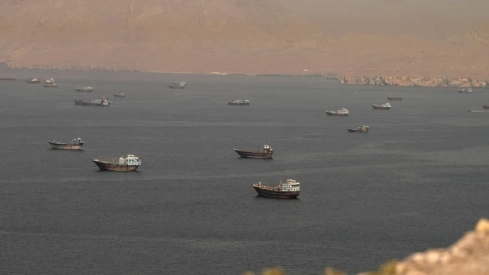
Iran announced this Wednesday an agreement with Oman on the coordinates of a new navigation route through the Strait of Hormuz. The two riparian countries have set the course that ships must follow and are preparing a joint declaration to include the main points of the understanding.
"The geographical coordinates of the proposed route have been agreed upon by both parties," confirmed the spokesman for the Iranian Ministry of Foreign Affairs, Ismail Bagaei. The text is in its final phase of review and drafting, provided that certain "third parties" do not hinder the process.
The allusion points directly to the United States. Tehran maintains that any agreement with Oman will be insufficient to guarantee security as long as the US naval blockade on Iranian ports and ships continues.
The talks have taken place over the last two months and cover the technical, legal, environmental, and security aspects of the new corridor. Iran and Oman are also studying a joint mechanism to regulate traffic through a route that connects the Persian Gulf with the Gulf of Oman and concentrates a large part of global energy trade.
The scope of the pact may go beyond the simple delimitation of a route. Iranian and regional sources cited by 'Reuters' assure that the scheme would give Tehran control over ships entering the Gulf, one of the main demands made by the Islamic Republic since the beginning of the negotiations.
It still remains to be defined how inspections will be carried out, what capacity Iran will have over outgoing vessels, and whether ships will have to pay for security services. Tehran demands fees of between 5% and 7% of the cargo's value, Oman proposes lower percentages, and Washington rejects any mandatory toll.
Trump threatens new attacks
The Iranian announcement came after Donald Trump assured that the strait would open "very soon." The President of the United States has once again accompanied his supposed negotiating optimism with a direct military threat against Tehran.
"If they back down again, they will receive a hard blow," he stated during an interview on 'Fox News'. Trump has also defined this moment as Iran's "last chance" to sign a "good deal" and has linked the reopening of Hormuz with Iran's renunciation of developing nuclear weapons.
The US president assures that he suspended a new large-scale attack over the weekend to allow room for diplomacy. According to his version, talks are progressing favorably and a negotiation that lasted all day was held on Tuesday.
Iran rejects that account and states that it is only negotiating with Oman. Tehran maintains that Washington has no direct involvement, while US Secretary of State, Marco Rubio, assures that his country is involved in the contacts and that progress has been made.
The contradiction has become another part of the political tug-of-war between both governments. Trump presents any movement as the result of his military pressure. Iran claims an agreement built between the two states that share the waters of the strait and accuses the United States of trying to appropriate the negotiation.
The US threat also comes at a delicate moment for its Armed Forces. Months of operations and a new bombing campaign in July have reduced the reserves of several munitions, while Iran retains the capacity to alter maritime traffic and respond through its allies in the region.
A reopening still pending
The agreement on the coordinates represents the most concrete progress achieved so far, but traffic through Hormuz remains very far from recovering pre-war normality. On Tuesday, eight vessels crossed the strait, including five oil tankers and three bulk carriers. Before the conflict, between 130 and 140 ships usually crossed it every day.
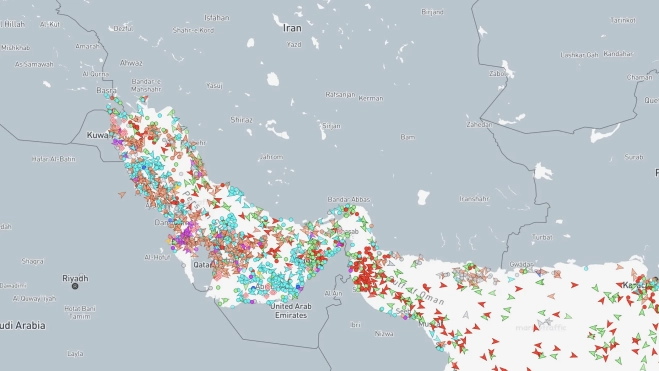
Around a fifth of the world's traded oil and liquefied natural gas circulated through this route. Its closure has forced the diversion of cargo, has increased maritime insurance costs, and has caused strong fluctuations in energy markets.
Iran assumed de facto control of the strait after the United States and Israel began their military offensive on February 28. The parties signed a memorandum of understanding on June 17 under the mediation of Pakistan and Qatar, but fighting resumed in early July.
Tehran responded by closing Hormuz again and Washington re-established a naval blockade on Iranian coasts and ports in mid-July. The Islamic Republic has since used control of the strait as its main instrument of pressure to demand an end to US operations.
The United States claims to have helped more than a thousand ships cross the area and assures that it keeps a southern route open. Navigation data shows, however, very limited transit and numerous companies continue to avoid passage due to the risk of attacks, boardings and new reprisals.
The drop in traffic has also shifted some of the tension to the Red Sea. Yemen's Houthis have attacked Saudi vessels and threatened the main alternative route used to bypass Hormuz, increasing pressure on Gulf countries to close a deal as soon as possible.
Iran and Oman will now have to specify the competencies of each country, the inspection system and the possible charges for vessels. Until the joint declaration is published, ships will continue to traverse a strait surrounded by Iranian forces, US warships and a negotiation subject to new threats in a limited way.
Add ElConstitucional.es as a preferred Google source for free.
Stay informed about all the latest breaking news with the best information. Against disinformation, for democracy and social rights.
