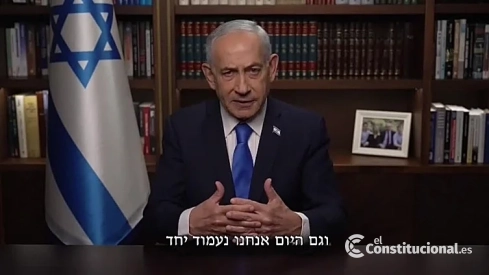
Israel closes the polls in decisive elections for the political future of Benjamin Netanyahu, questioned by the security failures of October 7, 2023, and by the war in Gaza. With an opposition led by Gadi Eisenkot and without a guaranteed majority in the polls, attention is now focused on the first surveys and on the battle to gather the necessary support to govern.
The prime minister, leader of Likud, has faced a day that comes after the attacks of October 7, 2023, and the war in Gaza, while Gadi Eisenkot, a retired general and former chief of staff, seeks to present himself as the main alternative to Netanyahu's bloc.
The Knesset distributes 120 seats and requires 61 deputies to form a government, but no bloc arrives with that number guaranteed. Israel elects in a single national constituency, with proportional lists and a barrier of 3.25% to enter Parliament.
The surveys published before the vote depicted a fragmented parliament: Kantar attributed 20 seats to Likud and 22 to Yashar; Midgam, 21 and 23, respectively. Together, the list linked to Naftali Bennett and Yair Lapid, appeared with 14 or 15, The Democrats with 8 or 10 and the Joint Arab List with 9 in both surveys.
Security, Gaza, and accountability continue to dominate
The Israeli offensive on Gaza has left massive devastation: tens of thousands of Palestinians dead, hundreds of thousands injured, entire neighborhoods destroyed, and a population subjected to forced displacement and severe restrictions on access to food, water, electricity, and medical care. The offensive and limitations on the entry of humanitarian aid have aggravated a crisis that international organizations and human rights organizations have been denouncing for years. In November 2024, the International Criminal Court issued an arrest warrant against Benjamin Netanyahu for alleged war crimes and crimes against humanity, including the use of starvation as a method of warfare and murder. Furthermore, on October 26, 2026, an independent UN commission of inquiry concluded that Israel had committed acts of genocide in Gaza, even after the ceasefire.
The campaign has focused on responsibility for October 7, the future of Gaza, the Palestinian question, judicial reform, and the recruitment of the ultra-Orthodox. The opposition demands an investigation into the security failures that left around 1,200 dead and 251 kidnapped, while Netanyahu defends his management and claims credit for subsequent operations. However, the military offensive has not closed the debate on the failures that allowed the attacks nor has it shielded Netanyahu from criticism for his political responsibility.
Eisenkot demands a state commission of inquiry and promises to end Hamas's military and governmental power within 18 months. Netanyahu, for his part, bases his campaign on national security and his experience, although he carries the reproach for previous failures and a corruption trial.
The main Jewish candidacies do not place the creation of a Palestinian State as a programmatic axis. At the same time, the far-right parties Otzma Yehudit and Religious Zionism support the prime minister's bloc, while Yisrael Beiteinu adds another layer of tension between secular and religious voters.
Polls close with record turnout and the battle for power remains open
The day has also seen an unusually high turnout. By 4:00 PM, 55.7% of the electorate had voted, the highest level at that time since 1973, and in the first three hours, turnout reached 16.7%, the fastest initial pace since 1981.
By 6:00 PM, the figure rose to 66.7%, above the 57.7% recorded at the same time in the 2022 elections. Netanyahu accused his rivals of trying to steal the elections and warned of alleged fraud, but the Electoral Commission denied that there was evidence of systematic manipulation.
The electoral authority is investigating specific irregularities, such as damaged or missing ballots, and police arrested three suspects for an attempted bribery of voters in favor of Ra'am. This episode adds political pressure, but does not by itself prove a general alteration of the process.
With polling stations closed, exit polls are already offering the first estimates of the distribution of the 120 Knesset seats, although these are not yet official results. The main unknown is whether Benjamin Netanyahu will manage to gather the 61 deputies needed to form a government or whether the opposition led by Gadi Eisenkot will be able to articulate an alternative majority. Pre-election surveys pointed to a fragmented Parliament, with both blocs below an absolute majority, so minority parties could prove decisive. The counting will continue over the next few days and official results are expected on November 4, before President Isaac Herzog begins consultations to commission the formation of the Executive.