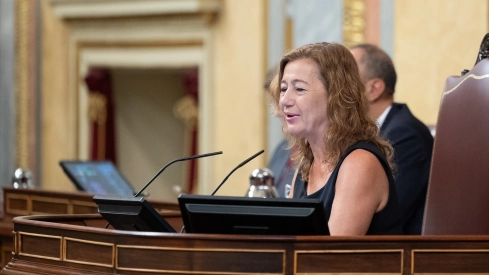
Francina Armengol focused this Wednesday on the advances in democratic memory, but she did so with an immediate warning: time is working against reparation and some autonomous communities, she denounced, are backtracking.
The President of Congress opened in Madrid the commemoration ceremony for the Day of Remembrance and Homage to the Victims of the Military Coup, the War and the Dictatorship, held in the Salón de Pasos Perdidos, in an event she defined as an “end of an era” due to the dissolution of the Cortes before the call for new general elections.
The advances cited by Armengol and the limit she sets for them
Armengol placed the democratic memory law and the additional provision known as the grandchildren's law among the “brilliant milestones” of the legislature, which, she recalled, has allowed for almost 2.5 million nationality applications from descendants of exiles.
She also highlighted the reports on political persecution, which, according to her assessment, have served to compensate more than 600,000 people. To this, she added the work of the democratic memory prosecutors, the thousands of exhumation works, and the symbolic actions in the Valley of Cuelgamuros.
But, at the same time, she warned that this impulse coexists with opposing movements in several autonomous communities, including the Balearic Islands, where, she denounced, memory laws are being replaced by other norms that seek to “erase the trace of truth and justice” and harm the reparation of victims.
The President of Congress insisted that there are still 11,000 bodies in Francoist mass graves and defended the need to “shield a firm commitment to truth, justice, and non-repetition.” She also highlighted the activities of the Spain in Freedom program to foster critical thinking.
The tribute focuses on women whose heads were shaved by the dictatorship
The Lower House dedicated its annual tribute to the victims of Francoism this year to women repressed during the dictatorship, particularly those whose heads were shaved as a form of humiliation.
Armengol pointed out that these women, who were called “the shaved ones,” are among the most silenced victims of Francoism and defended the need to repair, as far as possible, “that specific pain, that cruel shame” exercised against them. “Analyzing and observing our history with a gender perspective is a daily task that we cannot abandon,” she stated.
In her speech, she also recalled that this year marks 90 years since the beginning of the Civil War and the execution of the teacher María Domínguez, murdered in Fuendejalón. In addition, she mentioned the removal of the portraits of presidents of the Francoist Cortes, at the request of memorialist associations, and defended that Congress should be a place of memory.
After her speech, the event continued with a colloquium between historians María Rosón Villena, professor at the Complutense University of Madrid, and Sescún Marías Cadenas, professor at the University of Zaragoza. The commemoration closed with the puppet show of Melón Pelado, by the company ButacaZero.
Among the attendees were the Minister of Equality, Ana Redondo; the special prosecutor for memory, Dolores Delgado; the Secretary of State for Relations with the Cortes and Constitutional Affairs, Rafael Simancas; and the Secretary of State for Democratic Memory, Fernando Martínez.
Contact