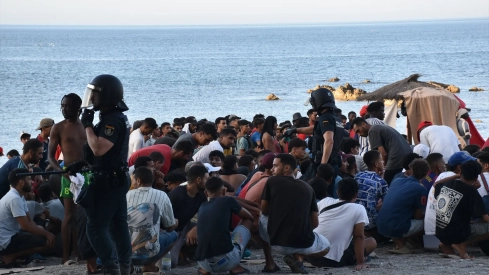
The European Commission defended this Tuesday that migrants who remain irregularly in Ceuta be returned to Morocco and has expressly included unaccompanied foreign minors. The statement hardens Brussels' position on the migration crisis, although the guarantees recognized by Spanish, European, and international legislation rule out any automatic return.
"We continue to insist that the expectation is that all those who remain illegally in Ceuta will be returned," said the community spokesperson for Internal Affairs, Markus Lammert, during a press conference.
Asked specifically about minors, Lammert maintained that they are also included because European law contemplates their return. Brussels expects Spain and Morocco to collaborate so that returns occur "effectively" and has welcomed Rabat's willingness to facilitate the return of children and adolescents who arrived without family references.
The autonomous city is already attending to 2,168 minors located by the Police since the massive entry began on July 30, according to the latest known balance. The Government maintains the total number of people who crossed during those days at 72,000 and has announced 1,500 additional temporary places to alleviate the pressure on reception resources.
The political message launched from Brussels requires, however, several legal clarifications. The possibility of repatriating a minor exists, but it is conditioned on an individual assessment, their right to be heard, and the verification that they can be handed over to their family, a guardian, or an adequate protection service in Morocco.
NGOs respond: "There are no illegal minors"
Specialized organizations have reacted harshly. The general director of the Spanish Commission for Refugee Aid, Mauricio Valiente, described Lammert's words as "a regrettable error" and called for his immediate rectification in statements to Europa Press.
CEAR reminds that unaccompanied minors are under the guardianship of protection services and have a reinforced legal regime. "There are no illegal minors," Valiente stressed, who warns that presenting them as people subject to the ordinary immigration regime fuels xenophobic discourses and blurs their rights.
Accem has introduced another relevant correction. The new European Return Regulation cited by the Commission was provisionally agreed in June by the Council and the European Parliament, but it still needs to be formally approved and published in the Official Journal of the European Union. Therefore, it is not yet in force.
The current European regulations already contemplate the possible return of unaccompanied minors, although they require assistance to be provided to them before a decision is made and verification that they will be received by their family, a designated guardian, or suitable facilities. The agreed text to replace it maintains these guarantees and places the best interest of the child as a primary consideration.
UNHCR has insisted that "it cannot be presumed that return to a particular country is automatically the appropriate solution." Its spokesperson, Paula Barrachina, calls for studying the family situation, ties, reception conditions, and possible security risks for each child. Access to asylum must also be guaranteed when there are international protection needs.
Each minor needs their own file
The Spanish Immigration Law allows for the repatriation of minors when it is in their best interest. The decision must seek reunification with their family or their delivery to the protection services of the country of origin, provided that adequate conditions exist. The procedure requires listening to the minor, gathering reports, and assessing their particular circumstances.
This framework excludes collective returns and connects with the Supreme Court ruling that rejected applying so-called "hot returns" to those attempting to reach Ceuta or Melilla by swimming without crossing a physical border containment element.
The ruling refers to immediate rejection at the maritime border and has a different scope than the repatriation of minors already identified and placed under protection. In both cases, authorities must respect national legislation, community rules, and the prohibition of sending a person to a place where they may suffer persecution, torture, or inhuman treatment.
Brussels has also clarified that Spain has not yet formally requested the extraordinary funding from the Asylum, Migration and Integration Fund announced by Minister Elma Saiz. For now, there are informal contacts and the Commission commits to evaluating the request quickly when it arrives. It also maintains its offer to deploy resources from Frontex, Europol and the European Union Agency for Asylum if the Spanish Government requests them.
