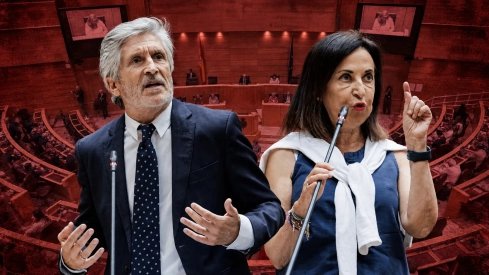
The Government responded this Tuesday from the Senate to the opposition's offensive over the Ceuta crisis. The Minister of Defense, Margarita Robles, has offered to go to Congress along with the director of the National Intelligence Center (CNI), Esperanza Casteleiro, while the Minister of Interior, Fernando Grande-Marlaska, has rejected the calls for resignation from the Popular Party with a resounding message. "I will remain here," he stated.
Ceuta has occupied a good part of an especially heated control session. The PP has accused the Executive of disregarding prior warnings to the massive entry on July 30 and 31, hiding reports, and maintaining an "internal war" between Defense and Interior. The ministers have defended the deployment carried out, the returns, and the work of public servants, while reproaching the right for its strategy of confrontation.
The border crisis has also permeated the questions addressed to the Minister of Foreign Affairs, José Manuel Albares, and the Minister of Youth and Childhood, Sira Rego. Added to this clash were Marlaska's explanations about the controversial Interior document that classified journalists and a harsh interpellation to Félix Bolaños regarding the so-called 'grandchildren's law'.
Robles offers explanations and Marlaska refuses to resign
PP Senator Fernando Martínez-Maíllo asked Robles to choose between Pedro Sánchez and Spain and urged her to leave the Government or help "unmask" its alleged lies. He also demanded the appearance of Casteleiro to learn about the reports that remain secret.
Robles's response began with irony. "I don't know why you don't get tired of giving me advice, if you know I don't pay any attention to you," she replied. Immediately afterwards, she expressed her "affection, solidarity, and pride" for the people of Ceuta and asked for respect for the Armed Forces, the State Security Forces and Corps, and the public personnel who continue to work in the city.
The minister then confirmed her willingness to explain the actions of the intelligence services. "As far as I am concerned and on behalf of the director of the CNI, we will go to the commission at any time," she announced. Already in the corridors of the Senate, she added that Casteleiro has "special interest" in attending and that she will appear when the Congress's Official Secrets Commission summons her.
🎙️ "My pride, solidarity and affection with the men and women of #Ceuta, who represent the best of Spain. We are with them in complicated and difficult moments".
— Ministerio Defensa (@Defensagob) September 15, 2026
Margarita Robles, today in the @Senadoesp. pic.twitter.com/kpGDcGgZkK
The offer comes after weeks of controversy over the warnings received by the Government Delegation in Ceuta. The known documents reflect communications from the CNI about a possible "jump", while Marlaska maintains that no intelligence service anticipated an entry of the dimension that finally occurred. The PP has used this difference to fuel the thesis of a confrontation within the Council of Ministers.
Robles has rejected that interpretation and has accused the popular party of acting with "disloyalty" during August. "You simply wanted to come and attack the Government," she assured before demanding "a little more sense of state". For the Minister of Defense, indiscriminately questioning the organizations that participated in the response ends up harming the institutions themselves.
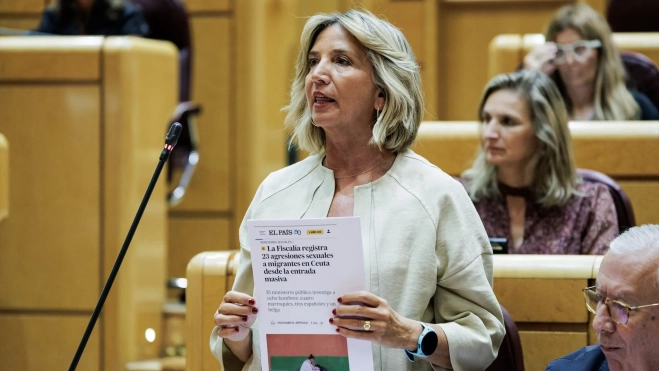
The clash escalated even further when the PP spokesperson in the Senate, Alicia García, listed ten reasons to demand Marlaska's resignation. She reproached him for the management of Ceuta, the prior warnings, the actions regarding the murders of two civil guards in Barbate, and the drafting of the document on journalists. "You don't lack reasons to resign, you lack dignity," she launched amid shouts of "resignation" from the popular bench.
The socialist senators and the ministers present responded with applause. Marlaska assured that he would continue in office because he rejects a way of doing politics based, according to his words, on "lying and calling for confrontation". He also reiterated that he would personally feel "subjectively insecure" in Ceuta, although he defended that the Government must avoid fueling xenophobia and social confrontation.
The Minister of Interior explained that up to July 29, around 1,020 irregular entries by swimming had been counted and that Morocco had prevented more than 3,000 attempts. In his opinion, these data did not allow anticipating the massive arrival of the following two days. After the crisis, the Ministry mobilized more than 1,600 agents to reinforce security and restore normality.
Marlaska has differentiated between usual operational warnings and an alert capable of anticipating the volume finally registered. "For us, an alert is, for example, 300 or 400 people entering in one day," he explained. His defense has once again clashed with the known documents and with the interpretation of the PP, which considers that the Government had enough time to reinforce the border.
The far-right Vox senator Javier Alonso has accused the Executive of acting as a "necessary accomplice" in an "invasion" and has spoken of betrayal, blackmail, and "unconfessable secrets" with Morocco. Marlaska has replied that this vocabulary responds to a "bellicose" and "maximally irresponsible" discourse. "We are concerned about Ceuta and the need to return to normality," he stressed.
Marlaska, ministro del Interior, en la sesión de Control al Gobierno en el Senado: "Dejo que geolocalicen mi móvil para que vean dónde he estado cada minuto del mes de agosto (...) Tenemos una situación absolutamente compleja en Ceuta que estamos abordando". #Canal24Horas pic.twitter.com/PwRmJyIDOQ
— RTVE Noticias (@rtvenoticias) September 15, 2026
Albares has also defended the Executive's actions. The Minister of Foreign Affairs has assured that 90% of the returned people returned within the first 48 hours and has highlighted the measures proposed to strengthen Ceuta and Melilla's link with the European Union. Among them, he cited a package close to 115 million euros, a greater presence of Frontex, the entry of both cities into the Committee of the Regions, and their incorporation into the customs union with a specific regime.
"A lot of rhetoric about Ceuta," Albares reproached the PP before accusing its regional governments of closing the door to reception. "If you don't lend a hand, at least don't get in the way," he concluded.
The Minister of Youth and Children, Sira Rego, starred in another confrontation after the popular senator Miriam Bravo accused the Government of transferring migrant minors against their will. Rego responded that the PP maintains a "systematic blockade" in reception policies and recalled its rejection of the distribution provided for by article 35 of the Immigration Law.
The minister has also accused the 'populares' of maintaining a "racist and criminalizing" discourse against migrant children and of promoting collective returns without the required guarantees. As she explained, each case must be processed individually and address the best interest of the minor.
Marlaska responds for the document on journalists
PP senator Marimar Blanco focused her question on the document prepared by the Interior Communication Office, which collected information on nearly 300 journalists and commentators, including comments on their ideological orientation. "When a ministry dedicates itself to singling out journalists, it becomes Marlaska's Stasi," she denounced before demanding that he resign "once and for all."
Marlaska acknowledged that the report was prepared in February 2024 with an internal and consultative purpose. The minister assured that it aimed to understand the topics of interest to professionals and improve the department's communication, but its content deviated from the original assignment. "It was never used," he stressed after recalling that Interior has apologized to those who felt affected.
The minister has defended his commitment to press freedom and has accused the PP of applying a different criterion when pressures come from the Community of Madrid. Marlaska recalled that Isabel Díaz Ayuso's chief of staff "textually threatened journalists in an undoubted and accredited way" and reproached the popular party for inviting a "social agitator and not much of a journalist" to their events.
The explanations have not convinced the Catalan senators either. Eduard Pujol, from Junts, warned that "a democracy needs critical and free journalists," a statement that Marlaska shared. The head of Interior defended that freedom of information especially protects those who are uncomfortable for power.
The debate has extended to police actions against fans carrying esteladas. Marlaska stressed that any legal flag or symbol can be displayed and reported that there is a file for an intervention in Elche that he himself considered disproportionate. He also pointed out that the Police can act when there is disobedience, an emergency exit is occupied, or calls for hatred and violence occur.
Bolaños attacks the PP over the 'grandchildren's law'
The latest major clash has pitted the Minister of the Presidency, Justice and Relations with the Cortes, Félix Bolaños, against the senator and general secretary of the PP of Madrid, Alfonso Serrano. The popular leader has accused the Government of irregularly expanding access to nationality through an administrative instruction and of turning the reparation to the descendants of exiles into an "electoral engineering operation".
Bolaños has replied by recalling that the measure comes from the Democratic Memory Law and seeks to repair the families who left Spain during the Civil War and the dictatorship. He also cited the commitment made by Alberto Núñez Feijóo in 2022 to promote a nationality law for the grandchildren of Spaniards residing abroad and the support included in the PP's 2023 electoral program.
The minister has accused the popular party of being dragged along by Vox and has defended that the new Spaniards can participate in the elections. According to the data presented by Bolaños, the usual participation in the Electoral Census of Absent Residents (CERA) is around 10%, which would reduce the effective vote among the nearly 400,000 affected by the legal dispute to about 40,000 people.
Bolaños added that the foreign vote only modified one seat in the 2023 general elections, which went from the PSOE to the PP in Madrid, and that it did not alter the distribution of deputies in the regional elections held during 2026. He has also asked the Supreme Court to resolve the merits of the case before the elections scheduled for 2027 to prevent citizens who already voted in previous calls from being excluded from the census.
The discussion included a direct jab at the Madrid leadership of the PP. "They are the pinnacle of the Popular Party of Madrid, the penthouse, we could say," Bolaños ironized in reference to the controversial real estate operation of the Ayuso Government. Serrano ended his speech by warning the minister of possible judicial consequences and mentioning several Madrid prisons.
Bolaños responded by accusing the PP of adopting a "bully style" and threatening political opponents with prison. The minister closed his speech by reiterating that the descendants of exiles must retain the same rights as the rest of Spaniards.
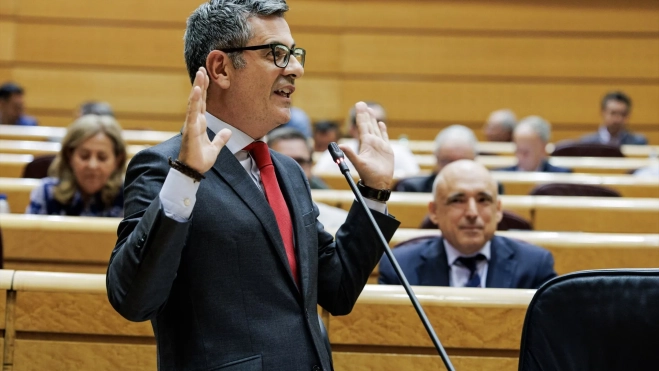
The face-to-face confrontation between the Government and the opposition will continue this Wednesday in the Congress of Deputies. The control session will bring to the Lower House chamber a political offensive that has once again placed Ceuta, the actions of the intelligence services, and the cross-accusations about democratic quality at the center of the parliamentary debate.
Add ElConstitucional.es as a preferred Google source for free.
Stay informed about all the latest breaking news with the best information. Against disinformation, for democracy and social rights.
