The Ceuta crisis has dominated this Tuesday the first control session of the Government of the new political course in the Senate. The Popular Party has launched an offensive focused on the previous warnings of the massive entry in July, the responsibility of Morocco, the return of migrants, and the problems that the city is still experiencing. From the blue bench, the ministers have accused the popular party of hindering the measures put in place and demanding solutions that may violate legality.
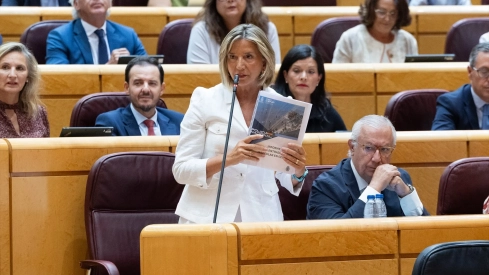
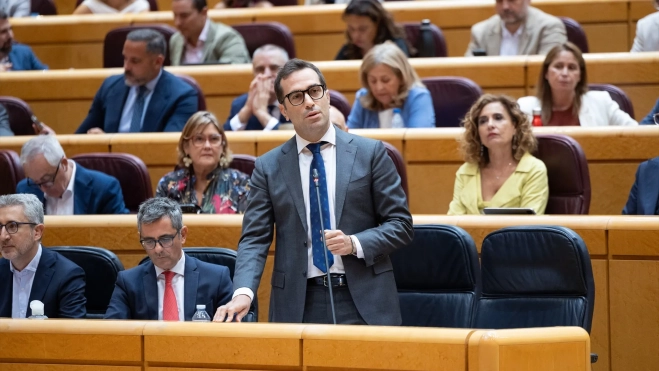
The main confrontation has been between the PP spokesperson in the Upper House, Alicia García, and the First Vice President and Minister of Economy, Commerce and Business, Carlos Cuerpo. García has demanded a date for the return of all people who entered irregularly on July 30 and 31, while the minister has asked for "institutional responsibility" and has defended that each file must be processed with the corresponding guarantees.
Alicia García accuses the Government of "covering up" for Morocco
"They have stolen Ceuta's life. Give it back to them," García demanded from the rostrum. The popular leader asked Cuerpo if he could set a date for "the return of all" and, without waiting for an answer, concluded with a "he doesn't know" which received applause from her bench.
García exhibited the police report incorporated into the investigation of the Audiencia Nacional and assured that the Government ignored nine alerts about the risk of a massive entry. She also accused the Executive of pointing fingers at the National Intelligence Center, the Police, the Ceuta president, Juan Jesús Vivas, and now at magistrate María Tardón. "They point to everyone who tells the truth, except Morocco," she launched.
The popular spokesperson went a step further by stating that "Morocco planned it and their Government covered it up." The Executive maintains that it still lacks conclusive evidence to attribute the operation to the Moroccan authorities. Judge Tardón, who has taken over the investigation, does appreciate in this initial phase a "clear and undeniable facilitating management" from Moroccan territory, although the case remains open and must still determine possible criminal responsibilities.
García has also requested that the declassification of documents announced by Moncloa include information related to espionage using the 'Pegasus' program. "What does Morocco have that you don't want to be known?" he asked before accusing the Government of being "hostile to the invaded and docile to the invaders".
Cuerpo has acknowledged that the people of Ceuta remain "shocked" and fearful that a similar situation could be repeated. "Every day that passes is a day we are late, and we are fully aware of it," he admitted. The vice president has assured that the Executive is mobilizing resources to expedite files, provide humanitarian aid, and support affected self-employed workers and businesses.
The minister recalled the 309 million euros approved last week to reinforce security, public services, and Ceuta's financial capacity. As he explained, aid for businesses and self-employed workers will begin to be paid out starting October 6. "This is a truth published in the Official State Gazette, in case it serves as a source for you," he snapped at García.
Cuerpo has reproached the PP for selling "impossible or even illegal solutions", putting "spokes in the wheels" of cooperation between administrations, and refusing to support the requests for aid made to the European Union. The Government maintains that expulsions require individualized files, that asylum applications must be resolved, and that minors need specific family reunification procedures.
The latest data offered this Tuesday by the Executive puts the number of people expelled at 278 and voluntary returns to Morocco at 4,516. 2,004 minors have also been counted. The Government acknowledges that it is still impossible to accurately determine how many migrants remain in the city.
Saiz and Senator Dívar raise tension over the media sent to Ceuta
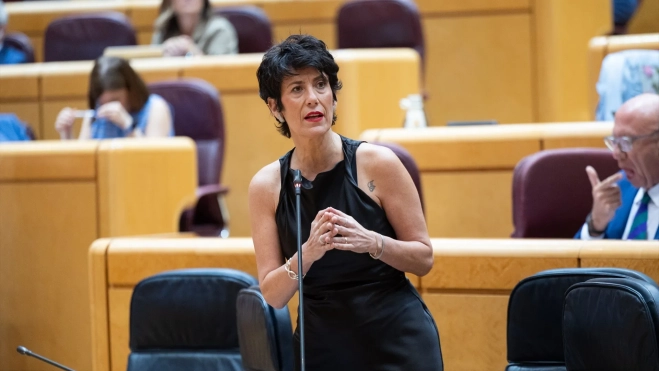
The second clash of the afternoon pitted popular senator Rocío Dívar against the Minister of Inclusion, Social Security and Migrations, Elma Saiz. Dívar accused the minister of abandoning Ceuta and summarized her criticism with a forceful comparison. "To regularize, thousands of officials; for Ceuta, six. It's not a problem of capacity, it's a problem of priorities."
The parliamentarian has stated that these six workers conduct around one hundred interviews daily and has criticized the Executive for still not providing a definitive figure of the people who remain on the streets. She has also reproached Saiz for continuing her vacation after visiting the city and has asked her if she shares the position of the Minister of Foreign Affairs, José Manuel Albares, who is in favor of those without the right to remain in Spain leaving Ceuta.
Saiz has focused her response on the discourse used by the PP during the crisis. The minister has censored proposals she considers contrary to the law, photographs with "ultra agitators," and theories about Morocco's actions. She has also accused a member of the popular bench of "mocking the death of children at sea," provoking a loud protest from the PP senators.
The President of the Senate, Pedro Rollán, has removed that statement from the official record after Javier Arenas demanded that Saiz identify the person singled out. The minister later clarified that she was referring to popular deputy Rafael Hernando and the gesture with which he imitated crying during an intervention by Patxi López about the death of the Syrian child Aylan Kurdi in 2015. For Saiz, that conduct "deserves all reprobation."
Puente accuses the PP of "disloyalty" over the port tents
The management of reception spaces has been the focus of the exchange between the senator for Ceuta Cristina Díaz and the Minister of Transport and Sustainable Mobility, Óscar Puente. Díaz has accused the Executive of imposing a camp for around a thousand migrants in the port despite the rejection of its Board of Directors and reports warning of risks to a strategic infrastructure.
"My city can't take any more," said the senator, who highlighted the proximity of fuel depots, a school with about 800 students, and a sports club frequented by hundreds of minors. "Do you want another blackout? If something happens, don't say no one warned you," she warned.
Puente has accused the PP of practicing a "permanent disloyalty" and has maintained that the president of Ceuta initially accepted the use of the port. According to the minutes of two official meetings published by 'El País', Vivas supported the incorporation of the port plots into the temporary device during the situation committee and the National Security Council. Days later, the Port's Board of Directors rejected the project by eleven votes to four.
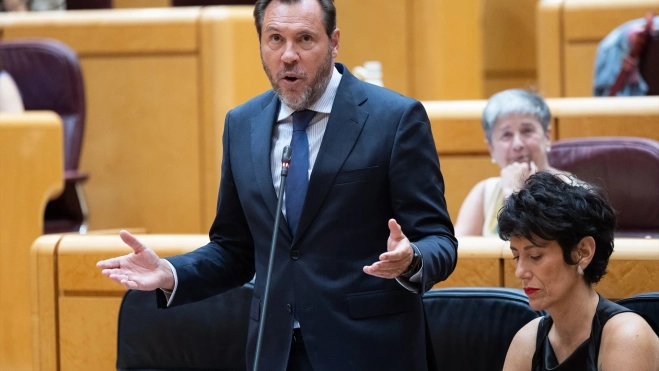
"You want us to solve the problem of Ceuta, but you put all the spokes in our wheels to do so", replied the minister, who linked the opening of these spaces with the possibility of identifying migrants and processing their protection requests or their returns. The discussion ended amidst shouts of "resignation" directed at Puente from the popular bench.
