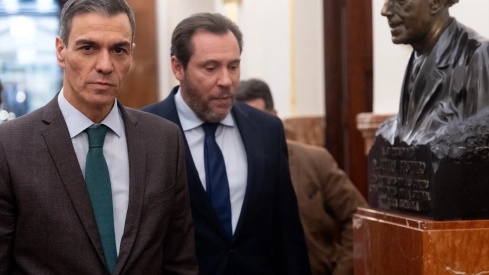
Sources from La Moncloa indicate that the President of the Government, Pedro Sánchez, maintains his confidence and support for Minister Óscar Puente, considering that the Urda (Toledo) accident has nothing to do with his management. Therefore, at least for now, neither blame nor responsibility.
The President's circle regrets that the pain of the victims and the accident are being used in the midst of the election pre-campaign. However, this time responsibilities are not only being demanded by the opposition: the Frente Amplio and the PNV have also demanded "responsibilities at the highest level".
For now, the debate is not on the table. The next step will be the minister's appearance before the Permanent Deputation of Congress next Tuesday at 5:00 p.m. He will do so in the body that assumes the functions of the Plenary when the Chamber is not in session, either because it is dissolved or because it is outside of the session periods.
Guilt is defined, primarily, as the imputation of an action to someone. And, with what is known so far, nothing indicates that the Minister of Transport, Óscar Puente, is to blame for two high-speed trains colliding after a series of errors that are still being investigated. But what about responsibility?
The RAE dictionary defines it, in one of its meanings, as the "moral charge or obligation that results for someone from a possible error in a specific matter or issue." And there, Puente, as the highest political authority of the Railway Infrastructure Administrator (Adif), is placed at the center of the matter.
The risk for the PSOE of keeping Puente
Maintaining the minister has political implications and, in the midst of the pre-campaign, these implications become a risk.
Truth, justice, and reparation is what the victims demand in the face of a catastrophe like that of recent hours.
Truth comes with explanations, clarity, and transparency.
Justice corresponds to the judicial investigation already underway: the judge has decreed the secrecy of the proceedings, prohibited access to the area, and seized the black boxes.
Reparation is perhaps the most complicated part. No one will return their loved ones to their families, and many survivors will never understand how something like this could have happened.
This reparation is further complicated when victims feel that no one assumes responsibility, not even in the form of resignation as a gesture of respect.
Two years since DANA: another tragedy, the same question about responsibilities
Yesterday marked exactly two years since the DANA of October 29, 2024. Its management and consequences opened an intense debate about the politicization of the tragedy and the role of victim associations.
From the beginning, political groups used emergency management, the number of fatalities, and the slowness of aid as a weapon of confrontation.
Then, and for many months, the Popular Party and its president, Alberto Núñez Feijóo, tied their position to that of the president of the Generalitat, Carlos Mazón: they publicly supported him and endorsed his arguments. The political and social pressure ended up being enormous for the Popular Party.
The DANA has nothing to do with what happened in Urda, and in this case there has not been, for now, a succession of inaccuracies and changes of version like the one that politically ended Mazón.
The parallel is elsewhere: in the question of who can exercise responsibility. Mazón was demanded to resign and he did not leave. He resisted for months, with a social outcry growing in the streets and in victim associations, until his position became untenable.
With Puente we are still in the first hours, but many voices already do not understand why he should be the one to repair the damage and restore citizens' trust in the railway sector.
The underlying question is not only who caused the accident, but who has the moral and political authority to lead that reconstruction. And that question, as then, may gain weight as the days go by.
This time the tragedy coincides with the pre-campaign for the next elections. Although all events have been paralyzed these days, it is inevitable to wonder what political cost an accident that already totals 69 fatalities will have for the PSOE.
It also comes after the one in Adamuz (Córdoba), last January 18, which left 46 dead and was the first major accident on the Spanish high-speed network since its launch in 1992. Just three days later, a retaining wall fell on a Rodalies convoy on the R4 line between Gelida and Sant Sadurní. The train driver died and another 37 people were injured in that accident.
"Now I'm not thinking about myself," he said yesterday to the media. But more and more people are thinking about it for him.