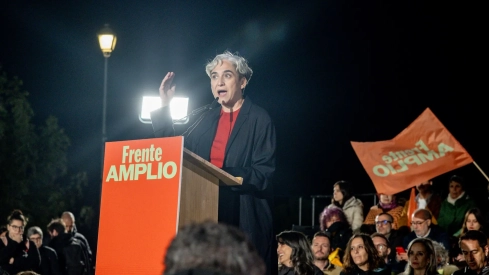
The candidate for Frente Amplio in the 29N elections, Ada Colau, has maintained that, in view of the Koldo plot and the derivatives that affected former PSOE leaders Santos Cerdán and José Luis Ábalos, she would have imposed more anti-corruption demands than those proposed by Sumar, while also drawing a red line, stating that if the alleged irregularities structurally affected the socialist party and not as specific cases, it would be grounds for breaking up the coalition government.
In an interview on the podcast 'The wild project', Ada Colau has defended that her position is one of “zero tolerance” against corruption and that, in the face of episodes as serious as those that splashed the PSOE during the legislature, she would have asked for “more anti-corruption measures or more explanations”.
Asked about the case of Santos Cerdán, the candidate recalled that Sumar already stated that “no one suspected of corruption can be in this government” and emphasized that both the former Organization Secretary and the former minister José Luis Ábalos “was immediately removed”.
Colau insisted that decisions must be made “at all times” and depending on the specific circumstances, because, as she explained, “there is no single answer” when cases of corruption affecting the government partner arise.
Con Jordi Wild tenemos opiniones distintas de temas importantes, pero nos sentamos a conversar durante dos horas. Un país se construye así, hablando entre personas diversas, desde el respeto y buscando puntos en común. Le agradezco a Jordi el trato cordial que tuvo dentro y fuera del plató. Abascal decidió darle plantón a Jordi Wild porque lo quería tener todo controlado, igual que eligió el público en la Revuelta para que le aplaudieran sus mentiras. Así es la extrema derecha, cobarde y autoritaria. Lo contrario de lo que necesita nuestro país. https://t.co/EAm1w5b0o4
— Ada Colau 💜🌈🔻 (@AdaColau) November 13, 2026
Rupture only if the problem is widespread
The former mayor of Barcelona has differentiated between individual cases and a broader scenario, and has stressed that, if it were a specific situation, with one or two perfectly identified people, the response should be their immediate removal and the adoption of a policy of "zero tolerance", with investigation and, if applicable, conviction.
"It's another thing if there's something more generalized, that is, they are two different situations," she said, arguing that committing a government action with measures such as raising the minimum wage, labor reform, or improving dependency cannot be decided automatically when there are isolated cases that can be removed from the Executive.
In that context, she has defended that it is necessary to "weigh in the balance on each occasion" what weighs more, whether the continuity of government action or the seriousness of the corruption case that has been detected.
Zapatero, the jewels of Saudi Arabia and the "example" in politics
Regarding the situation of the former socialist president José Luis Rodríguez Zapatero, investigated in the Plus Ultra case, Ada Colau has admitted that it may be legal for him to keep jewels in his office as a gift from Saudi Arabia, but she added that she "doesn't like it".
"There is no one close to me who has jewels worth more than a million euros. So I tell you, in politics it is no longer just a question of what is judicial or what is corruption, it is what we said about having to lead by example," she reflected, before emphasizing that a "politician has to be moral".
Complaint of 'lawfare' and archived lawsuits
The Frente Amplio candidate has also denounced that left-wing leaders, including herself when she was in charge of the Barcelona City Council, have suffered episodes of "lawfare", and recalled that she was subjected to about twenty lawsuits that ended up being archived.
Contact