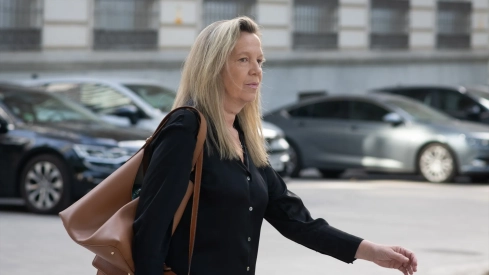
The lawyer for the Bárcenas family, Marta Giménez-Cassina, has placed this Thursday the Ministry of Interior of the Government of Mariano Rajoy at the origin of the Kitchen operation. In her final report before the Audiencia Nacional, the lawyer argued that the operation against the former PP treasurer was launched because the information that Luis Bárcenas kept about popular leaders and about the party's accounting "could bring down the Government".
The private prosecution has described Kitchen as a "parapolice, clandestine and illicit" operation directed from the top of the Interior Ministry and executed by high-ranking police officials. According to their thesis, the real objective was not to track Bárcenas' hidden money abroad, as several defenses have argued, but to access sensitive documents related to the Gürtel case and the Bárcenas papers, the piece about the alleged opaque accounting of the PP.
Giménez-Cassina has recalled that Bárcenas was treasurer of the Popular Party, worked for decades in the party and knew internal information of enormous political scope. "What Luis Bárcenas might know could bring down the Government," the lawyer insisted before the court.
An operation against the Bárcenas family
The lawyer has focused on the former treasurer's family as direct victims of the operation. She has argued that Bárcenas, his wife Rosalía Iglesias and his son Guillermo Bárcenas were subjected for two years to illicit police surveillance, with tracking, movement control, intrusions into their privacy and access to private documentation.
One of the central points of her report has been the recruitment of Sergio Ríos, then the family's driver, as a police informant. For the prosecution, Kitchen used a person from Bárcenas' trusted circle to betray the family and obtain information that was not under judicial control.
Giménez-Cassina has also cited the entry into Rosalía Iglesias' restoration studio and the dumping of Bárcenas' mobile phones and tablets. In her opinion, these actions were carried out without judicial authorization and outside the procedure that was already investigating Gürtel. "There was no judicial order for dumping, there was no order for entry and search, there was no order to agree to surveillance," she summarized.
The prosecution has also rejected the explanation that Kitchen sought the former treasurer's money abroad. The lawyer recalled that in January 2013, two accounts in Switzerland with 48 million euros were already known and that the UDEF, under judicial supervision, was already working on that line. For this reason, she considered it unlikely that the Interior Ministry needed to activate a reserved and parallel operation to investigate what was already in the hands of the judge.
Pressure in Soto del Real and the role of the Interior Ministry
Bárcenas' defense has also brought to trial the pressures that, it claims, the former treasurer suffered during his provisional imprisonment in Soto del Real between 2013 and 2015. Giménez-Cassina presented that period as part of the same climate of pressure, with the aim of preventing Bárcenas from collaborating with justice or handing over compromising documentation.
The lawyer's intervention came in a session where the State Attorney's Office also pointed to former Interior Minister Jorge Fernández Díaz as a key figure in the operation. The State representative argued that Kitchen was articulated from within the Ministry and sought to "torpedo" the Gürtel investigation.
The Attorney's Office gave credibility to the thesis that the operation aimed to take away from Bárcenas "the papers that compromised the president", referring to Mariano Rajoy. It also highlighted the statement of former Secretary of State for Security Francisco Martínez, who pointed to Fernández Díaz for having asked him for information about the former treasurer's driver.
The trial thus enters its final stretch with the accusations outlining the same scheme: an operation from the Interior Ministry, with the use of reserved funds, police commanders, and a confidant from Bárcenas' circle to access information that could affect the PP. The defenses will now have to present their reports before the court grants the last word to the accused and leaves the case ready for judgment.
