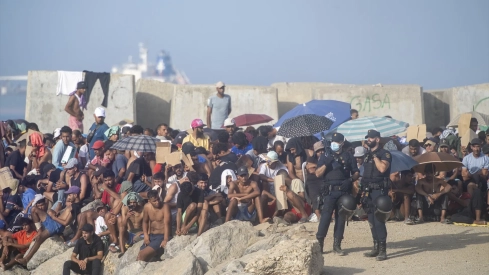
The Audiencia Nacional accepted this Wednesday that the State appear as a private prosecution in the case for the massive entry of migrants into Ceuta. Judge María Tardón considers that the investigated events could cause direct harm to Spain as a whole and constitute an attack against national sovereignty, territorial integrity, and the stability of the State.
The decision allows the State Attorney's Office to actively participate in the procedure as a representative of the injured party. It will be able to access the proceedings within the limits set by judicial secrecy, request proceedings, file appeals, and formulate an accusation when the investigation progresses.
"The condition of injured party undoubtedly falls on the Spanish State itself," Tardón states in the order. The magistrate thus supported the request presented by the Government's legal services, which argued that the entry of tens of thousands of people affected essential interests of the country.
The judge recalls that Ceuta and its inhabitants were the direct and immediate victims of what happened on July 30 and 31. The crisis put the lives and rights of thousands of people at risk, altered the city's security, and overwhelmed its public and welfare services.
The order extends that harm to the Kingdom of Spain itself. The conduct under investigation could affect "national sovereignty, the independence and stability of the State, its territorial integrity, national defense, external security, and the stability of our rule of law."
The State's entry as a private prosecution has a different importance than the presence of parties and organizations as popular prosecutions. The Attorney's Office intervenes because the magistrate recognizes direct damage to the public interests it represents, while PP, the far-right Vox, Hazte Oír, and Iustitia Europa exercise criminal action without presenting themselves as victims of the events.
Tardón has, however, established a limit. The State will not be able to appear expressly within the separate piece used to order the reserved proceedings. The magistrate considers that this piece has an instrumental character and serves only to preserve the secrecy of confidential proceedings.
The restriction affects that specific piece and keeps the participation of the State Attorney's Office in the main procedure intact. The Executive thus joins the Autonomous City of Ceuta, whose appearance as a private prosecution had already been admitted by the court.
Crimes against independence and 140 deaths
The case investigates whether the massive entry could have been due to a criminal act organized from abroad with the capacity to seriously damage the territorial integrity of Spain. Tardón assumed jurisdiction after appreciating indications that allowed the facts to be placed within the matters reserved for the Audiencia Nacional.
The magistrate has mentioned possible crimes against the peace and independence of the State, against the rights of foreign citizens, negligent homicides, and criminal organization. The investigation must clarify how the calls were promoted, who could have intervened in their preparation, and what responsibility the individuals or organizations involved had.
During the crisis, around 140 people died, 83 of them in Spanish waters, while tens of thousands managed to reach Ceuta from Morocco. The procedure also examines the actions of the Moroccan forces, whose permissiveness and delayed response were recorded in various police and intelligence documents.
The judicial decision coincides with the publication of the 40 documents declassified by the Government. The reports contain alerts, messages, and analyses prepared during July by the National Police, the Civil Guard, the National Intelligence Center, and the Armed Forces Intelligence Center.
The State Attorney's Office can now use this documentation to promote proceedings and claim responsibilities within the case. The investigation remains under the direction of María Tardón and must identify those who promoted or facilitated a massive entry that the judge considers capable of having attacked essential interests of Spain.
