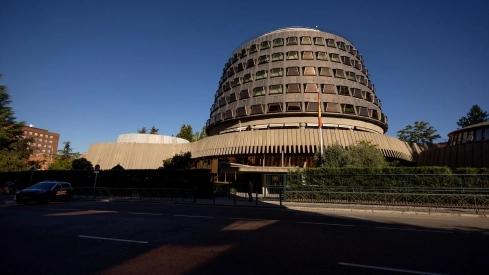
The Supreme Court, like the rest of Spain, could not imagine there would be an early election when it decided, with a surprising precautionary measure, to suspend the right to vote of more than 160,000 naturalized Spaniards, considering them descendants of exiles from Francoism. After the early election, the far-right parties that requested the suspension demanded from the Supreme Court a confirmation that these Spaniards would not be able to vote in the general elections on November 29; something they achieved with a brief order against the criteria of the State Attorney's Office.
After the High Court's decision, the Government regretted the decision but did not clarify what it would do about it. The issue seemed to remain that way, at least for the next elections, until we learned that the Ombudsman had filed an appeal for protection before the Constitutional Court (TC), requesting an urgent ruling from the Court of guarantees after having received, in his own words, petitions from numerous entities and individuals.
It should be remembered that the figure of the Ombudsman -currently Ángel Gabilondo- is described in the Constitution as a "High Commissioner of the Cortes Generales" for the defense of the Rights of Title I, so, in no way, can he be considered linked or subject to the Government. Furthermore, he is the only one legitimized in the Spanish legal system to file appeals of unconstitutionality and protection. And it is this latter instrument that he has used to request a decision from the TC that rehabilitates the right to vote of these thousands of Spaniards.
Now, the decision of the TC does not have to be immediate; and in fact, it may not even hear the matter. The steps to follow are the following: first, the Plenary of the Constitutional Court will debate the admissibility of the appeal, something that normally corresponds to a Section composed of three Magistrates but which, given the repercussions of the case, they have chosen to refer to the Plenary. To appreciate this consideration, they will take into account whether there is a Fundamental Right that supports the amparo -in this case, art. 23 CE makes it evident- and, above all, that the ordinary judicial process has been exhausted. In this last point is where the appeal may find its end, even before being admitted, if the TC considers that the procedure before the Supreme Court has not finished. And here a very interesting legal debate will arise about the consideration of an order for precautionary measures, whose effects can be irreversible once the general elections pass, as exhaustion of the ordinary process. In other words, if the TC does not immediately reverse the suspension of the vote, its effects will be irreparable.
Assuming that the TC accepts the admissibility of the appeal, a new dichotomy would arise: adopting a "cautelarísima" measure that immediately rehabilitates the right to vote of those Spaniards; or processing it through an ordinary precautionary measure, in which a 5-day period for allegations would be opened for the parties. In the latter case, the deadlines to request the vote of the CERA (Electoral Census of Absent Residents), which is already meager, would be even more constrained. Once that hearing is held, the Constitutional Court would make a decision maintaining or revoking the effects of the order.
While waiting for what the TC decides in the coming hours, 163,000 Spaniards residing abroad still do not know if they will be able to exercise their Fundamental Right to suffrage, as, by the way, many of them already did in the 2023 elections. And meanwhile, one more day, the pre-election campaign is more focused on the courts than on proposals.
