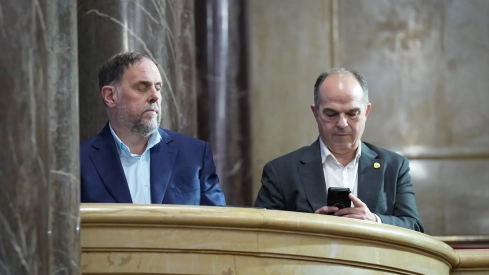
The Constitutional Court has closed the appeals for protection that had been filed by the former Catalan vice-president Oriol Junqueras and former ministers Jordi Turull and Raül Romeva. The procés politicians appealed at the time because the Supreme Court refused to apply the amnesty law to them for the crime of embezzlement, a scenario that changed when the high court finally granted them this measure of grace.
In an official note, the Plenary of the Constitutional Court has detailed that, by unanimity, the supervening loss of the object of these appeals has been declared in two judgments. In this way, since the amnesty has already been applied to the convicted persons, the judicial process in the Constitutional Court on this matter is officially concluded.
The Supreme Court extended the effects of the ruling on Dolors Bassa
In its resolutions, the Constitutional Court points out that, after the pronouncement of the court of guarantees that upheld the appeal for protection filed by former minister Dolors Bassa against the same judicial resolutions of the Supreme Court, the Criminal Chamber of the high court “agreed to extend the effects” of that judgment “to the rest of the convicted persons affected by the same enforcement order, declaring their criminal liability extinguished with the definitive archiving of the enforcement order”.
For this reason, the Plenary concludes that with that order “the legitimate interest asserted in both appeals for protection is exhausted, and therefore their extinction due to supervening loss of object is appropriate”.
Jordi Turull's arguments in his appeal
The Constitutional Court recalls that Jordi Turull argued in his appeal for protection that “the challenged judicial resolutions had verified an extensive interpretation contrary to the defendant of the exception provided in the Amnesty Law of having acted with the purpose of obtaining a personal patrimonial benefit, which would have infringed his rights to criminal legality”.
Turull also alleged that “the exception of the affectation of the financial interests of the European Union due to the existence of a risk of territorial secession of Catalonia that the conviction itself considered not to be real” had been applied, which, in his opinion, would have violated his rights to effective judicial protection and to a process with all guarantees.
The allegations of Oriol Junqueras and Raül Romeva
In the case of Oriol Junqueras and Raül Romeva, both argued that “the challenged judicial resolutions made an unreasonable interpretation of the same exceptions to the application” of the measure of grace, “emptying the content of the norm and making it inoperative”.
They also stated that the Supreme Court found a purpose of enrichment and an affectation of the financial interests of the European Union that were not subject to contradictory debate nor were they reflected in the judgment, which, according to their approach, would have violated their fundamental rights to effective judicial protection, the principle of criminal legality, the right to a process with all guarantees and the right to political participation.
