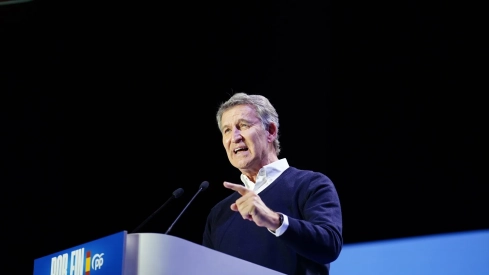
The president of the Popular Party (PP), Alberto Núñez Feijóo, has announced that, if he comes to power, he will reinstate "the aggravating factor for sentences when disturbances and acts of vandalism occur with faces covered," a measure that, as he recalled, was removed from the Penal Code by the PSOE and Podemos in 2022. In an interview on Onda Cero, the popular leader also stated that he will promote an increase in penalties when disturbances are organized through social media.
"Therefore, we are going to act. I have to be the guarantor of public order in the streets of my country," Feijóo defended, linking his proposal to the altercations recorded in recent days in A Coruña, Barcelona, and Bilbao.
Criticism of the Minister of Interior and the Government's reaction
The leader of the PP also criticized the Minister of Interior, Fernando Grande-Marlaska, whom he described as having been "missing for some time" after the incidents. "No one knows where he is," Feijóo quipped, adding that he is more "concerned" about having been on the PSOE lists than about managing the ministry.
Furthermore, he reproached the President of the Government, Pedro Sánchez, for taking "two days" to react to the violent acts recorded in the Catalan capital, which resulted in 130 arrests, of which 76 were minors.
Condemnation of the altercations in Bilbao
Before his radio interview, Alberto Núñez Feijóo had expressed his "most absolute condemnation" of the "new attempt at intimidation by the violent left" in Bilbao, where the altercations left 19 arrested, including seven minors. The disturbances occurred after a student demonstration against an event by Vito Quiles that, ultimately, did not take place.
The streets of the Basque city suffered damage to urban furniture and several premises, in an episode that the president of the PP has framed within the reported altercations.
In a message on X, Feijóo stated that, after the general elections on November 29, "there will be a Government that guarantees order and security so that decent Spain can live peacefully in the streets."
La más absoluta condena a un nuevo intento de intimidación de la izquierda violenta, esta vez en Bilbao. El 29 de noviembre habrá un Gobierno que garantice el orden y la seguridad para que la España decente viva tranquila en las calles.
— Alberto Núñez Feijóo (@NunezFeijoo) October 26, 2026
Ceuta, Morocco and the housing encampment in Sol
The popular leader has also returned to the Ceuta crisis at the end of July and has criticized the Executive's response. He has stated that he has "no commitment" to Morocco and that he does not know "what was contained" in Sánchez's "mobile sewer." "I would have acted with Morocco with the firmness that being president of the government demands," he said.
Asked about the possibility that the head of the Executive "may be blackmailed by Morocco," Feijóo replied that, if he reaches the Presidency, he will explain "a set of issues" about what happened, especially in relation to the information from the National Intelligence Center (CNI) and the Police in the days prior to the avalanche. "I will tell Spain what has happened and I am convinced that they are lying to us," he stressed.
Regarding the encampment for the right to housing in Puerta del Sol, the president of the PP considered that it does not respect "the parameters that demand freedom of movement, freedom of enterprise and the minimum health conditions that are required in the streets of Madrid," so, in his opinion, it "should be lifted" as it is an "absolutely inadequate" place. Although he defended freedom of expression and demonstration, he specified that this does not mean "that one can demonstrate wherever one wants," and also questioned the reasons for the resignation of the Government delegate in Madrid, Francisco Martín.