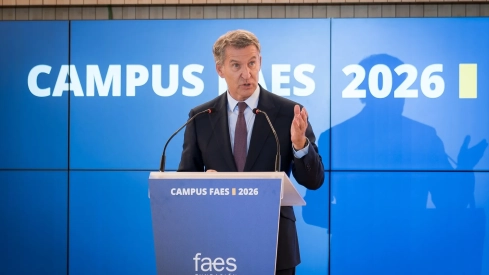
The president of the Popular Party, Alberto Núñez Feijóo, took advantage of the closing of the Campus of the Foundation for Analysis and Social Studies (FAES) this Friday to present the general lines of his alternative to Pedro Sánchez. Before José María Aznar and numerous party officials, he called for a broad majority that would allow for an "authentic national reconstruction" after the next general elections.
"Spain does not need a mere substitution in its Government," Feijóo defended. His purpose, as he explained, is to renew the "social contract" between citizens and the State, restore confidence in institutions, and open a political stage that goes beyond Sánchez's departure from the Moncloa Palace.
The PP leader depicted a "divided, tired, and resigned" country and blamed the Executive for allowing problems such as housing, the loss of purchasing power, the deterioration of some public services, or the migratory crisis in Ceuta to grow. "Spaniards comply and the State responds," he summarized when presenting the principle on which he intends to build his project.
Two days after Maricarmen's eviction
Feijóo also spoke for the first time about Maricarmen's eviction, two days after the 87-year-old woman was expelled on a stretcher from the Madrid house where she had lived since 1956. The popular leader described the image as "heartbreaking" and admitted that exceptional situations like this require "exceptional responses," although he did not detail what specific measure he would have applied.
"Using Maricarmen to do politics, I am not going to do it. The Government is already there for that," he stated in response to journalists' questions. That promise was followed by a direct attack on Sánchez, whom he blamed for having aggravated the housing crisis during his eight years at the head of the Executive.
Feijóo asked for "an opportunity" to solve the problem and argued that the main response involves building more than a million homes. The PP's plan is committed to mobilizing land, reducing urban planning procedures, offering legal certainty to owners and tenants, and applying tax aid for young people and families. The party maintains that this new offer would allow for price containment and generate up to 750,000 jobs.
The PP has also rejected the Government's claim that the previous anti-eviction decree would have protected Maricarmen. Its parliamentary spokesperson, Ester Muñoz, argues that the 1956 contract was governed by legislation prior to the 1994 Urban Leases Law contemplated in the text. The Executive maintains another interpretation and is preparing a new decree that still needs to reconcile the positions of Sumar, Podemos and Junts.
This afternoon, Urbagestión's proposal for the Madrid City Council to manage an affordable rent through the Municipal Housing and Land Company (EMVS) to allow Maricarmen to return has joined this debate. The offer still needs to be finalized, and neither the affected party's lawyer nor the Tenants' Union had received formal communication.
A majority for "national reconstruction"
Feijóo's intervention had a markedly electoral tone. The president of the PP has positioned the upcoming elections as a "great national call" and has compared the current moment with the pact of trust reached during the Transition. His objective, he assured, is to recover equivalent rights, obligations, and public services for all citizens.
The popular leader has promised to strengthen the rule of law, guarantee the independence of judges, prosecutors, and regulatory bodies, present the General State Budgets every year, and recover the Debate on the State of the Nation. He has also proposed reducing tax pressure on the middle class, limiting bureaucracy, and raising wages through increased productivity.
Feijóo reserved some of his harshest words for the Government, which he accused of having "fewer principles than some organized crime clans. Literally." The comparison appeared when referring to reports about the alleged harassment suffered by Judge Beatriz de Biedma, who is investigating the case of Pedro Sánchez's brother, facts that still need to be clarified.
The Ceuta crisis and foreign policy have completed his speech. The leader of the PP has described Sánchez as a president "submissive inside and outside of Spain" and has defended a migratory policy that allows deciding "who enters, how, and under what conditions they remain." He has also promised to maintain diplomatic relations with allied countries from a position of greater firmness. "All diplomacy, no docility," he proclaimed.
Aznar has presented Feijóo as the leader Spain needs and has predicted that he will return to the FAES Campus in 2027 as President of the Government. The leader of the PP has accepted the support as a "challenge," but has avoided repeating the overconfidence that preceded the 2023 elections. "Nothing is done yet," he warned before asking for a majority "commensurate" with his project.
Add ElConstitucional.es as a preferred Google source for free.
Stay informed about all the latest breaking news with the best information. Against disinformation, for democracy and social rights.
