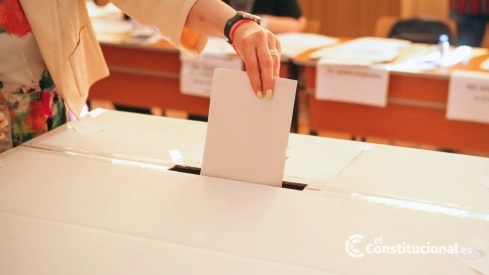
Almost 38.73 million Spaniards are registered in the electoral census for the elections to the Congress and the Senate on November 29, including 2.35 million residing abroad, according to data released this Friday by the Electoral Census Office (OCE) of the National Institute of Statistics (INE).
Compared to the elections held on July 23, 2023, the number of people called to vote increases by 1,261,924 electors, which represents an increase of 3.36%, and within this advance, the growth of the Electoral Census of Absent Residents (CERA) stands out, which now adds about 420,000 more Spaniards with the right to vote from outside the country.
Census review and claims period
The electoral census is permanently reviewed, and the one in force for these elections is the one existing as of August 1, as established by law. However, next week, between October 12 and 19, the list will be displayed in town halls so that citizens can check their registration and, if applicable, submit claims.
Pending that update, those called to the polls are 38,728,356 electors, all of Spanish nationality, as this requirement is essential to participate in general elections. Foreigners, for their part, can only vote in municipal elections in the localities where they reside.
More than 1.6 million new voters
Of the total electorate, 35,141,122 people reside in Spain, 817,589 more than in the 2023 elections, and among them are 1,615,127 young people who will be able to vote for the first time in general elections, having turned 18 since the previous election for the Cortes Generales, which was also brought forward and held on July 23, 2023.
By provinces, the constituency for the distribution of seats in Congress, the one that contributes the most electors is Madrid, with 5,536,913, that is, 688,900 more than in the last general elections, an increase that has granted the province one more seat, bringing it to 38 deputies, to the detriment of Cádiz, which loses one.
After Madrid are Barcelona, with 4,398,757 electors; Valencia, with 2,067,797; and Seville, with 1,606,972. At the opposite extreme are Soria, with 77,069; Teruel, with 106,251; and Segovia, with 121,460, in addition to Ceuta and Melilla, with 65,591 and 63,968 electors, respectively.
Voting abroad, under special attention
The suffrage of Spaniards residing outside Spain takes on special relevance in these elections due to the controversy generated around the so-called 'grandchildren's law', which has facilitated access to Spanish nationality for descendants of exiles. In this context, the Supreme Court has provisionally suspended certain registrations in the electoral census of beneficiaries of this norm, a measure that the State Attorney's Office has requested to lift given the proximity of 29N.
Pending the judicial resolution, the INE certifies that 2,769,645 electors living abroad will be able to vote at the end of November. The largest community resides in Argentina, with 524,852 people, about 90,000 more than in the 2023 elections, followed by France, with 267,387; United States, with 213,007; Mexico, with 192,177; Cuba, with 169,290; Germany, with 157,637; and the United Kingdom, with 154,907 electors, among other countries.
In addition, for the second time in general elections, after the repeal of the 'rogado vote', Spaniards registered in the CERA will be able to vote without having to request it previously.
Documentation, ballot box and inquiries at the electronic headquarters
The Electoral Census Office (OCE) will send all electors the necessary documentation for voting in two independent shipments. This material can also be obtained directly at the polling stations established by the Ministry of Foreign Affairs between November 21 and 26, days enabled for depositing the vote in the ballot box.
Electors residing abroad can check their registration data at consular offices from October 12 to 19, while a service for consulting census data is already available on the INE's Electronic Headquarters, after identity verification with the Cl@ve system, among other mechanisms such as the electronic DNI.
In the case of electors residing in Spain, the electronic consultation also shows the polling station and the address of the polling place. Both voters within the country and those residing abroad can submit claims electronically with the Cl@ve system, provided they provide a valid certificate of registration in the municipal register or in the Consular Registration Register.
Claims can also be formalized before the town halls, consulates or provincial delegations of the OCE within the same period, from October 12 to 19. Similarly, electors can request through the INE's electronic headquarters, or in town halls and provincial offices of the OCE, not to receive electoral propaganda from political parties, a request that can be submitted until October 19 and that, if registered later, will take effect in the following elections.
Census cards and immediate calendar
From November 2, census cards will be sent to homes, informing citizens of the polling station and polling place where they can vote. With this, the electoral administration completes one of the most relevant preliminary procedures for the election day on November 29, when millions of electors are called to the polls throughout Spain and abroad.
