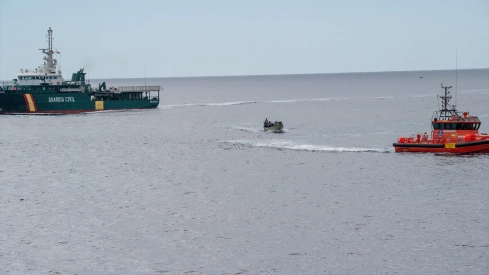
More than 3,200 immigrants have arrived in the Canary Islands in 39 cayucos and pateras during the first five days of November, a figure that has set off alarms in several assistance services, because it approaches rates not seen on the Canary Route since the record months of 2023 and 2024.
The rebound comes after an October in which the downward trend observed since early 2025 had already been broken. Last month alone, 6,164 people were rescued, 46% of the accumulated total for the year, and the last few days point, according to available data, to a particularly visible change in Senegal, from where most of the cayucos arriving in El Hierro now come.
El Hierro concentrates the greatest pressure and forces derivations to be activated
According to a count by emergency services to which EFE has had access, with provisional figures because rescues were still underway at 6:30 p.m., 2,300 people in 26 cayucos have arrived in El Hierro in these five days, including 307 minors, among them eleven babies.
Given this avalanche, the Government Delegation has chartered several ferries to relieve the initial reception resources on the island, which has about 11,000 inhabitants and which already suffered a strong impact during the peaks of arrivals in 2023 and 2024.
At that time, the situation was alleviated by the transfer, in one or two days, and sometimes in just a few hours, of the newcomers to reception facilities in Tenerife, first, and Gran Canaria, later, from where they were then redistributed to humanitarian centers on the peninsula.
The Government delegate in the Canary Islands, Anselmo Pestana, has confirmed that this rotation is again underway, because the resources of the Canary Islands are limited and it is not advisable to saturate them given the forecast of new arrivals. This Thursday, Pestana acknowledged that the increasing influx of cayucos to El Hierro is "straining" some of the island's resources, although he defended that the system is working normally thanks to the derivations.
Police unions and Maritime Rescue warn of exhaustion
Police unions Jupol, SUP and UFP have disseminated a different view of the situation and have warned that the agents deployed in El Hierro are "at their limit". Union sources from Maritime Rescue have conveyed a similar perception: there are enough rescue boats on the island, but the crews are exhausted, with shifts where they barely rest and with one-month rotating guard shifts.
Lanzarote, second island with most rescues and a change in inflatables
After El Hierro, the island with the most arrivals so far this month is Lanzarote, with 435 people rescued, including at least 76 minors. In this case, these are immigrants who depart from the coastal strip of southern Morocco between Agadir and Tan-Tan, mostly in inflatable boats.
Also in Lanzarote, a change has been observed since this summer: the mafias operating in southern Morocco are embarking more than a hundred people per inflatable, something never seen in this area of the Atlantic. This Monday, a boat with 134 occupants, two of them already dead, was rescued after three days of travel.
This figure doubles the number of passengers that inflatable boats with immigrants usually carried in the Lanzarote and Fuerteventura area, which used to transport between 60 and 70 people, and increases the risk of the boat breaking apart in the middle of navigation due to the overload of people and fuel.
Behind Lanzarote are Gran Canaria, with 224 people rescued since November 1, Tenerife, with 175, and La Gomera, with 80.
Clavijo asks for urgent measures from Guadeloupe
The president of the Canary Islands, Fernando Clavijo, has reacted to this situation from Guadeloupe, a French territory in the Caribbean, where he is participating in the meeting of the Outermost Regions of the European Union (EU). There he conveyed his concern to the Vice-President of the Commission, Raffaele Fitto.
Clavijo has again addressed the President of the Government, Pedro Sánchez, to ask him to urgently convene a coordination meeting and has urged him to activate new measures and resources. The head of the Canarian Executive has warned that the situation "will worsen" in the coming months, because the migratory routes from North Africa to Europe "have been closed" and because the "positive expectations" that the change of government in 2024 generated in the population of Senegal "have not been satisfied".