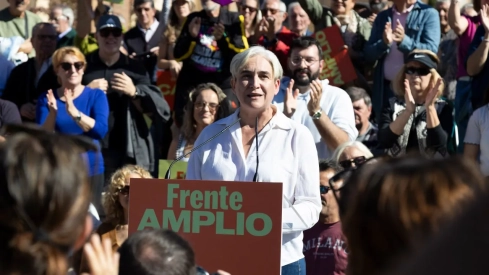
Ada Colau has proposed to Pedro Sánchez, Alberto Núñez Feijóo, and Santiago Abascal a commitment to keep the humiliating uses of artificial intelligence out of the campaign. The Frente Amplio candidate for the Presidency of the Government has sent a letter to the other three candidates in which she demands responsibility in the face of the dissemination of videos that imitate faces and voices to attack the adversary. "We don't need to humiliate and lie to convince," she states.
The initiative comes in a pre-campaign marked by the montages by the PP and the far-right Vox. Colau asks for an agreement to "not use and not promote the humiliating use of AI", both against political rivals and in general. She also expressly commits her coalition to avoid this practice, even if other organizations resort to it.
Her warning connects the behavior of parties with situations that affect those who suffer digital violence. "How are we going to tell our sons and daughters not to use AI to impersonate the identities of their peers when that becomes a common use in an election campaign?", she asks in the letter.
She then refers to sexual falsifications, known as deepfakes, which use the image of real people. "How will women humiliated by sexual deepfakes feel when they see their political leaders use similar techniques to insult each other?", she asks. Colau focuses on the example that leaders transmit when they turn identity manipulation into a habitual propaganda tool.
The former mayor of Barcelona defends a campaign based on ideas and admits "even harsh confrontations in tone". Her proposal demands that parties assume shared limits before November 29. Frente Amplio, she states, refuses to enter into an escalation in which what adversaries do serves to justify others repeating and increasing it.
The montages by the PP and the far-right Vox that cross the line
The debate has already had concrete examples. The PP disseminated a video that recreated with AI Begoña Gómez, wife of the President of the Government, and various socialist officials and former officials, attributing false confessions about crimes and irregular conduct to them. The PSOE announced that it was studying legal actions against that publication, which responded to Sánchez's message claiming to be "left-handed".
The popular party defended the montage, claiming that its creation with artificial intelligence was warned. The PP spokesperson, Borja Sémper, maintained that "I am not worried about artificial intelligence being used", while the parliamentary spokesperson, Ester Muñoz, presented the strategy as a response to their adversaries, playing "with the same weapons".
The far-right Vox also published an artificial sequence in which Sánchez removed his face like a mask and gave way to other characters. Colau's letter proposes to renounce this competition of montages and insults, with a commitment that she also directs to the socialist candidate. The request comes before the formal start of the campaign, scheduled for November 13.
What does the law already require?
Colau also demands specific regulation of the electoral use of artificial intelligence. Her proposal adds a political commitment to renounce humiliation to European transparency obligations that are already in force. Since August 2, 2026, Article 50 of the Artificial Intelligence Regulation requires a warning when manipulated images, audios, or videos that constitute a deepfake are disseminated.
The norm contemplates clearly artistic, satirical, or fictional works and allows adapting the notice to preserve their enjoyment, maintaining the obligation to inform about the manipulation. Identifying a video as artificial and respecting the rights of affected people are distinct requirements. The legality of each content also depends on what it represents, its context, and its possible injury to honor or self-image.
In Spain, Organic Law 1/1982 protects these rights and contemplates the caricature of public figures in accordance with social customs. It also considers the attribution of facts that injure dignity and undermine a person's reputation as an illegitimate interference. When such a violation is proven, it allows claiming its cessation and compensation, including moral damages and taking into account the dissemination achieved.
