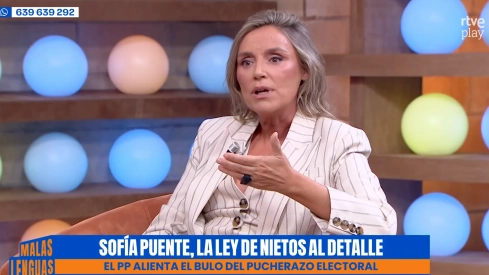
The Secretary General for Innovation and Quality of Public Justice Service, Sofía Puente, defended this Monday the instruction that developed the well-known ‘grandchildren’s law’ and which is now being questioned by the right and the Supreme Court. During an interview on ‘Malas Lenguas’, alongside Gonzalo Miró and Esther Palomera, Puente highlighted the change in the Popular Party's stance on a regulation that, as she recalled, has been applied "peacefully" since 2008, including during PP governments.
The statements come after the Supreme Court agreed to provisionally suspend new registrations in the Electoral Census of Absent Residents (CERA) of those who have acquired Spanish nationality under the so-called ‘grandchildren’s law’. The high court considers that the strong growth recorded in this census could compromise the guarantees of the electoral process and maintains that there is a "founded, real and serious danger of seriously affecting the objectivity and transparency of the electoral process".
The decision was adopted at the request of Iustitia Europa and Vox and is provisional while the merits of the case are resolved. The measure affects citizens who have obtained Spanish nationality under the regulations aimed at children and grandchildren of Spaniards who had to go into exile during Franco's regime.
Puente recalls that the instruction was already applied under PP governments
In the face of current criticism, Puente has defended the legality and continuity of the instruction of which she is the author. The head of Justice explained that the current regulation is "identical" to the one approved in 2008 to complete the Historical Memory Law, thus emphasizing the change in position that, in her opinion, has occurred in the political debate.
Puente has pointed out that the current controversy also allows her to analyze the arguments used by the Supreme Court to justify the precautionary suspension. As she explained, the synthesis of the high court's reasoning is based on the fact that there has been an increase in the electoral roll that could generate "a real danger for the correct formation of electoral results." However, the general secretary of Justice rejects that the mere growth of the electoral roll can be considered an electoral risk. "That the electoral roll increases in itself is neutral, the electoral roll does not have a political color, we do not know what people are going to vote for when they are incorporated into the electoral roll," she defended.
Puente recalled that other norms that have expanded rights have also led to an increase in the number of voters. She cited both the Historical Memory Law and the Sephardic Law, which, as she explained, incorporated some 80,000 people into the census, in addition to the Democratic Memory Law. "The electoral roll is always in motion," she remarked.
🤔 De defender la nacionalización en 2022, a oponerse a la 'ley de nietos': el PP cambia su postura.
— Malas Lenguas (@MalasLenguas_Tv) September 14, 2026
💬 Sofía Puente (@aifosan) analiza la ley al detalle en #MalasLenguas: "hay un prejuicio del Tribunal Supremo contra los nacionalizados" pic.twitter.com/KnjpCuaEfT
Puente has gone a step further by questioning the premise that, in her opinion, exists behind the argument of "real danger" collected by the Supreme Court. "In that real danger that the Supreme Court sees, what I believe is that there is a prejudice in that formulation, in those terms of expression, because it believes that those almost 400,000 voters, which are actually 375,000, it believes that they will all vote entirely for the Socialist Party. This is a simplistic approach. It starts from the premise that since the law has been approved by the socialist government, one has the captive vote of all these citizens," she said.
In this regard, Puente has questioned that the increase in the census can be associated with a certain political option and has defended that the incorporation of new citizens into the census does not allow anticipating what their electoral behavior will be.
Puente accuses the right of "delegitimizing" the electoral system
The general secretary for Innovation and Quality of the Public Justice Service has also attributed the change in the right's stance to a political current that, in her opinion, questions electoral processes when the results are not favorable. Puente has placed this phenomenon "four years after the approval of the new instruction and 18 since the first one was given the green light" and has pointed out that "both media and political parties are "in a Trumpist current" that "delegitimizes electoral results and the electoral system."
In this regard, she has raised a hypothetical scenario for the next regional elections: "If for next year's elections on the 27th the Popular Party wins and can form a government with Vox, nothing will have happened here. But if the Socialist Party wins or can govern, the bell will be rung again that there has been electoral fraud here," she lamented.
🔸 "Siempre se habla de la independencia judicial y es muy importante que nuestros jueces resuelvan sin presiones internas y externas pero jamás hablamos de la imparcialidad, de lo importante que es que el ciudadano perciba que se resuelve con objetividad y muchas veces, esa… pic.twitter.com/Ctf69zBkIr
— Malas Lenguas (@MalasLenguas_Tv) September 14, 2026
