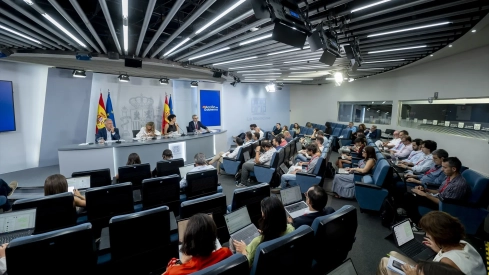
The Government faces this Tuesday a Council of Ministers crossed by two issues that have once again pitted the coalition against the Popular Party and the far-right Vox. The precautionary suspension of the electoral effects of part of the registrations linked to the so-called 'grandchildren's law' has opened a battle for the right to vote of thousands of Spaniards, while the Ceuta crisis continues to demand visible results after more than six weeks.
The response of the Central Electoral Board has reinforced the Executive's arguments. The body will comply with the Supreme Court's order, although it will do so after two very close votes and with serious reservations about the restriction of a fundamental right. The PSOE has made these doubts the center of its response and demands a definitive resolution before elections can be called.
Ceuta will also reach the cabinet meeting after a day full of figures, reproaches and new demands. The Government maintains that 5,300 people have voluntarily returned to Morocco, another 300 have been expelled by judicial order and at least 1,800 return files are underway. The Autonomous City estimates, despite these advances, that around 13,000 migrants still remain in its territory.
At the close of this edition, Moncloa had not announced a new specific measure for Ceuta within the Council of Ministers. Attention will be focused on the execution of the already approved package of 309 million euros, on the pace of transfers and on the validation of the decree scheduled for this Wednesday in Congress.
The Electoral Board obeys with reservations
The Central Electoral Board agreed this Monday to execute the Supreme Court's order, although the decision revealed an unusual division. Seven members voted against filing an appeal and six defended challenging the measure. In a second vote, eight members supported complying with the mandate in its strict terms and five sought to open a broader debate on its scope.
A majority of the body's members expressed during the meeting their concern about the precautionary suspension of the suffrage of citizens who fully retain Spanish nationality. Those affected have also not had the opportunity to appear or present allegations before the measure was adopted.
The Supreme Court's Administrative Litigation Chamber itself was divided in its decision. Five magistrates supported the order, and Alicia Millán issued a dissenting opinion in which she considered the risk to future electoral processes to be insufficiently proven. The magistrate also questioned the proportionality of removing those affected from the census while the merits of the procedure are resolved.
The so-called 'grandchildren's law' is a provision of the 2022 Democratic Memory Law that facilitated access to nationality for descendants of Spaniards forced to leave the country during the Civil War and the dictatorship. A subsequent instruction established the presumption of exile for those who left Spain between July 1936 and December 1955.
The Supreme Court has ordered a review of the files processed under this presumption. Nationality remains valid, and the measure is limited, for now, to its electoral effects. Descendants who have already documented the exile of their relatives will maintain their rights as the procedure progresses.
The latest government data indicates that 333,696 people naturalized through this route were registered in the census as of May 31, while another 238,065 had requested their inclusion. The figure of 408,262 new overseas voters used in the procedure reflects the entire growth of the CERA since 2023 and does not equate to the definitive number of affected individuals.
Consulates will now have to review each file and certify which ones meet the conditions set by the court. The representative of the National Institute of Statistics warned the Central Electoral Board that this work could last for months or even years due to the volume of documentation and the lack of staff in already saturated offices.
The Minister for Digital Transformation and Public Function, Óscar López, on Monday called the Supreme Court's decision a "savagery" and a "democratic outrage". During an interview on TVE's 'La hora de La 1', he accused certain judicial sectors of acting as "saviors of the homeland" and working to "overthrow the Government," although he accompanied his criticisms with a general defense of the work of judges.
The most institutional position remains that expressed by the Minister of Justice, Félix Bolaños, who considers the suspension legally "very debatable" and demands a quick ruling. The Executive wants the merits of the appeal to be resolved before any electoral call to prevent thousands of citizens from going to the polls without knowing if they can exercise their right.
The PSOE reinforced this message after the meeting of its Federal Executive. Its spokesperson, Montse Mínguez, warned that the measure could end up establishing first and second-class Spaniards. "The vote is sacred and hangs on nationality," she affirmed before demanding explanations from the Supreme Court.
"The real danger for a democracy begins when for some it seems dangerous to vote," Mínguez added. Socialists also recalled that Alberto Núñez Feijóo defended for years the expansion of the rights of descendants of Spanish emigrants and attributed his change of position to pressure from Vox.
PP and the far-right Vox clash over escalating the offensive
The far-right has tried to take advantage of the precautionary decision to prolong its campaign against the norm. Its national spokesperson, José Antonio Fúster, asked this Monday for the Senate to open an investigation commission on the nationalities granted and demanded to know their possible electoral impact.
Fúster even spoke of "fraudulent nationalities" without presenting evidence to demonstrate the existence of widespread fraud. The Supreme Court has not annulled any nationality nor declared the files irregular. Its decision is limited to temporarily suspending the electoral rights of a part of those registered while studying the appeals from Vox and Iustitia Europa.
The PP has so far rejected using its absolute majority in the Senate to open that commission. Its spokesperson, Borja Sémper, assured that the 'populares' will wait for the definitive resolution and maintained that they do not need a parliamentary investigation to question the instruction applied since 2022.
Génova maintains, despite this, its political offensive. Sémper described the instruction as an "outrage" and Feijóo has been talking for months about "electoral engineering". The difference with Vox is concentrated in the instrument and the tone, because both parties support the review of the electoral effects of the norm.
The available data also do not allow to affirm that the new Spaniards form an electoral bloc favorable to the Government. In the 2023 general elections, the participation of the external census was around 8% and the only seat modified after its recount went to the PP in Madrid.
Vox has extended its pressure on the Ceuta crisis and demands that the PP support the use of article 102 of the Constitution to accuse Pedro Sánchez of treason. Santiago Abascal's party has 32 deputies and needs to gather at least 88 signatures to initiate the procedure, in addition to a subsequent absolute majority in Congress.
Ceuta demands noticeable progress
The Government arrives this Tuesday with more data on the departures and transfers made in Ceuta. The Minister of Interior, Fernando Grande-Marlaska, estimated at 5,300 the voluntary returns to Morocco since August 10 and 300 judicial expulsions related to crimes or infractions.
Interior has launched at least 1,800 return files and has deployed about twenty police lines to speed up the identification of people remaining in the city. About a hundred have also renounced to request international protection.
The Executive has enabled around 4,500 temporary places for adults and resources for about 2,000 minors. Another 864 people who were sleeping rough were recently moved to enclosed spaces before their relocation to the enabled centers.
The situation continues to be very difficult in several settlements. Women, minors and families remain in precarious facilities in the Tarajal industrial estate, while the Autonomous City has requested to urgently clear a camp set up next to the perimeter of the desalination plant. Neighborhood protests have also accompanied the opening of some reception centers.
Margarita Robles acknowledged this Monday the harshness of the situation and again apologized to the people of Ceuta who feel that the State has left them alone. "The Government is with them," she affirmed, conveying her support to the affected women and girls and defending the work of the Armed Forces, police forces and intelligence services.
Óscar López maintained that no organization could anticipate an entry of more than 70,000 people, although he admitted that there were signs and calls on social media. Grande-Marlaska also maintained that the CNI did not transfer an alert related to the dimension reached by the events of July 30 and 31.
That version continues to clash with the declassified documents and with the account of Gonzalo Sanz, former Chief of Staff of the Government delegate. Sanz resigned after assuring that he transferred the communications received from the CNI. The delegate, Miguel Ángel Pérez Triano, maintains that he never had knowledge of those warnings.
The Audiencia Nacional has asked the Investigating Court number 6 of Ceuta to consider referring the open case against Pérez Triano to it. Judge María Tardón intends to gather these proceedings with the investigation she is already leading into the massive entry.
The spokeswoman minister, Elma Saiz, accused the PP of using the crisis to spread disinformation and assured that the 'populares' have stopped behaving like a state party. The socialist leadership followed the same line and reproached Feijóo for trying to turn Ceuta into a permanent election campaign.
The PP responded by stating that the situation "has worsened" in recent weeks and again demanded resignations. Feijóo will travel next Monday to the city accompanied by the president of the European People's Party, Manfred Weber, and the general secretary of the organization, Dolors Montserrat, after Genoa decided to move its offensive to Brussels.
The president of Ceuta, Juan Jesús Vivas, has also increased pressure on Moncloa. The popular leader maintains that he alerted the Government before the massive entry, demanded the declaration of a national emergency and even received a request to stop calling for being "very annoying". His intervention this Monday on 'El Hormiguero' was followed on a giant screen installed by local businessmen in the Plaza de los Reyes.
Sumar directed its criticism towards the Ceuta Executive itself. The co-coordinator of Movimiento Sumar and Secretary of State for Social Rights, Rosa Martínez, asked for explanations for two emergency contracts for the reception of minors that jointly exceed 5.7 million euros and were awarded to companies family-linked to people close to Vivas.
"Reception is a very serious matter, it is not a business," Martínez affirmed. The Government of Ceuta has defended the legality of the awards, while Sumar demands to know the conditions of the contracts and the reasons why they were processed without a public tender.
The immediate front will move this Wednesday to Congress. The Chamber will have to validate the decree that mobilizes 309 million euros, approximately equivalent to 16% of Ceuta's annual gross domestic product. The package reserves 118 million for reception and humanitarian aid, 90 million for security, 80 million for businesses and workers, and 21 million for essential services. Applications for the 36.6 million in direct aid to self-employed workers and businesses opened this Monday, and the first payments are expected for early October.
The validation will allow maintaining in force tax bonuses, specific ERTEs, aid for commerce and tourism, and the reinforcement of health, educational, and judicial services. The debate will coincide with the demand to accelerate the files, remove families from settlements, and transfer minors out of Ceuta whose reception corresponds to the rest of the autonomous communities.
Add ElConstitucional.es as a preferred Google source for free.
Stay informed about all the latest breaking news with the best information. Against disinformation, for democracy and social rights.
