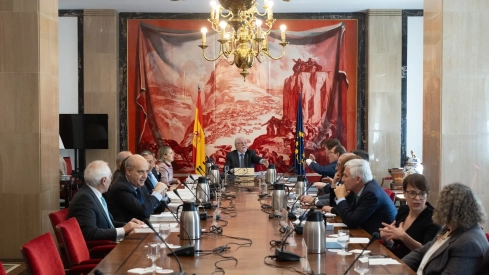
The application of the so-called 'Grandchildren's Law' has opened a significant division within the Central Electoral Board. Four of its thirteen members have signed a dissenting opinion against the agreement approved this Thursday and maintain that the body should prevent new registrations in the census when the applicant has not accredited the cause of exile provided for in the Democratic Memory Law.
The document was formulated by the Professor of Constitutional Law Carlos Vidal Prado and is supported by Javier Tajadura Tejada and Supreme Court magistrates Vicente Magro Servet and Fernando Marín Castán. Vidal Prado and Tajadura were proposed by the Popular Party to be part of the electoral body.
The signatories consider that the Board has "the obligation to prevent the census from being expanded contra legem" and warn of a "formidable and irreversible" growth. Their position was in the minority against the nine members who supported the official resolution, which maintains that the JEC lacks the authority to review the conditions used to grant Spanish nationality.
The scope of the dissenting opinion therefore has clear limits. It does not suspend the Electoral Census of Absent Residents, it does not annul any nationality, nor does it curtail the right to vote of Spanish residents abroad. The decision approved by the majority remains in force and new registrations will continue to be processed.
The Ministry of Justice's instruction, at the heart of the discrepancy
The four members place the origin of the problem in the instruction approved on October 25, 2022, by the Directorate General for Legal Security and Public Faith. According to their interpretation, the growth of the census they question comes from that administrative document and not directly from the Democratic Memory Law.
The eighth additional provision of the law allows those born outside Spain whose parents or grandparents were originally Spanish and had lost or renounced their nationality as a result of exile for political, ideological, belief, sexual orientation, or sexual identity reasons to apply for nationality.
The 2022 instruction interpreted this section more broadly. It also allowed descendants of people who had been originally Spanish to apply for nationality, even if their departure from the country or the loss of nationality was not directly linked to political exile.
The document also established a presumption of exile for those who left Spain between July 18, 1936, and December 31, 1955. Descendants of people who left during that period must prove their departure from the country, but they are not required to individually demonstrate political or ideological persecution.
The dissenting members believe that this interpretation extended the procedure to descendants of emigrants who left Spain for economic, labor, family, or academic reasons. According to their statement, a measure intended for "a few tens of thousands of people" ended up reaching "hundreds of thousands".
They also question the legal rank of the instruction. A general directorate cannot modify the requirements set by a law through an internal document, create legal presumptions, or change the evidentiary regime established by the Cortes.
The majority rejects intervening on nationalities
The dissenting opinion itself states that "the vast majority" of the members shared during the deliberation that some sections of the instruction could be contrary to the law. The rupture arose when deciding whether the Electoral Board had the capacity to act in that situation.
The majority concluded that the JEC can supervise the preparation of the census, but not review the circumstances that allow obtaining Spanish nationality. Any challenge against the instruction of Justice must be raised before the Constitutional Court or before the contentious-administrative jurisdiction.
The four signatories reject that boundary. They argue that a norm related to nationality can be subject to the control of the Board when its effects directly reach the electoral census, an essential piece for the holding of elections.
Their proposal consisted of ordering the Electoral Census Office to send instructions to consulates, city councils, and Civil Registry officials. Registrations could only be processed when the interested party had proven the exile of their ancestor for one of the causes expressly included in the Democratic Memory Law.
The measure would have excluded files based solely on the temporary presumption created in 2022 and those processed for descending from someone who had been originally Spanish, regardless of the reasons why they left the country.
The dissenting vote underlines that, once nationality is registered in the Civil Registry, the incorporation of the citizen into the census occurs ex officio. The members fear that any defect committed during the concession will end up being automatically transferred to the CERA and will be difficult to correct later.
The official agreement maintains the registrations
The resolution approved by the majority of the Electoral Board took another path. The body has asked the Census Office to expand the report sent on July 10 and prepare common rules to determine the electoral municipality of each new citizen residing abroad.
The municipality is decisive because it determines the province and the constituency in which the vote will be counted. Those who have lived in Spain must be registered in their last municipality of residence. For those who have never resided in the country, the place of greatest roots of their own or their ancestors is used.
The Board wants to know who examines the declarations presented by the applicants, what criteria the consulates use, and how the assignments made ex officio are supervised. The new instruction must specify how roots are accredited, what documents can be accepted, and how each decision must be justified.
The resolution also does not support the request of the far-right Vox to suspend postal voting for Spaniards residing outside Spain. The Board recalled that it lacks the power to eliminate a procedure regulated by law and that the electoral administration must facilitate the exercise of suffrage while the regulations remain in force.
The PP has tried to present the decision as a confirmation of the suspicions raised by Alberto Núñez Feijóo about alleged "electoral engineering." The agreement does not stop registrations, does not prove manipulation of the census, and does not confirm the existence of electoral fraud.
The concept of "irregular increase" belongs to the dissenting vote signed by four members. The official resolution certifies that there are update, control, and traceability mechanisms, although it calls for improved supervision over the assignment of municipalities.
The Census Office will now have to complete its report and draft new instructions for consulates. Until the Electoral Board examines that document, CERA will remain operational, registrations will continue to be processed, and mail-in voting from abroad will remain intact.
