The Government faces this Wednesday one of the most important votes since the migratory crisis in Ceuta began. Congress will decide whether to keep in force the 309 million euro shock plan approved to reinforce security, public services, reception, and the economic fabric of the autonomous city.
The validation of Royal Decree-Law 22/2026 will come after the control session, which will begin at nine in the morning and will once again place the management of Ceuta at the center of the political debate. The President of the Government, Pedro Sánchez, will respond to the leader of the Popular Party, Alberto Núñez Feijóo, who will ask him if he believes that "Spain's image has been degraded".
The Congress's agenda also includes two questions from the PP to the Minister of Interior, Fernando Grande-Marlaska, about Ceuta's return to normality and his actions during the crisis. Sumar will ask about the protection of minors and the far-right Vox will question the Executive about its plans for the city.
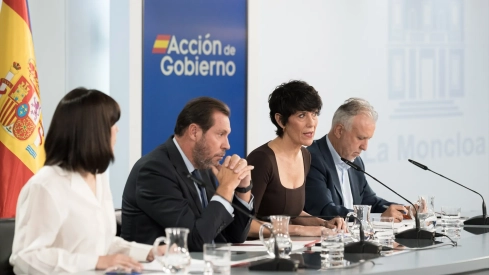
La Moncloa will arrive at this double parliamentary examination with a message based on the operational advances and the aid already activated. The Executive admits that the situation remains complicated, although it maintains that returns, administrative procedures, the expansion of places, and the recovery of daily activity have begun to show results.
Returns, aid, and minors
The latest balance presented by the Minister of Territorial Policy and Democratic Memory, Ángel Víctor Torres, places voluntary returns to Morocco at 5,482 since August 10. To these are added 307 expulsions and about a hundred people who have given up requesting international protection.
The authorities have initiated 1,822 files corresponding to adults and are currently assisting 4,160 people in temporary places. The Government is working with a forecast of up to 10,000 reception places to remove settlements from streets and beaches, complete identifications, and resolve each administrative situation.
"The sooner they are in resources, the sooner they can be returned," explained Torres during the press conference after the Council of Ministers. The head of the single command believes that a large part of the adults will not have the right to international protection, although each file must be processed individually.
The most delicate step affects children and adolescents. The first ten procedures began on Monday after ensuring the presence of lawyers during the interviews. Each case must verify identity, locate the family, and certify that any reunification is carried out safely.
Ceuta already has 2,048 minors under its guardianship, including 1,612 who arrived during July 30 and 31. Another 300 remain in facilities dependent on the central government, and Torres estimates that there are still between 700 and 1,000 unidentified on the streets. The Minister of Inclusion, Social Security, and Migration, Elma Saiz, has urged Feijóo to facilitate the collaboration of the communities governed by the PP to alleviate the pressure on the city.
The norm that arrives this Wednesday at Congress mobilizes an amount equivalent to 16% of Ceuta's gross domestic product. Of the 309 million, 118 are allocated to reception and humanitarian aid, 90 to security, 80 to businesses and workers, and 21 to strengthening essential services such as health, education, Justice, and water supply.
The decree includes aid of 5,000 euros for self-employed workers and up to 150,000 for companies, tax bonuses, temporary employment regulation files with exemptions in contributions, and measures for trade and tourism. It also incorporates an additional line of 50 million in guarantees from the Official Credit Institute (ICO).
The application has already begun. The Treasury has received 408 direct aid applications during the first two days and plans to make the first payments in early October. Nearly 2,000 migrants have been vaccinated, about 300 women will be transferred to facilities with better conditions, and school attendance has reached 90.43%, a percentage close to that of an ordinary day.
Robles and Marlaska facing the PP's offensive
The debate will reach Congress after another day of strong tension in the Senate. The PP used its absolute majority this Tuesday to approve its own plan for Ceuta, backed by the far-right Vox and UPN, which demands accelerating returns, reinforcing the border, expanding the capabilities of the Armed Forces, and maintaining permanent parliamentary information. The motion is political in nature and has no binding effects for the Executive.
The harshest criticisms focused on Margarita Robles and Fernando Grande-Marlaska. Popular senator Fernando Martínez-Maíllo demanded that the Minister of Defense choose between Sánchez and Spain and asked her to leave the Government or contribute to "unmasking it."
Robles responded by offering her appearance before the Congress's Official Secrets Commission alongside the director of the National Intelligence Center (CNI), Esperanza Casteleiro. "We will go to the Commission at any time," she assured before accusing the PP of acting disloyally and using the crisis to attack the Government.
Marlaska also rejected the calls for resignation launched from the popular bench. "I will remain here," replied the minister, who recalled the deployment of more than 1,600 agents and defended that no national or foreign intelligence service anticipated the dimension that the massive entry would eventually have.
The documents published in recent weeks reflect warnings about calls disseminated on social media and about a possible "jump" to the border. The Executive maintains that those communications lacked sufficient information to foresee that tens of thousands of people would try to cross in a matter of hours. The opposition believes that these messages should have prompted a much greater preventive reinforcement.
Brussels demands speed and looks to Morocco
Political pressure has also reached the European Parliament. The Commissioner for Home Affairs and Migration, Magnus Brunner, has defended that all persons who entered irregularly and do not have the right to remain should be "quickly" returned to Morocco. He has also called for improving early warning mechanisms, strengthening network control, and expanding the capabilities of the European Border and Coast Guard Agency (Frontex).
Brunner simultaneously acknowledged the response of the Spanish authorities and Rabat's subsequent cooperation. The commissioner highlighted that most of those who crossed returned to Morocco in the first hours and that no person reached the Schengen area, whose integrity remained protected during the crisis.
The European People's Party (EPP), the main group in the European Parliament, has increased pressure on Morocco. Its proposed resolution demands that Rabat fulfill its commitments on border surveillance, migration cooperation, and readmission, in addition to considering any questioning of Spanish sovereignty over Ceuta and Melilla incompatible with its status as a partner. Some 'popular' voices have raised consequences for the association agreement between the European Union and Morocco, although the draft does not yet expressly propose its suspension.
Rabat has tried to establish its position before the vote through a letter sent to some Spanish MEPs. The Moroccan diplomatic mission rejects any deliberate responsibility and promises to readmit Moroccan citizens, minors, and nationals of third countries. The execution of this commitment remains pending the procedures and guarantees required by Spanish and European legislation.
The socialists have called for a community response based on solidarity and support for Spain as responsible for an external border. Their leader in the European Parliament, Iratxe García, has defended that "Ceuta is Spain and Ceuta is Europe" and has warned that the returns of minors must respect their right to an individual assessment and safe reception.
The European pulse has extended to Italy's decision to extend its border controls with Spain for another fifteen days. Madrid has applied the same reciprocal measure and the Minister of Foreign Affairs, José Manuel Albares, has described the actions of Giorgia Meloni's Government as "absurd, useless, and a disgrace".
Brunner will travel to Madrid this Thursday to meet with Torres, Marlaska, and Saiz, in addition to holding a meeting with Feijóo. On the same day, the European Parliament will vote on its resolution on Ceuta, Morocco's actions, and the common response to protect the external borders of the Union.
Add ElConstitucional.es as a preferred Google source for free.
Stay informed about all the latest breaking news with the best information. Against disinformation, for democracy and social rights.
