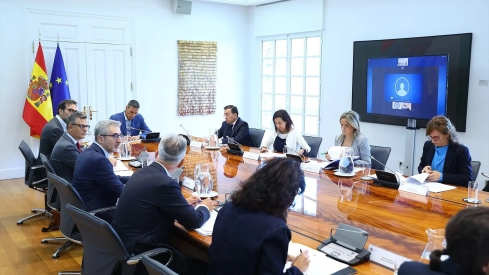
The Government has dedicated this week to giving explanations in the Congress of Deputies on the management of the migratory crisis in Ceuta, after the massive entry of people into the autonomous city between July 30 and 31. The round of appearances will close next September 3, when the President of the Government, Pedro Sánchez, will go to the Lower House to explain the Executive's actions in the face of a crisis that has placed several ministries under the political spotlight.
The first to appear was the Minister of Defense, Margarita Robles, who defended the actions of the Armed Forces, the Civil Guard and the National Police and vindicated the Spanishness of Ceuta and Melilla: “Ceuta and Melilla are Spain. They are very Spanish and represent the best of Spain”. She also supported the actions of the CNI, which, as she explained, monitored the situation with 25 agents from different perspectives, including mafias, jihadist terrorism and irregular immigration, and assured that the intelligence service “carried out the work required of them and provided the requested information”.
Thursday was the turn of Félix Bolaños, Mónica García and Ángel Víctor Torres. The Minister of the Presidency conveyed a message of confidence to the citizens of Ceuta and assured that the State is working to restore normality. In judicial matters, he explained that the Institute of Legal Medicine of Ceuta increased its capacity by 300% and performed 82 autopsies and nine identifications, while civil servants and the Public Prosecutor's Office were reinforced. Bolaños also recalled that return and family reunification procedures must be carried out with all legal guarantees.
The Minister of Health, Mónica García, denied that the health system had collapsed and placed the risk of disease transmission among migrants at a “moderate” level due to the conditions in which they have remained, compared to a “low” risk for the population of Ceuta. García defended that housing, vaccinating, monitoring and caring for these people reduces risks and rejected presenting migrants as a health threat: “Presenting an entire population as a health threat is unfair, it is not real and it is a lie”.
As head of the single command for crisis management, Ángel Víctor Torres detailed the measures adopted after the declaration of the situation of interest for National Security. The minister put the number of adult migrants who can now sleep under a roof at 1,827, thanks to the expansion of the Temporary Immigrant Stay Center (CETI) and the habilitation of new spaces. Torres also placed among the Executive's objectives the return of those who still remain in Ceuta, but always within the "margins of the law" and international legal order, with special protection of the "best interest of the child."
On Friday, the Minister of Interior, Fernando Grande-Marlaska, defended the Executive's actions and assured that the Government and its ministries have worked "tirelessly" alongside the population of Ceuta. Marlaska described what happened as "an attack on the territorial integrity of Spain," differentiated from usual migratory flows, and called for "calm and a cessation of any type of violence." He also put the number of migrants still remaining in the city at 5,000, noted that entries stopped on August 1, and described the collaboration with Morocco to facilitate returns as "sustained and effective." He also recalled that since July 30, the National Police has made 1,500 minors available in Ceuta.
The Minister of Foreign Affairs, José Manuel Albares, focused his appearance on the relationship with Morocco and the defense of Spanish sovereignty over Ceuta and Melilla. The minister assured that "there has not been, there is not, and there never will be any type of conversation about it" with Rabat and stressed that both cities are part of Spain and the European Union: "Ceuta and Melilla are Spain and are the European Union, they are part of our territorial integrity and our sovereignty." At the same time, he defended that maintaining diplomatic dialogue with Morocco is "indispensable" and assured that communication channels remain permanently open to contain the crisis and prevent a similar situation from occurring again.
The last to appear was the Minister of Inclusion, Social Security, and Migrations, Elma Saiz, who placed humanitarian response at the center of her department's actions. Saiz assured that the priority has been to offer a “basic humanitarian response” and “leave no one behind,” with the distribution of 93,650 food kits, 1,396 feminine hygiene kits, and 2,150 masculine hygiene kits. She also condemned the attacks and threats against Red Cross volunteers and vindicated the “solidarity and humanity” of Ceuta's residents and associations. The minister also assured that Spain requested help from the European Union and EMAS funds “from the very first moment.”
With these appearances, the Government has defended before Congress the response deployed from various areas—security, Defense, Justice, Health, territorial management, foreign policy, and humanitarian aid—in the face of the Ceuta crisis. Next September 3, it will be Pedro Sánchez who takes over from his ministers and appears in the Lower House to offer his own explanation on the management of the crisis.
