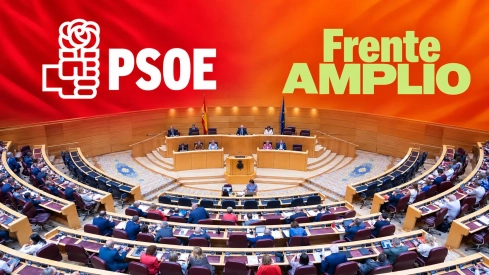
A joint candidacy of the PSOE, Frente Amplio, and Podemos could change the Senate majority on 29N. An internal report used by the socialists calculates that running together would allow them to obtain 40 more seats than running separately and reach 150 representatives, above the 134 needed for an absolute majority. The document, accessed by 'elDiario.es', provides a concrete electoral incentive for negotiations that are progressing by territories and are still pending closure.
Pedro Sánchez publicly supported this possibility this Thursday, upon his arrival in Brussels. "We want to win the Senate," he affirmed, before pointing out that "all options are on the table," including running with other left-wing forces. The president also defended respect for the decisions of the parties to the left of the PSOE, which are facing their own conversations for candidacies to Congress.
The election of the Upper House particularly favors the concentration of support. In provincial constituencies, four senators are elected, and each voter can mark up to three candidates, even from different parties. When the vote is concentrated on the names of the same candidacy, it is common for the most supported force to get three representatives and the next one, one. An agreement allows voters from different parties to support the same candidates, even if they keep different ballots for Congress.
The numbers of unity
The study is based on provincial estimates prepared with polls from October 7 and 8. In the scenario of separate candidacies, it attributes 96 elected senators to the PP, 89 to the PSOE, six to the far-right Vox, and three to the UPN-PP coalition in Navarra, in addition to eight to ERC. By incorporating representatives designated by regional parliaments, the right and far-right would jointly reach 134 seats, exactly the absolute majority, compared to the 110 that the report assigns to the progressive space studying the alliance.
The common candidacy would raise its representation to 129 senators elected at the polls and 150 when adding those of autonomous designation. The 40-seat difference corresponds, therefore, to the comparison between running together or separately within that same projection. The resulting Chamber would have 267 members, one more than until now, because Formentera will elect its own senator for the first time, separate from Ibiza's, after the constitutional reform approved this year.
The document also contemplates an incomplete transfer of support. If the alliance retained 70% of the votes its parties obtained for Congress, it would reach 141 senators, 120 of them elected, and would retain an absolute majority. This is an internal PSOE simulation whose result depends on its vote estimates and how voters respond to shared candidates. The pacts that end up being closed and their territorial scope will determine what part of that scenario gets put to the test.
The advantage would be distributed across numerous constituencies. In eleven provinces, going from one to three senators would provide 22 more seats. The calculation adds advances by undoing nine distributions of two representatives per bloc, another seven seats in Mallorca, La Rioja, Navarra, Soria, Lleida, A Coruña, and Almería, and the possibility of retaining Ibiza and Formentera against the PP. The alliance would be the most voted in 45 of the 60 constituencies. The study also identifies opportunities to win seats with variations of less than one point of vote in La Rioja, Gipuzkoa, Navarra, Murcia, and Zamora.
Open Pacts in Both Blocs
Conversations for the Senate allow for different agreements in each territory, so a provincial discrepancy can coexist with pacts in other places. Contacts have advanced between Catalan socialists and the Comuns, and Frente Amplio interlocutors describe greater willingness in the Balearic Islands, Canary Islands, Extremadura, Madrid, and the Valencian Community. Galicia and Castilla-La Mancha present more difficulties. In Ibiza, the candidacy of Juanjo Ferrer has already been announced, backed by PSOE, Ara Eivissa, Esquerra Unida, and Sumar, with the support of Podemos.
That understanding coincides with the first advances of the unit for Congress. Nueva Canarias, Podemos, IU and Movimiento Sumar have agreed to run as Unidad del Pueblo Canario, while Ara Més, Sumar and Esquerra Unida have reached a pending pre-agreement in the Balearic Islands for ratification, still without the purples. The Canarian example offers a formula for territorial cooperation on a day also marked by the clash between Podemos and IU over the conditions for agreement outside Madrid and Barcelona. Alliances to the Senate open another way to expand the representation of these forces and dispute the majority with PP and Vox.
The right also studies how to respond to a concentration of the progressive vote. PP and the far-right Vox are exploring joint candidacies in certain constituencies, a possibility that 'ElConstitucional.es' has already reported and that still lacks an announced agreement. The operation would be conditioned on the success of the left-wing alliance and would seek to strengthen its options of reaching three-fifths of the Chamber. The deadline to communicate coalitions ends this Friday, October 16, before the presentation of the complete candidacies.
The institutional scope of that majority requires distinguishing the thresholds. An absolute majority allows approving vetoes to laws, which Congress can lift through the constitutional procedure. To propose the four magistrates of the Constitutional Court corresponding to the Senate, three-fifths of its members are required, equivalent to 161 votes in a Chamber of 267 members. This requirement obliges to gather additional support when a bloc exceeds the absolute majority, but falls below that figure.
