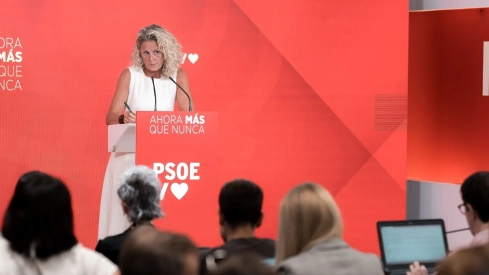
The PSOE has increased pressure on the Supreme Court this Monday for the precautionary suspension of the electoral rights of thousands of Spaniards covered by the so-called 'grandchildren's law'. The spokesperson for the Socialist Federal Executive, Montse Mínguez, has demanded that the court resolve as soon as possible an issue that directly affects the right to vote and has warned of the seriousness of presenting the vote of citizens whose nationality remains fully recognized as a threat.
"We are very concerned," Mínguez admitted during the press conference after the meeting of the socialist leadership in Ferraz. The leader recalled that the resolution is still provisional and that the norm itself remains in force. "The vote is sacred and hangs on nationality," she defended.
The Supreme Court has suspended the electoral effects of certain registrations in the Census of Absent Residents, known as CERA, while studying the appeals filed by the far-right Vox and Iustitia Europa. The measure affects those who accessed nationality through the presumption of exile established in a 2022 instruction and have not yet documented before the consulates that they descend from exiled Spaniards.
The decision temporarily affects suffrage, although it does not revoke nationality or paralyze all files processed through the Democratic Memory Law. The court has established an exception for people who can demonstrate that their parents or grandparents suffered exile for political, ideological, religious reasons or related to their sexual orientation and identity.
First and second-class Spaniards
Mínguez directed a good part of her criticism against the Supreme Court's argument about the existence of a "founded, real and serious danger" to the objectivity and transparency of future electoral processes. The socialist spokesperson rejected that the growth of the foreign census could justify the suspension of the vote of Spanish citizens before a definitive sentence exists.
"The real danger for a democracy begins when for some it seems a danger to vote," she stated. In her opinion, distinguishing between Spaniards who can exercise suffrage and others who must wait for an administrative review means establishing "first and second-class" citizens.
The spokesperson has demanded a detailed explanation of how such a significant measure was reached. "We want this issue to be resolved quickly. We cannot understand how we got here, and it will have to be explained very well," she warned.
Jamás votar puede ser un peligro real. Eso viene de otra época, de una época que, afortunadamente, en este país la hemos superado, y queremos seguir superándola.
— PSOE (@PSOE) September 14, 2026
Decidir qué españoles pueden votar y qué españoles no, es tener españoles de primera y españoles de segunda.… pic.twitter.com/ogxYE3muwH
The socialist leadership has also pointed out the shift adopted by Alberto Núñez Feijóo. Mínguez recalled that the PP leader defended for years the expansion of rights for Spanish residents abroad and even committed to the descendants of emigrants during his visits to Latin America.
In 2022, Feijóo supported a specific law that would facilitate the recovery of nationality for descendants of Spaniards. Four years later, he has placed this process under suspicion and linked it to an alleged government operation to alter the census. Mínguez attributes this change to pressure from the far-right. "Vox is writing their electoral program and changing it for them," she denounced.
The PSOE believes that the offensive against the 'grandchildren law' fuels the idea that newly naturalized citizens form an electoral bloc at the service of the Government. The available data does not support this conclusion. Nationality also does not imply immediate registration in the CERA, and being listed in the foreign census does not guarantee that the vote will ultimately be cast.
As ‘ElConstitucional.es’ already explained, the foreign vote is distributed among the different constituencies and registered a participation close to 8% in the 2023 general elections. That year, it even changed a seat in Madrid, precisely in favor of the Popular Party.
Narváez, at the center of the clash
Mínguez has also focused on Antonio Narváez, a Supreme Court magistrate and rapporteur of the orders that have agreed to the precautionary suspension. "Independence does not mean impunity," the spokesperson stated, before demanding that members of the Judiciary be independent and also maintain an appearance of impartiality.
Narváez participated in April 2023 in a private dinner hosted by Feijóo with fifty prosecutors linked to the majority and conservative-leaning association. According to 'El País' at the time, the now magistrate personally expressed his wish for the popular leader to reach the Presidency of the Government.
During that meeting, he also cast suspicion on the electoral processes in which the company Indra participates and criticized the agreements between the Socialist Party of Euskadi and EH Bildu. The PSOE considers this precedent particularly relevant because Narváez has now drafted a resolution that warns of the possible effects of the growth of the foreign census on elections.
The precautionary measure was approved by five of the six magistrates who participated in the deliberation. Alicia Millán issued a dissenting vote in which she reproached the majority for an incomplete weighing of the interests at stake and warned that the order prevents the exercise of a political right recognized by Spanish nationality.
Mínguez's criticisms have extended to the general functioning of the courts. The spokesperson has denounced that some cases affecting the Government advance with enormous speed, while other procedures remain open for "12 or 14 years". She mentioned the investigations into Begoña Gómez, David Sánchez, and the former Attorney General of the State Álvaro García Ortiz as examples of actions that, in the opinion of the PSOE, are eroding the trust of a part of the citizenry in Justice.
The Central Electoral Board agreed this Monday to execute the Supreme Court's mandate, although the votes revealed a deep division. By seven votes to six, the body decided not to appeal the order. Another majority of eight to five decided to limit the agreement to complying with the resolution without adding interpretations about its content.
Consulates will now have to review the files and differentiate between those who directly accredited the exile of their ancestors and those who availed themselves of the presumption approved in 2022. Government data up to May counted 333,696 beneficiaries already registered in the census, while another 238,065 had applied to do so. The specific number of people who will temporarily lose their vote remains pending this verification.
The PSOE demands that the final ruling arrive before the next general elections. Until then, the Electoral Board, the Census Office, and consular registries will have to apply a precautionary measure discussed within the Supreme Court itself and narrowly accepted by the body responsible for ensuring electoral guarantees.
Add ElConstitucional.es as a preferred Google source for free.
Stay informed about all the latest breaking news with the best information. Against disinformation, for democracy and social rights.
