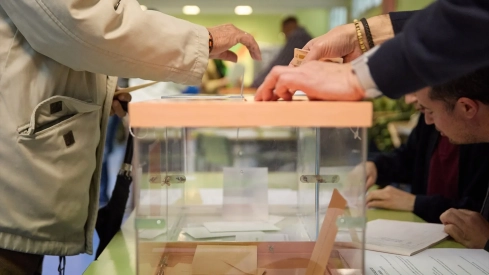
The legislature has entered a political countdown that is already openly looking towards the ballot boxes. Pedro Sánchez publicly maintains his intention to remain until 2027, but within the Government, the possibility of holding general elections between February and March is growing. The outcome of the Budgets, the PSOE's interest in separating the state campaign from the municipal and regional elections in May, and the Executive's parliamentary weakness fuel an increasingly tight calendar.
The date of February 14 jumped into public debate this week during an intervention by Esther Palomera on 'Malas Lenguas'. The journalist placed that Sunday as a possible election day, a statement quickly picked up and disseminated on social media. The comment coincides with one of the scenarios that have been circulating for weeks in the coalition parties.
‼️ OJO: A Esther Palomera se le acaba de escapar en @MalasLenguas_Tv que las elecciones generales podrían ser el domingo 14 de febrero. pic.twitter.com/tGX7TANpxJ
— Miguel Ángel Bernal Sánchez-Roxado (@mabernalsanchez) September 14, 2026
According to internal sources from Sumar consulted by 'ElConstitucional.es', Moncloa would have conveyed to the minority partner a roadmap that grants the budgetary attempt until the end of December, approximately until the 30th. If the 2027 accounts fall in Congress, Sánchez could immediately activate the electoral call. The same sources insist that this is a possibility subject to the political development of the coming months and that the decision remains exclusively in the hands of the president.
The legal calendar narrows the electoral window
The 14-F date presents an obvious difficulty. The Organic Law of the General Electoral Regime establishes that elections must be held 54 days after the publication of the call decree. To vote on February 14, the dissolution of the Cortes would have to be published around December 22. Sánchez would then have to abandon the budgetary battle before the limit handled by the Government.
If Moncloa keeps the accounts open until the last days of the year, the dates would fit better from February 28. A call published on January 5 would bring the ballot boxes to that Sunday. March 7 would require signing the decree on January 12, and March 14, another date contemplated by the sources, would require doing so on the 19th.
March 14 adds a symbolic component for the PSOE. That day would mark 23 years since José Luis Rodríguez Zapatero's electoral victory in 2004. Its main advantage, however, would be practical. It would allow the Budgets to be processed for several weeks, assume its probable defeat, and open the campaign with the social measures of the accounts converted into an electoral program.
The consulted sources also point to a discreet understanding between the PSOE and the PNV to distance the general elections from the Basque municipal and regional elections, scheduled for May 23. The nationalists want to prevent a campaign dominated by the confrontation between Sánchez, Feijóo, and Abascal from conditioning their local disputes with EH Bildu. For now, this agreement lacks public confirmation.
The Budgets can close the legislature
PSOE and Sumar have just activated the negotiation of accounts that the Government promises to endow with the highest social spending in history, with a spending ceiling of 226,032 million euros. The minority partner demands more investment in public housing, measures to lower rents, a universal child-rearing benefit, new resources for dependency, and a tax reform that increases the contribution of large fortunes.
The problem is in Congress. Junts maintains the investiture agreement broken, and Podemos rejects accounts that consolidate the increase in military spending. ERC demands advances in regional financing, while the PNV and EH Bildu maintain negotiating prudence that does not guarantee their votes either. The arithmetic necessary to approve the project is difficult to reconstruct today.
A parliamentary rejection of the Budgets would allow Sánchez to continue governing with the 2023 accounts extended, as has happened throughout the legislature. The eventual call would respond to a political decision. The Executive could present the project as its last great social proposal, force each group to show its true colors, and then go to the polls denouncing the blockage of an exhausted parliamentary majority.
The president already left room for a possible adjustment of the calendar during his back-to-school interview on Cadena SER, although he has subsequently reiterated his intention to complete the legislature. The Constitution attributes to Sánchez the responsibility of proposing the dissolution, after deliberating with the Council of Ministers, so any date will remain open until the publication of the decree.
Polls warn a divided left
The electoral snapshot explains part of the caution. The simple average of four national polls published in September —CIS, InvyMark, Hamalgama, and Target Point— places the PP at 31.1%, the PSOE at 27.1%, and the far-right Vox at 18.4%. Sumar hovers around 6.1% and Podemos at 3.4%.
The differences between studies are significant. The CIS keeps the PSOE in the lead with 31%, while the three private polls place the PP between 31.5% and 33.7% and the socialists between 25.1% and 26.8%. Even incorporating this disparity, the average of their projections leaves approximately 132 deputies for the PP, 113 for the PSOE, 64 for the Vox ultras, eight for Sumar, and three for Podemos. The bloc of Feijóo and Abascal would reach about 197 seats.
The biggest threat to Sánchez lies in the fragmentation on his left. Sumar and Podemos together gather around 9.5% on average in September, almost three points less than their combined result in 2023. By running separately, moreover, the provincial distribution can leave thousands of votes without representation. The analyzed projections grant both forces about eleven deputies, compared to the 31 obtained by Yolanda Díaz's coalition in the last general elections.
This scenario has accelerated conversations about candidacies, primaries, and possible alliances. It also explains the fear that a part of the progressive electorate will return to the PSOE through strategic voting. Sánchez needs the alternative left to resist and for the sovereignist parties to retain sufficient parliamentary strength to try to rebuild a majority against PP and Vox.
The first decisive day will be December 22. If by then the Cortes are still open and the Government continues negotiating the Budgets, February 14 will have been removed from the calendar. The battle will shift to late February and a month of March that Moncloa, Sumar, and the rest of the partners already contemplate as the possible end of the legislature.
Add ElConstitucional.es as a preferred Google source for free.
Stay informed about all the latest breaking news with the best information. Against disinformation, for democracy and social rights.
