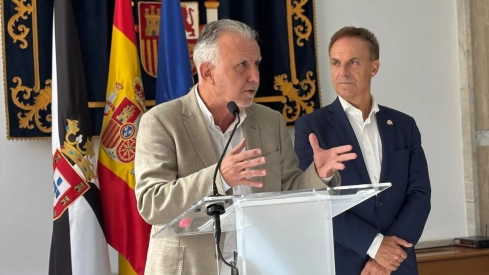
The Government raises to 11,025 the migrants who have returned to Morocco since the beginning of the crisis, while the Minister of Territorial Policy, Ángel Víctor Torres, denies that the Executive concealed a report from the Government Delegation that, six days before the massive entry on July 30, warned that it was "highly probable" that new attempts of massive entry into Ceuta would occur.
The document, prepared on July 24 by the then chief of staff of the government delegate, Gonzalo Sanz, and sent to the Ministry of Territorial Policy by Miguel Ángel Pérez Triano, also warned of a possible "collapse of administrations and institutions" and called for reinforcements to face a possible worsening of migratory pressure. Its existence has now come to light within the framework of the National Court's investigation into the crisis.
Torres defended this Thursday that the report was not hidden and that the warnings from the Delegation reached the corresponding departments. According to Minister Torres, he confirmed: "That email did not reach me", but rather the Secretary of Territorial Coordination, who subsequently forwarded it to the competent ministries. The minister also maintains that the requested measures began to be activated before the massive entry occurred.
More than 11,000 returns to Morocco while migratory pressure continues
Torres has put the number of people who have returned to Morocco since the beginning of August at 11,025, including both voluntary returns and repatriations. Of these, 2,783 have returned since last Tuesday, reflecting the increase in departures in recent days. The increase in returns coincides with the operations launched to clear the settlements formed after the massive entry. Among them is the operation carried out on Trampolín beach, where around 1,300 people were transferred and, according to data provided by the Ministry, almost all of them subsequently chose to return to Morocco.
The Government defends that migrants transferred from these settlements can go to the Temporary Foreigner Care Center (CATE) to initiate the corresponding procedures or return to Morocco. Torres has also rejected doubts about the circumstances of these returns. Meanwhile, pressure on reception resources continues. Ceuta maintains under its protection system 2,831 unaccompanied foreign minors, a figure that multiplies its ordinary capacity by 98. The Executive has also transferred 259 minors to the peninsula, while studying new family reunification files.
The Government assures that it has also expanded the available reception capacity, which would have increased from about 2,000 places on August 24 to more than 7,000 distributed in ten resources.
The July 24 report that warned of a massive entry
In parallel to these figures, the political and judicial focus has shifted to a report prepared on July 24, six days before the massive entry that occurred during July 30 and 31. The document, prepared by the then chief of staff of the Government delegate in Ceuta, Gonzalo Sanz, warned that it was "highly probable" that new attempts at massive entry would occur and contemplated a scenario of "migratory overflow." It also warned of the possible "collapse of administrations and institutions" and called for reinforcements to face a possible worsening of migratory pressure.
Among the measures proposed were the reinforcement of security means, the urgent establishment of a provisional center to carry out triages, and the study of mechanisms to expedite returns to Morocco. The date of the document has acquired special relevance within the investigation of the Audiencia Nacional, as it was prepared just six days before the crisis. The report was also not among the July documents that the Government made public in September to reconstruct the information available before the massive entry.
The investigation now seeks to determine what information reached the central Government, when it did so, and what decisions were adopted based on the warnings received. References to communications from the Civil Guard and the CNI about the situation at the border and about possible movements that could anticipate new entry attempts have also appeared in it.
Torres denies that information was concealed
Given the controversy, Torres has denied that the Executive concealed the report and has assured that the warnings from the Government Delegation reached the corresponding departments. The minister explained that the document did not reach him directly, but rather the Secretary of Territorial Coordination, who subsequently transferred it to the competent ministries. According to his version, on July 29, five days after the report was prepared, a meeting was held to analyze the requests made from Ceuta.
Torres has assured that some of the requested measures began to be implemented before the massive entry, including the installation of a "provisional and urgent" infrastructure to carry out triages, the reinforcement of personnel at the Temporary Immigrant Stay Center (CETI) and the increase in resources for the Maritime Service of the Civil Guard. "Nothing has been hidden," defended the minister, who maintains that the Government acted based on the available information.
The central question of the investigation is now focused on what exactly the Executive knew before the crisis and what response it gave to those warnings. The existence of the July 24 report certifies that the Government Delegation was contemplating a scenario of massive entry a few days before, while Torres maintains that the alerts were transferred and that measures began to be activated before it occurred. The management of the crisis thus continues to be marked by two fronts: on the one hand, the Government highlights the more than 11,000 returns to Morocco and the reinforcement of reception resources; on the other hand, the judicial investigation tries to clarify how the prior information circulated and whether the response of the administrations was sufficient in a scenario that had already been warned.
