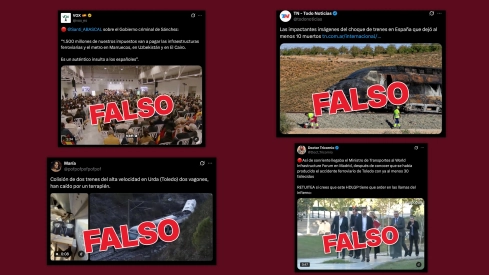
Photographs of other train accidents began circulating as if they were from Urda when emergency teams were still attending to the victims. These publications have been joined by scenes fabricated with artificial intelligence, invented threats, and messages attributing the crash to sabotage without providing any evidence. The tragedy of Toledo, with a provisional toll of at least 68 fatalities, has also become fertile ground for disinformation.
Among the reviewed messages are authentic images used with a false date or location, accusations that videos do not support, and economic data presented in a misleading way. The offensive against the Government includes a recording of Óscar Puente to which a meaning that it does not accredit is attributed. For its part, the far-right Vox has used railway financing in other countries to denounce that money needed by Spain is being given abroad, omitting that these operations include loans that must be repaid.
Old photos and fake rescue scenes
Several of the photographs presented as images of Urda correspond to the Adamuz accident last January. One shows the rear of the derailed Alvia; others show red Iryo wagons and agents working next to the crashed trains. These scenes were already published months before the Toledo crash. A screenshot of a video that the Civil Guard disseminated on January 19 about their intervention in Adamuz has also been reused.
Another image shared after the accident shows the burned front of an AVE and two operators in front of it. Its origin is Ricla, in Zaragoza. The original photographic archive dates it October 15, thirteen days before the Urda tragedy, and describes the train that caught fire in that town in the previous days. The photograph also belongs to the Madrid-Barcelona corridor.
An image of the Rodalies accident that occurred on January 20 between Gelida and Sant Sadurní d’Anoia, in Barcelona, has also been used. It shows emergency teams assisting those affected after a wall fell on the convoy. To these decontextualized photographs are added two scenes generated with artificial intelligence, one of the arrival of emergency services and another with a supposed aerial view of the crash. In some publications, the warning of synthetic or illustrative content is preserved; in other versions, this indication disappears. None of these recreations document the actual rescue.
The mix of accidents also affects the counts. The list presenting five railway accidents from 2026 as five fatal high-speed accidents is false. It includes the Rodalies accident in Gelida and the collision of a narrow-gauge train with a crane in Cartagena on January 22. The latter left six minor injuries and no fatalities. The accidents in Adamuz and Urda are the two major fatal high-speed accidents this year and, with the provisional balance known, total at least 114 victims.
Sabotage without proof and invented threats
Publications attributing the crash to a cyberattack or an operation by foreign intelligence services lack evidence to support these accusations. Some messages present as information from alleged intelligence sources what no investigating authority has confirmed. Others directly suggest intervention by the United States or Israel.
The initial explanations from the Ministry of Transport describe a failure of the LZB railway protection system and subsequent decisions to resume circulation from the Adif control center. The existence of a computer failure does not prove that someone caused it from outside. The investigation must clarify what happened, what instructions were transmitted, and how the collision between the two trains occurred. The independent authority in charge of the technical investigations has warned that it is “too soon” to advance hypotheses.
To these speculations has been added an invented phrase attributed to Israeli Prime Minister Benjamin Netanyahu. The publications claim that he threatened Spain with “sudden power cuts and train accidents.” These words do not appear in the original statement used to support it.
The authentic message was published on April 10 by the Israeli Government Press Office. Netanyahu announced the withdrawal of Spanish representatives from the Kiryat Gat coordination center and lashed out at Spain's position regarding Israel. He also warned of an "immediate price" for a "diplomatic war." The statement contains no references to train accidents or power outages.
Puente's video and the loans Vox omits
Another of the most aggressive publications uses a video of the Minister of Transport, Óscar Puente, arriving at the World Infrastructure Forum in Madrid. The profile Doctor Tricornio shows him greeting and smiling, and assures that he already knew about the accident and a toll of at least 30 dead. The message accompanies this statement with insults and asks to share it.
The recording does not prove that Puente had that information. The sequence was recorded between 8:56:59 and 8:57:29, a few minutes after the time of impact offered by the minister himself. Puente left the forum before giving his speech and went to the Adif control center. Transportes maintains that he received the warning when he was already inside the premises. Turning the images of his arrival into proof that he decided to continue with the event knowing the number of victims distorts what happened.
In parallel, messages have reappeared presenting the financing of trains in Morocco, Uzbekistan, and Egypt as money given away by Spain. The president of the far-right Vox, Santiago Abascal, has fueled this discourse from his rally in Valladolid by denouncing that 1.5 billion of Spanish taxpayers' money goes to pay for infrastructure in those countries. In his explanation, he omitted that the operations include repayable loans for projects with the participation of Spanish companies.
Official agreements confirm this. In April 2019, loans were approved for railway projects in Morocco and Uzbekistan; in December 2024, another one of up to 227.8 million was authorized to modernize material for the Cairo metro. They are channeled through the Fund for the Internationalization of the Company. The foreign buyer incurs the debt and disbursements are made to the Spanish exporter through the Official Credit Institute. These operations, by themselves, also do not prove that money has been withdrawn from the maintenance of the accident line.
