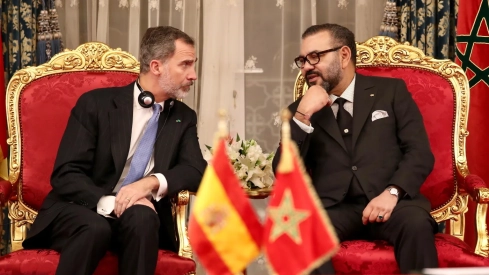
The King of Morocco, Mohamed VI, has accused certain Spanish political and media sectors of instrumentalizing the migration crisis in Ceuta and has warned that cooperation between both countries cannot be subjected to pressure, threats, or "blackmail". The monarch has spoken for the first time about the massive entry of migrants recorded at the Ceuta border at the end of July, in a speech delivered during the opening of the new session of the Moroccan Parliament.
The message comes at a delicate moment for relations between Madrid and Rabat, a few days before the Kings of Spain visit Ceuta and Melilla. The migration crisis, the cross-accusations about Morocco's actions, and the Moroccan claim of sovereignty over both autonomous cities add tension to a relationship marked by the need to maintain bilateral cooperation.
Mohamed VI responds to criticism over the Ceuta migration crisis
During his speech, the King of Morocco denounced the "instrumentalization" of the crisis by certain Spanish political and media circles. The monarch defended that: "cooperation between both countries must develop without pressure" and called for a relationship based on mutual respect.
The statement represents the first public reaction of the Moroccan king to the massive entry of some 80,000 people, mostly Moroccans, who crossed the Ceuta border on July 30 and 31 in the Tarajal area. The episode caused a migration crisis and opened a political debate in Spain about border control and the possible responsibility of the Moroccan authorities. Accusations about Rabat's involvement have been rejected by the Moroccan Government, which maintains that there is no evidence to hold its authorities responsible for what happened. In Spain, the crisis has fueled opposition criticism of the Executive for its management of the situation and for the diplomatic response to Morocco.
Against this backdrop, Mohamed VI has raised the need to open a new stage of cooperation. As announced, Morocco will present a document with a "clear and practical strategic vision" to guide bilateral relations towards joint development, economic competitiveness, and regional stability.
The visit of the Kings to Ceuta and Melilla increases anticipation in Rabat
The monarch's speech comes just days before the visit of Felipe VI and Queen Letizia to Ceuta, on October 13, and to Melilla, on the 14th. It will be the first time during the reign of Felipe VI that the Kings travel to both autonomous cities, whose sovereignty Morocco historically claims.
The trip has significant institutional and diplomatic meaning. The visit seeks to convey a message of normality and state presence in both territories, while in Rabat there is anticipation for the response it may generate. In 2007, the trip of the then Kings, Juan Carlos I and Sofía, provoked an official protest from Morocco and the recall of its ambassador in Madrid for consultations. For the moment, Mohamed VI's speech has not meant a concrete announcement of reprisals in response to the visit. However, his warnings about pressures and blackmail reflect the sensitivity of bilateral relations at a time when the migratory crisis continues to have political consequences.
The evolution of the relationship between both countries will now depend on how the royal visit is managed and whether the cooperation proposal announced by Mohamed VI translates into new diplomatic initiatives. The challenge for Madrid and Rabat will be to keep the channels of dialogue open despite disagreements over Ceuta, Melilla, and the management of their borders.
