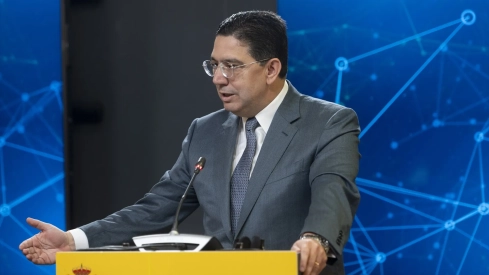
Morocco broke its silence on Thursday regarding the Ceuta crisis with a harsh statement against Spain. The Moroccan Ministry of Foreign Affairs has denied any involvement of its authorities in the massive entry recorded at the end of July and has warned that a supposed "strategic blindness" can turn the bilateral relationship into a source of "chronic distrust and recurrent tensions".
Rabat maintains that "no data, fact or report" allows its authorities to be held responsible for what happened on July 30 and 31, when more than 70,000 people crossed the border on foot or by swimming. The statement appears in the communiqué issued by Moroccan diplomacy, which presents the kingdom as a victim of a political and media campaign promoted from Spain.
The Government of Mohamed VI assures that Morocco refuses to be used as a "pre-electoral political pawn" and also does not accept becoming the "scapegoat" for internal Spanish clashes. The text accuses certain media and parties of exploiting the border crisis and reproaches long-standing formations for having fallen into an "irrational and populist escalation".
The reference to "historical parties" points especially to the Popular Party, although Foreign Affairs avoids explicitly naming it. The PP has demanded an investigation into Moroccan actions and has supported the mission that a delegation from the European Parliament will carry out in Ceuta in February. The far-right Vox has also used the crisis as one of its main battering rams against the Government and has fueled for weeks an openly xenophobic discourse about the people who remain in the city.
Rabat's statement comes after Pedro Sánchez's Executive published 40 documents prepared by intelligence services and Security Forces and Corps before and during the massive entry. Morocco now questions these analyses and even attacks Spanish legislative and judicial institutions for promoting what it describes as "unfortunate initiatives".
The reports do describe passivity
Rabat's categorical denial clashes with part of the declassified documentation. The papers known so far lack a definitive conclusion attributing the direct organization of the entry to the Moroccan Government, but several reports do reflect the lack of action by its forces during the decisive hours.
The National Intelligence Center (CNI) notified Moroccan services on July 29 about calls disseminated in Facebook and WhatsApp groups encouraging people to cross the border coinciding with the Feast of the Throne. The communication included references to communities that gathered around 180,000 followers and warned of planned attempts by the fence and the sea.
When the entry was already underway, a military intelligence report described the actions of Moroccan forces as "passive" and "negligent". The Civil Guard also noted that the collaboration observed during previous days had given way to a lack of intervention that allowed thousands of people to reach the border. The document left open the question of whether that behavior was circumstantial or obeyed "concrete instructions". The documentation published by the Government also does not prove that Rabat deliberately ordered the operation.
The Moroccan statement avoids clarifying what its authorities did after receiving the CNI warning and why their containment device lost capacity precisely during the hours of greatest pressure. Rabat merely defends that its migratory cooperation with Spain has always been "coordinated and effective" and only accepts the need to investigate the circumstances of those "regrettable events".
Returns, minors and more controversy with Western Sahara
Morocco also directs its reproaches against the Spanish response after the crisis. Its Ministry of Foreign Affairs asks why people who entered irregularly remain in Ceuta if the Moroccan Government has committed to readmitting them and why minors remain separated from their families despite Rabat's requests for return.
Moroccan willingness to receive them does not make returns automatic. Spain must identify each person, study international protection requests, and individually process possible returns. In the case of minors, European regulations require attending to their best interest and verifying that they will be handed over to a family member, a guardian, or an adequate reception center.
The statement was released on the same day that Congress backed, by 168 votes in favor, 31 against, and 145 abstentions, the initiative that will facilitate access to Spanish nationality for Sahrawis born during the Spanish administration and their descendants. The PSOE and Sumar supported the proposal, the PP abstained, and the far-right Vox voted against it. Between 70,000 and 110,000 people could benefit from the measure.
Rabat avoids expressly mentioning this decision, although its attack against Spanish legislative institutions coincides with a particularly sensitive vote for Mohamed VI. Morocco claims sovereignty over Western Sahara, and Pedro Sánchez's government modified Spain's position in 2022 to support the Moroccan autonomy plan as the "most serious, realistic, and credible" proposal.
Foreign Affairs closes its first official response to the crisis with a direct warning. According to Rabat, any change of course in the relationship built since 2022 can transform the neighborhood between Spain and Morocco into "a source of chronic distrust and recurrent tensions."
Add ElConstitucional.es as a preferred Google source for free.
Stay informed about all the latest breaking news with the best information. Against disinformation, for democracy and social rights.
