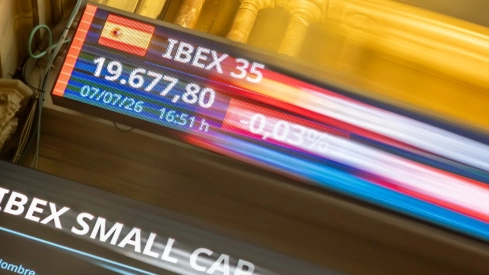
The world stock markets have experienced a week of strong turbulence, marked by investor fear that the development of artificial intelligence (AI) will lose momentum. Doubts about the profitability of enormous investments in this technology and the possibility of greater regulatory control in the United States have triggered a wave of sales that has especially hit technology companies and the semiconductor sector.
In this context, the Democratic victory in the US midterm elections has added uncertainty about future policies related to competition, data usage, and the construction of data centers, fundamental facilities for AI development.
Despite international turbulence, the Ibex 35 has managed to maintain a positive balance and accumulate a rise of 4.09% in the first four sessions of the week. This evolution contrasts with that of the main US indices: the Nasdaq Composite fell 4.45% and the Nasdaq 100 lost 6.21% until Thursday.
However, this Friday's session has once again highlighted market nervousness. The Ibex 35 recorded a midday decline of 1.32%, to 19,225 points, dragged down by strong losses on Wall Street and Asian stock markets.
PUNISHMENT OF TECH COMPANIES SHAKES WALL STREET
The trigger for the sales was the collapse recorded on Thursday in the United States. The Dow Jones closed with a 3.44% drop, while the Nasdaq plunged 5.52%. For its part, the Philadelphia Semiconductor Index, which groups 30 of the largest companies in the sector listed in the US, came to lose more than 10% during the session.
Among the most punished companies were Nvidia, whose shares fell by as much as 8.99%, ASML (-8.65%) and Broadcom (-9.3%). Intel lost more than 10% and Qualcomm exceeded a 13% drop, while AMD and Micron came to fall more than 17%.
The losses also extended to Asia, where the Japanese Nikkei fell 5.96% and the South Korean Kospi fell close to 6%, in line with Wall Street's downward trend.
WHY ARE MARKETS CONCERNED ABOUT THE FUTURE OF AI?
The fear of investors focuses on the possible consequences of greater Democratic control of the US legislative chambers on the development of artificial intelligence and, especially, on the construction of data centers, the facilities necessary to train and execute these models.
The XTB investment platform foresees a cautious reaction in the markets and points out that the sectors most exposed to this scenario are banking, oil, gas, technology platforms, data centers, and digital assets.
Specifically, a Democratic victory could drive new measures on competition, data usage, and the expansion of data centers, due to their high electricity and water consumption and the impact they can have on household bills.
This scenario could raise costs and delay projects for Microsoft, Amazon, Alphabet, and Meta, in addition to affecting Nvidia and other technology providers whose orders depend on these investments.
For Bankinter, the reaction of the semiconductor sector in the stock market is being "exaggerated," especially when compared to the performance of large technology companies linked to data centers, such as Microsoft, Amazon, Meta, and Alphabet, which show a more favorable behavior.
The entity maintains that a Democratic victory does not mean a paralysis of the development of artificial intelligence, although it can cause investors to be more demanding with valuations and the quality of company balance sheets.
Likewise, it warns that greater regulatory pressure can slow down the implementation of data centers and increase their costs, although it does not believe that demand will disappear. Therefore, it expects operators to maintain their projects, although "in a slower way and probably in some cases having to move the projects to other states."
For its part, XTB believes that factors such as corporate profits, regulation, employment, wages, competition, and margins may have more weight for the markets than the election result itself.
In the technological field, investors also remain attentive to the possible IPO of Anthropic, scheduled for the week of November 16, according to estimates collected by Bankinter.
The entity considers that this operation could serve as a reference to value the entire artificial intelligence sector, at a time when markets are readjusting their expectations about the growth of these companies.