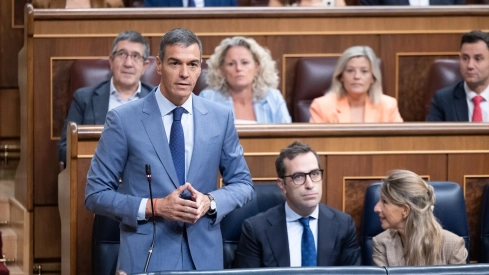
In politics, there are days that do not invite optimism. Wednesday's in the Congress of Deputies was one of them. The right-wing parties of PP, Vox, Junts, and UPN, along with the abstention of the PNV, Podemos, and three deputies from Sumar, ended up overturning the 'lobbies' law, a regulation that contemplated the creation of a mandatory state-level registry for interest groups.
The defeat served to update the scoreboard: eleven decree-laws overturned and a total of 39 lost votes on legislative initiatives during the legislature. A balance that once again highlights one of the Executive's main difficulties: getting its initiatives through a Congress where the investiture majority is increasingly fragmented.
Not even the government partners, nor other groups like the Jeltzales or the Purples, agreed with the Executive's proposal. The discrepancies, both in substance and form, were exposed once again, and the socialist bench is beginning to assume a scenario of greater loss of cohesion and, therefore, greater difficulty in advancing the legislative agenda.
In addition to the eleven decree-laws, so far this legislature the Government has seen two bills fall. The Plenary has also overturned eight PSOE bill proposals and seven from its parliamentary partners, while it has admitted for processing, despite socialist opposition, a dozen norms, almost all of them promoted by the PP.
Not everything, however, is reduced to a catalog of setbacks. Wednesday's Plenary itself also gave final green light to the reform of the dependency and disability laws, a norm that the Executive claims as the most significant change in the care of dependent people since the original law was approved two decades ago.
The contrast between both votes —one overturned, another passed with broad support— shows that the Government retains room to negotiate in certain areas, although it finds it increasingly difficult to do so in others.
"For one reason or another, we have assumed that it will not be a full-performance legislature," explains a PSOE deputy, who assures that this is an idea accepted among their ranks. "The situation is complicated," adds another colleague from the bench, pointing to the crisis in Ceuta as an element that could contribute to greater parliamentary gridlock.
The Executive maintains the capacity to remain in Moncloa, but the margin to convert its commitments into laws is increasingly narrow.
In some federations, such as in Euskadi, they are somewhat more optimistic despite the “bad atmosphere in Madrid.” Sources from the territorial organization believe there is a “drag” effect, but they defend that each autonomous body should follow its own roadmap. They want to avoid transferring the poor parliamentary result from Madrid to territorial management.
The PP capitalizes on its role as a legislative engine from the opposition
The Popular Party has turned these data into an argument in favor of its political narrative: despite not governing, it claims to have taken the initiative in the legislative processing of the Cortes Generales and to have displaced the Executive in setting the parliamentary agenda.
The dozen norms admitted for processing despite socialist opposition —most of them promoted by the popular party— fuels this discourse. In Génova, they present it as proof that the PP, and not Moncloa, is setting the legislative pace of the legislature.
The Budgets, the last big test of the year
The real test will come at the end of the year. The General State Budgets will be the last big test for a Government that accumulates parliamentary defeats and is beginning to assume that each new procedure will be more difficult than the previous one.
The approval of the accounts will require bringing together an increasingly complex parliamentary majority again. And here is the difference: it is not just another initiative. The Budgets are the main political instrument of an Executive and their processing allows measuring to what extent it retains the capacity to articulate a majority.
If the accounts do not pass this procedure, the pressure on Moncloa will increase significantly. The idea of an early election is increasingly present in the political debate and, should that scenario arrive, it would not mean bringing forward the times too much compared to the ordinary calendar.
Therefore, beyond each isolated defeat, the data that begins to matter is the accumulation. A Government can survive a lost vote, even several. What is more difficult to sustain is a dynamic in which each initiative becomes a maximum negotiation and each parliamentary partner uses their vote to mark distances.
The Budgets will, therefore, be the great test of endurance of this stage. If the Executive manages to save them, it will still have room to prolong the legislature. Otherwise, the early election could materialize at the beginning of the year.
Add ElConstitucional.es as a preferred Google source for free.
Stay informed about all the latest breaking news with the best information. Against disinformation, for democracy and social rights.