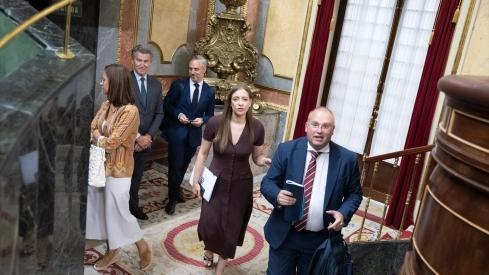
“Neither adults nor minors. All must return.” This is the position that Alberto Núñez Feijóo, leader of the Popular Party, set in recent hours, and which, according to sources from the party, they will defend next week in Congress during the appearances of seven ministers on the situation in Ceuta. The PP considers these appearances “especially relevant” to convey its position and demand the return of all migrants remaining in the autonomous city, including minors.
Feijóo's statements were made during his second visit to Ceuta, where thousands of migrants—among them, around 2,000 minors—remain in the city after the massive entry recorded at the end of July.
Feijóo, who hardened his discourse in Ceuta and thus set the PP's roadmap for the last political term before the elections, increasingly openly disputed the discourse on immigration with VOX. The popular leader made his own interpretation of the Immigration Law and added that “we have to take care of our minors. Morocco has to take care of its children.”
But what is true about this? Can minor children be returned to Morocco by the Spanish authorities? What does the law say?
From a legal point of view, and according to the public statements of Vicente Cabedo on 'Cadena SER', a tenured professor of Constitutional Law and director of the Chair of Childhood and Adolescence at the Universitat Politècnica de València, the Immigration Law offers specific guarantees to these people. There are ways for return to the country of origin, but not in any way.
The first is family reunification. Once the minor child or adolescent is identified—and the relevant tests are carried out to determine their age when necessary—Spain must ensure contact with their family of origin to guarantee a safe return. A process that is neither quick nor simple and can take weeks or months, according to professionals who deal with these situations on the ground.
In addition, the professor of Constitutional Law points out that another way for return involves “placing the minor at the disposal of protection services,” clarifying that the country of origin, Morocco in this case, must guarantee the conditions for that return to occur. Without the participation and guarantees of the neighboring country, it would not be possible to proceed.
Thus, the Organic Law on the Legal Protection of Minors offers a series of guarantees to these people who are already in national territory, regardless of how their arrival occurred. While Feijóo maintains that "the Law on the Protection of Minors is not designed for that (in allusion to the massive entry into Ceuta). It does not foresee cases of invasion or occupation by citizens of another country," the norm does not establish a specific exception for a situation like the one raised in Ceuta. The law is in force and the political debate raised by the popular leader involves modifying it or applying a different interpretation of its guarantees.
A precedent: 55 minors returned in 2021 ended in a conviction
There are judicial precedents that contradict the possibility of returning minors without respecting established procedures. In 2025, the Provincial Court of Cádiz, based in Ceuta, convicted for prevarication the former Government delegate in the autonomous city, Salvadora Mateos, and the former vice president of the Ceuta Government, Mabel Deu, for the repatriation of 55 minors to Morocco in August 2021. Both were sentenced to nine years of special disqualification from holding public office.
The sentence considered that they had acted outside the foreseen legal procedure and that the Immigration Law and the United Nations Convention on the Rights of the Child had been violated. The court concluded that the repatriations did not respect the guarantees required for minors.
During the trial, the existence of instructions from the Ministry of Interior was also raised. However, that issue was not judicially proven in the terms necessary to attribute criminal responsibility to the political officials indicated.
It is not the only precedent.
In 2017, a chamber of the European Court of Human Rights condemned Spain for the collective expulsion of two migrants who had been intercepted at the Melilla fence in 2014. Years later, in 2020, the Grand Chamber of the ECHR revoked that ruling and concluded that there had not been an illegal collective expulsion, considering the specific circumstances of the case and that the migrants had chosen to enter irregularly, making it difficult to use ordinary legal channels.
More recently, in July 2026, the Supreme Court has established that border rejection or “hot return” cannot be generally applied to migrants intercepted at sea when they try to reach Ceuta or Melilla by swimming. The Supreme Court points out that in these cases, the ordinary return procedure provided for in the Immigration Law must be applied.
ANALYSIS | The PP finds in immigration a ground to dispute the narrative with VOX
Laws, regulations, and sentences issued by different courts are established facts that allow information to be built.
From there, the political analysis begins: why does Feijóo insist on defending a return formula that clashes with the guarantees established in current legislation?
Fundamentally, there are two keys that can explain this drift of the popular party.
On the one hand, immigration has become one of the major issues with which the leader of the PP intends to set the roadmap for the last political course before the elections. And the appearances of seven ministers next week acquire, in this context, special importance for Génova. The PP intends to use the lower house to publicly defend its position: the return of all migrants, including minors, and to directly confront the Government's strategy.
It is also an electoral battle.
The popular party will dispute with VOX a political space in which immigration has gained weight in recent months. Santiago Abascal's party threatens to obtain a result that could hinder Feijóo's goal of governing alone. In this scenario, the hardening of the PP's discourse and its decision to bring to Congress a position that strains the limits of current legislation is understood.
But the dispute with the far-right is not the only reason.
In recent weeks, after the massive arrival of migrants in Ceuta, a social current has spread that shares the idea that exclusion is the solution. Génova has understood that joining this popular current allows not only to get closer to the existing sentiment in part of Ceuta's society and to the populist messages that have circulated on social networks, but also to confront Pedro Sánchez's Government.
The message that the PP intends to establish is simple and politically effective: with the Popular Party there will be no more “invasions” and those who enter Spain must be returned to their country of origin.
The issue is that, when that message reaches Congress next week, the debate will not be solely about a political position. It will also be about how far a government can go when the people it intends to return are minors and about what part of the legal guarantees the PP is willing to modify to fulfill its roadmap.