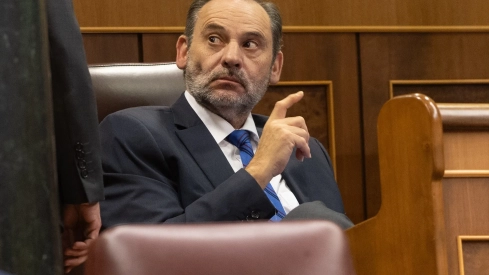
The former Minister of Transport José Luis Ábalos has filed an appeal for protection before the Constitutional Court (TC) after the Supreme Court ruling that sentenced him to 24 years and 3 months in prison for kickbacks in public mask contracts, and in his brief he requests the annulment of the ruling and the suspension of the sentence while the high court resolves.
According to the appeal, to which EFE has had access, the defense of José Luis Ábalos presents eight reasons to challenge the sentence and argues that the conviction was decisively based on the incriminating statement of the commissioner Víctor de Aldama, to whom a highly qualified mitigating circumstance and the suspension of prison sentences were applied.
The former minister's defense alleges, however, that there is no objective and independent data to corroborate Víctor de Aldama's version regarding the alleged payments, properties, trips, criminal organization, or influence peddling. At this point, the appeal insists that the commissioner's statement cannot by itself sustain the core of the proven facts.
Aldama's sentence and the defense's thesis
Víctor de Aldama, who confessed to paying kickbacks, will not go to prison after the Supreme Court suspended the 4 and a half year prison sentence imposed on him, on the condition that he does not commit another crime, submits a semi-annual activity report, and performs one year of community service.
For Ábalos's defense, this situation would reinforce the need to review the weight given to the commissioner's statement in a case in which, according to the appeal, the conviction rested on an insufficiently contrasted evidentiary basis.
Criticisms of the motivation of the sentence and the competence of the Supreme Court
The brief also denounces the lack of motivation in the individualization of the sentences, which total 24 years and 3 months in prison, and argues that, despite being ordered to set them in the lower half, the sentence applied the maximum disqualification for continuous bribery and the maximum prison sentence for influence peddling, taking as the sole criterion the condition of minister, something that, according to the defense, implies re-evaluating a circumstance already integrated into the criminal types.
The defense of the former minister, who has been in prison for almost a year, also argues that the Supreme Court was not competent to judge him, because he resigned his seat as a deputy before the trial date was set. The appeal recalls that the magistrates justified the continuation of the procedure in that body by an agreement of the Criminal Chamber of 2014, according to which jurisdiction in cases with privileged persons was established at the time the order for the opening of oral proceedings was issued.
The challenge criticizes that this interpretation has prevented him from appealing his conviction before higher instances. Regarding the sentencing court, José Luis Ábalos also alleges lack of impartiality and recalls that he challenged five of the seven magistrates.
Chain of custody and digital evidence, under suspicion
Regarding the evidence seized, the appeal for protection questions the chain of custody and focuses on digital evidence, considering that the defense did not receive the complete content of any electronic device, but only the selection made by the Central Operative Unit (UCO) of the Civil Guard.
Furthermore, the defense argues that the fragmentation of the procedure has caused him defenselessness, since testimonies and documents from investigated persons in separate pieces who did not testify at the oral hearing were evaluated in the trial.
Last October 14, the Supreme Court rejected the nullity incidents presented by José Luis Ábalos and by his former advisor Koldo García against the sentence that condemned them to 24 years and three months and 19 years and eight months in prison, respectively, which opened the door for both to appeal to the Constitutional Court.