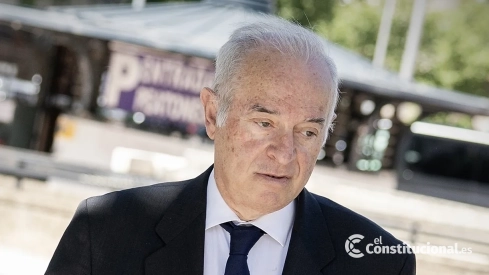
The controversial judge Juan Carlos Peinado has been cleared of disciplinary sanction for suggesting that the police officers in charge of protecting Begoña Gómez could help her escape. The acting Presidency of the High Court of Justice of Madrid (TSJM) has filed the summary information opened as a result of the complaint filed by the Unified Police Union (SUP).
The dismissal comes with an unusual reproach towards the way the 'Begoña Gómez case' instructor acted. The resolution itself acknowledges "the undeniable inaccuracy of the wording used" and considers that his words were "not very delicate" regarding the work of the agents of the State Security Forces and Corps.
Despite this pointing out, the TSJM understands that Peinado described a "hypothetical and diffuse" conduct and that his statements lack the necessary specificity and seriousness to apply the disciplinary regime. The court thus closes the file without endorsing the suspicion launched by the magistrate, who sowed doubts about the loyalty of the bodyguards without attributing a single concrete fact to them.
The TSJM censures Peinado's words and halts the file
The controversy arose from the order of June 20 in which Peinado agreed to open oral proceedings against Begoña Gómez, withdrew her passport, and prohibited her from leaving Spain. The defense had argued that the wife of the Prime Minister remained accompanied by police officers and that this protection reduced any alleged risk of flight.
The judge responded with a statement that caused deep discomfort within the Police. He maintained that those agents could, "either on their own initiative or following orders from their hierarchical superiors", collaborate to facilitate an escape that would leave Gómez beyond the reach of Justice.
The SUP brought the matter before the General Council of the Judiciary (CGPJ). In its brief, it denounced that Peinado had projected a general suspicion on the officials in charge of protecting authorities without identifying any agent, describing an irregular action, or providing evidence that questioned their professionalism.
The reaction spread to other police unions and the Ministry of Interior. Fernando Grande-Marlaska then conveyed a strong complaint against the controversial judge and described his words as a serious questioning of the officers. Jupol spoke of "an absolute outrage," while the Spanish Police Confederation criticized the discredit caused to officials subject to strict security protocols.
The Permanent Commission of the CGPJ ended up remitting the file to the TSJM to examine a possible disciplinary responsibility. The presidency of the court opened a summary inquiry on July 31 and requested explanations from the magistrate himself. Its resolution now concludes that the sanctioning scope must be interpreted strictly and that an ill-advised or reprehensible expression can only be punished when it is sufficiently precise and serious.
The Audiencia had already revoked Peinado's measures
Peinado maintained his suspicions after the first wave of criticism. In the report sent during the processing of the complaint, he argued that the existence of Internal Affairs units demonstrates that some police officers may fail to comply with their obligations. He also referred to the case of former Italian Prime Minister Bettino Craxi, who fled to Tunisia in 1994, to defend the possibility that a person under police protection could leave the country.
The comparison also did not provide evidence related to Begoña Gómez or her escort agents. The magistrate relied on a generic possibility to justify precautionary measures that the Provincial Court of Madrid ended up revoking weeks later.
The Audiencia returned Gómez's passport, lifted the prohibition to leave Spain, and eliminated her obligation to appear periodically before the court. It also subsequently dismissed two of the four crimes that Peinado intended to bring to trial. The procedure has been limited to accusations of influence peddling and embezzlement.
The Prosecutor's Office plans to request the acquittal of Begoña Gómez and her advisor at La Moncloa, Cristina Álvarez. The popular prosecution led by Hazte Oír, which initially demanded 24 years in prison, reduced its request to 13 after the intervention of the Provincial Court.
The TSJM's resolution admits an appeal before the Contentious-Administrative Chamber. The SUP preserves that avenue while Peinado faces his last weeks in the judicial career, with his retirement planned before the end of September.
