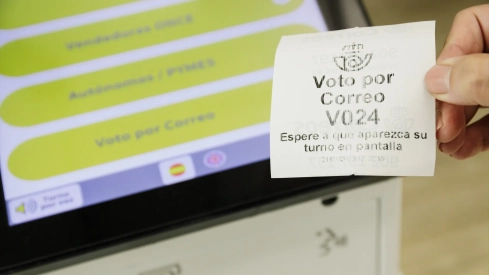
Since this Tuesday, October 6, it is now possible to request to vote by mail for the general elections on November 29. The period opened with the publication of the electoral call in the Official State Gazette and almost at the same time that the president of the Community of Madrid, Isabel Díaz Ayuso, asked that no one "think of voting by mail". The leader of the far-right Vox, Santiago Abascal, has also urged people to vote in person while sowing doubts about the cleanliness of the process. Neither of them has provided evidence of manipulation of the mail-in vote.
The discussion affects a form of voting used by 2,471,935 people in the 2023 general elections, according to votes admitted by Correos. This time, in addition, the PP itself has offered different messages. Its national spokesperson, Borja Sémper, has described the system as "guaranteeing" and has encouraged voting by mail as well, distancing himself from Ayuso's warning.
How to request it and when to submit the vote
Anyone who expects to be outside the locality where they are supposed to vote or who will not be able to attend their polling station can request it. There are two ways. The in-person method is carried out at any Correos office, proving identity with original DNI, passport, or driving license. The request can also be made on the Correos mail voting website with an electronic DNI or a valid digital certificate. The last day to request it is Thursday, November 19. The online process is for requesting the documentation; the vote will be delivered later at a post office.
The Electoral Census Office will check the request and send the ballots, envelopes, and census certificate to the address indicated by the voter, which may be different from their usual address. Correos indicates that this shipment will begin on November 9. The documentation is delivered after identification of its recipient. If an illness or disability prevents requesting the vote personally, the law allows another person to request it with a medical certificate and a notarial or consular authorization.
Once the ballots are received, the one chosen for Congress must be placed in its envelope and, if one also wishes to vote for the Senate, the corresponding ballot must be completed. The sealed voting envelopes are placed together with the census certificate inside the envelope addressed to the polling station. The latter is delivered to Correos as certified mail, without paying postage and proving identity. Leaving it in an ordinary mailbox does not complete the process. If the elector cannot go to the office, they can authorize another person with the documentation required by Correos.
The deadline for delivery is Wednesday, November 25, according to the Correos website and official note for 29N. Some guides published after the call indicate the 26th; to avoid the vote being out of time, it is advisable to pay attention to the date communicated by the operator in charge of collecting it.
There is a consequence that deserves to be decided before submitting the application. When the Electoral Census Office accepts it and registers the elector as a postal voter, they will no longer be able to vote in person on November 29, even if they ultimately do not deliver their envelope to Correos. Those who reside in Spain but are temporarily abroad must follow the specific procedure for voting from outside; the online application described here is not enabled for that case.
What happens to the envelope until the count
The vote goes through Correos, the Electoral Census Office, and the polling station, with controls at each phase. The census verifies that the person can vote and prevents them from appearing later as an in-person voter. Correos registers and safeguards certified mail. Since 2023, it is also required to identify who delivers the vote at the office; a resolution from the Central Electoral Board admits the MiDNI application to do so personally. The Director of Operations at Correos, Olga García, has explained that the envelopes travel with traceability and custody measures to the polling stations.
On election day, Correos will take the votes to their polling stations. At the end of in-person voting, the polling station will check each voter's certificate and place the ballot envelope into the ballot box without opening it. These ballots will be mixed with the others and counted in the same scrutiny, before the members of the polling station and the representatives of the candidacies. The electoral system is supervised by the electoral boards; the Central Electoral Board includes, among its members, eight Supreme Court magistrates chosen by lot.
