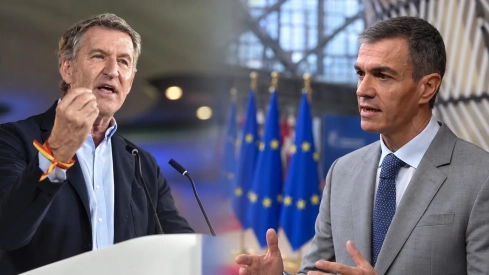
Pensions have become one of the major issues of the pre-campaign for November 29. Pedro Sánchez guarantees that the Government will approve the 2027 increase before the end of the year, even if it is in an acting capacity by then, and accuses the PP and Vox of hiding their intentions until after the elections. Alberto Núñez Feijóo responded by promising to maintain the update in line with the CPI and declaring pensions "non-negotiable", after his parliamentary spokesperson, Ester Muñoz, stated that the current model "is going to burst".
The exchange on Thursday included interventions from the president, the leader of the opposition, and several popular spokespersons, who came out to defend the continuity of the public system. The PSOE tries to place the protection of pensions at the center of the election, while the PP tries to reconcile its guarantees to the elderly with warnings about future sustainability. The far-right Vox keeps open the possibility of reforming it after its economic head proposed moving towards a model with a public and a private part.
The discussion directly affects more than 9.5 million people who receive contributory pensions from Social Security. In September, some 10.55 million benefits were paid out, because the same person can collect more than one, with a monthly payroll of 14,498 million euros. For these households, maintaining purchasing power determines how much money is available to cover purchases, utilities, or rent.
The 2027 increase, before the end of the year
Sánchez took advantage of his presence in Brussels to reassure pensioners and confirm his intention to approve the revaluation before the end of 2026. The First Vice President and Minister of Economy, Carlos Cuerpo, set December as the time when the measure could be adopted. In his interview on 'La hora de La 1', on TVE, he argued that the urgency of updating benefits would allow it to be done even with the Executive in an acting capacity, although he specified that this interpretation must be evaluated by the State's legal services.
The guarantee to update contributory pensions according to prices is already included in the law approved in 2021, in force since January 2022. The norm restored the link with inflation to protect the purchasing power of pensioners. The commitment now proposed by the Government consists of applying this obligation for 2027 despite the fact that the elections on November 29 may leave the formation of a new Executive pending.
The PSOE has taken advantage of Muñoz's words to accuse the popular party of preparing a "pension cut". Sánchez raised the tone this Thursday and maintained that PP and Vox want to hide their plans until after voting. The accusation of future cuts is part of the political confrontation, while Feijóo publicly assures that he will maintain the system and the CPI. The Minister of Inclusion, Social Security and Migrations, Elma Saiz, has demanded rigor and responsibility when addressing its financing.
El primer sacrificio de los que anunció Feijóo: hachazo a las pensiones. Como Vox.
— PSOE (@PSOE) October 14, 2026
No les dejaremos hacerlo.#LaFuerzaDeLaGente pic.twitter.com/8kzi7Deidy
The dispute also spread to social media due to Eduardo Inda's intervention on 'Horizonte', Iker Jiménez's program on Cuatro. The director of Okdiario asked the popular party "to shut up about pensions" until after the elections. Sánchez shared the fragment to reinforce his denunciation against the right. The commentator's recommendation fueled the controversy, although his words do not constitute an electoral proposal from the PP.
El plan del PP y Vox nos queda claro: mentir a los jubilados hasta el 29N y, después, recortar las pensiones. pic.twitter.com/e0Hg6x9ygp
— Pedro Sánchez (@sanchezcastejon) October 15, 2026
The PP tries to close the controversy
The immediate origin of the clash lies in Muñoz's statements on a podcast, where she defended changing the model because, she claimed, "it doesn't work" and "it's going to blow up". The spokesperson linked her diagnosis to the retirement of the baby boom generation and the low wages of those who contribute. This Thursday, from Almería, she referred to the report by the Independent Authority for Fiscal Responsibility, AIReF, and presented her words as part of a colloquial conversation about the system's problems.
Feijóo assured from Brussels that he will guarantee its viability and its update with the CPI if he reaches Moncloa. Muñoz also defended that link and maintained that the party's proposal involves improving productivity, wages, and Social Security revenues. Borja Sémper went further by stating that the PP will not negotiate with anyone the questioning of the public system and asked that this matter stop being used to "instill fear." The interventions did not specify changes in contributions, retirement age, or the calculation of benefits.
To respond to the Government, the popular party has brought back the freeze approved by José Luis Rodríguez Zapatero in 2010, which had Sánchez's vote as a deputy. The measure affected 2011 and excepted, among others, minimum and non-contributory pensions. The PP's record includes, for its part, Mariano Rajoy's 2013 reform, which delinked increases from the CPI and established a minimum of 0.25%. That mechanism allowed nominal increases that could fall below the cost of living.
To that discussion is added the position of Vox, a possible partner of the popular party if both gather a majority. Its economic spokesperson in this debate, José María Figaredo, has defended a mixed system with public and private components. This Thursday, Pepa Millán assured that pensions will be paid "at all costs", but avoided closing off reform options. The differences between that approach and the PP's guarantees are still awaiting an explanation of what measures they would accept in a potential government negotiation.
What the data says about its future
The system faces the retirement of large generations at a time of employment growth. Social Security exceeded 22.4 million average affiliates in September, with nearly 740,000 more than a year earlier. According to the Ministry of Inclusion, the ratio between contributors and pensioners reached 2.51, the highest level since 2011. Funding also depends on wages and contribution bases, in addition to State contributions.
The AIReF report to which Muñoz refers concludes that the pension expenditure rule is met, but warns that this compliance is insufficient to certify the sustainability of public accounts. The rule compares an average expenditure forecast until 2050, discounting the effect of revenue measures, with a legal threshold. The body considers that its design allows it to be considered fulfilled even if pressure on State finances increases.
In its projections, public spending on pensions goes from around 13% of GDP in 2025 to 16.4% in 2050, mainly due to population aging. This scenario requires foreseeing how to finance benefits and what resources the State will need. Employment growth strengthens current revenues, while demographic forecasts force planning for the coming decades. The report warns of this challenge without setting a collapse date for the system.
The January 2027 update is still awaiting a specific figure. The percentage will be calculated with the average of the year-on-year CPI rates from December 2025 to November 2026. Data is still missing to complete that period, so the commitments announced this week do not equate to an already approved increase nor allow its amount to be considered definitive.
