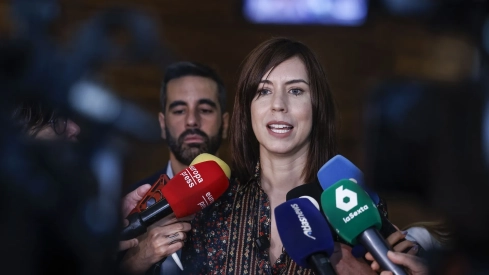
Diana Morant has caused one of the biggest political controversies this summer by comparing the path taken by Alberto Núñez Feijóo alongside the far-right Vox with the "criminal governments" of Adolf Hitler. The PP began by demanding a rectification and this Thursday has escalated its response to demanding the immediate resignation of the Minister of Science and leader of the PSPV-PSOE.
The response has also reached the socialist ranks. Patxi López has clearly distanced himself from Morant's words, while Sumar and Podemos have questioned the use of such an extreme historical reference. Izquierda Unida has been the only force in the progressive bloc that has openly supported the substance of her warning.
The phrase was uttered this Wednesday during an interview on 'Mañaneros 360' on TVE, coinciding with the approval in Les Corts of the Valencian Budgets agreed between PP and the far-right Vox. Morant was criticizing the so-called "national priority", the principle with which both formations intend to link access to certain aid and public services to the roots of each person.
"Alberto Núñez Feijóo is wrong, he is drawing a path that increasingly resembles those criminal governments like Hitler's," said the minister. Previously, she had recalled that the Nazi regime came to power through democratic channels before becoming a dictatorship. Morant linked this approach to speeches that differentiate between citizens according to their origin. She also alluded to the racist insults directed against Spanish national team footballers like Lamine Yamal, whom she defined as "as Spanish as Feijóo", and asked the PP leader for an express condemnation.
The reference to Hitler ended up prevailing over the rest of the interview.
The PP goes from demanding apologies to asking for her resignation
The first reaction came from the official account of the Popular Party. Génova accused Morant of crossing "an unacceptable line" and demanded that she rectify and apologize for statements that, in their opinion, fuel tension and offend democrats.
Quien compara a un adversario político con Hitler cruza una línea inaceptable.
— Partido Popular (@ppopular) July 22, 2026
Diana Morant debe rectificar y pedir perdón por unas declaraciones que solo alimentan la crispación y ofenden a cualquier demócrata. https://t.co/8yIU5g6MZ4
Borja Sémper demanded from the minister "some level" and "respect for intelligence", while Ester Muñoz interpreted her words as part of a strategy to dehumanize the main opposition party. The popular leadership has hardened its tone this Thursday and has turned the request for an apology into a formal demand for resignation.
Miguel Tellado has assured that Morant "is not enabled" to continue being part of the Council of Ministers and maintains that her words portray a leader and a PSOE in a "desperate" situation. The general secretary of the PP has extended the offense to the millions of citizens who vote for his party.
Isabel Díaz Ayuso has joined the pressure from Madrid. The regional president has called the comparison a "complete stupidity", considering that Morant is "disqualified and unable" to exercise political responsibilities and has stated that she should "go home".
From the far-right Vox, Pepa Millán has responded that "ignorance is very bold" and has accused the Executive of rewarding mediocrity. Santiago Abascal's party avoids entering into the content of the "national priority" and concentrates its reaction on discrediting the minister.
Patxi López distances himself and the PSOE admits the excess
The most uncomfortable response for Morant has come from her own party. Patxi López answered with a resounding "no" when journalists asked him if he shared the comparison and explained that such language is outside his way of understanding politics.
"It's not my style, I don't like it when politics is taken to extremes," said the socialist spokesperson in Congress. López avoided asking for his colleague's resignation or rectification, although he made it clear that the reference to Nazism is not part of the vocabulary with which the PSOE wants to confront the PP.
Within the party, the discomfort has been more evident in private. Socialist sources cited by RTVE consider that "there was no need" to make that comparison and even admit that Morant "lost her mind".
The Valencian leader has not received the support of most of the Government's parliamentary partners either. The spokesperson for Sumar, Verónica Martínez Barbero, has framed her statements among those affirmations designed to generate big headlines and noise instead of building political arguments.
Sumar understands the weariness caused by the strategy of PP and Vox, but refuses to respond with references of such gravity. "We have to stick to the argumentation," defended Martínez Barbero after asking that the confrontation remain around concrete policies.
Ione Belarra has raised a different criticism. The general secretary of Podemos asked Morant for "fewer high-sounding words and more anti-racist policies" and demanded that the PSOE act on immigrant detention centers, ethnic profiling, and the regularization of migrants.
Enrique Santiago has indeed supported the political core of the complaint. The parliamentary spokesperson for Izquierda Unida has maintained that some measures defended by PP and Vox resemble the first discriminatory norms approved in Nazi Germany, especially when they establish differences based on national origin or social status.
The "national priority" disappears behind Hitler
The comparison has shifted the focus from the issue Morant intended to denounce. The Valencian Budgets have incorporated for the first time into a law the concept of 'national priority', also included in the agreements reached by PP and the far-right Vox to govern together in several communities.
Feijóo has defended this policy as a way of taking into account roots when granting public aid. "That all the criticism of the agreements with Vox is to order access to aid according to roots leaves me very calm," said the popular leader during his end-of-year assessment.
Tellado has assured that there are no fissures between both parties on this issue. The PP itself recognizes, however, that it will have to review how the criterion affects military personnel and other Spanish citizens forced to frequently change residence for professional reasons.
Its detractors warn that roots can end up establishing different categories among people who meet the same economic or social requirements. The concern especially affects migrants with legal residence and families who have been registered in a community for less time.
The controversy coincides with Feijóo's growing rapprochement with Santiago Abascal. The president of the PP has defined his relationship with the far-right leader as "correct, fluid, and courteous" and has left open the possibility of forming a coalition government if the result of future general elections forces him to depend on Vox.
The use of Hitler is also not new in recent Spanish politics. During Pedro Sánchez's investiture in 2023, Abascal compared the socialist candidate to some of the "worst tyrants and criminals in history" and recalled that the Nazi dictator also came to power through elections. At the time, Patxi López described those words as an offense to intelligence and asked for them to be withdrawn.
That precedent reflects the extent to which references to Nazism have been incorporated into the confrontation between parties. On this occasion, the words come from a government minister and the highest representative of Valencian socialism, which has multiplied their institutional reach. Until Thursday afternoon, Morant has not publicly retracted. The PP maintains its request for resignation, and the PSOE limits its response to the disassociation expressed by Patxi López and other members of the progressive bloc.
Add ElConstitucional.es as a preferred Google source for free.
Stay informed about all the latest breaking news with the best information. Against disinformation, for democracy and social rights.
