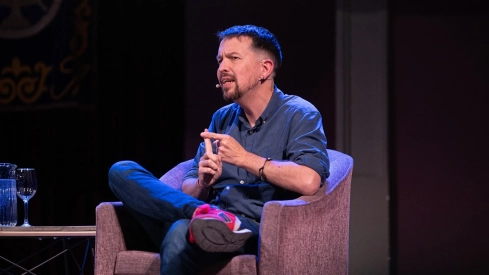
Pablo Iglesias has questioned this Tuesday the transfer of Toni Valero to the Broad Front candidacy for Madrid and has interpreted it as a sign of Izquierda Unida's distrust in its electoral possibilities in Andalusia. The former Vice President of the Government has linked the decision to the failure of agreements with Podemos and to the risk that the division will leave part of the left-wing electorate without representation on November 29.
"If Izquierda Unida presents its leader in Andalusia as number 3 on the list for Madrid to Congress, instead of presenting him for Malaga or Seville as 1, it is because they do not trust in obtaining any deputy for Andalusia," he wrote on X. The statement expresses Iglesias' interpretation of IU's move, which has defended Valero's incorporation into Madrid due to his role as an electoral reference and the "federal dimension" of the organization.
The decision completes the reorganization of the list headed by Emilio Delgado and Tesh Sidi, both from Más Madrid. Valero will occupy the third position and Verónica Martínez Barbero, from Movimiento Sumar, the fourth, after Mónica García has ruled out running for Congress to focus on her regional candidacy for 2027. That step does not imply her departure from the Ministry of Health.
Valero, coordinator of IU Andalusia since 2019 and elected deputy for Malaga in 2023, won his party's primaries with 77.4% of the support. IU maintains that his presence in Madrid reinforces his participation in Frente Amplio and has announced that other candidates will occupy prominent positions on the lists for Congress and the Senate in different territories.
🙋🏽♂️Entiendo que haya gente de los partidos del FA y Sumar que no me traguen, pero creo que en esto que explico aquí, a propósito de que el líder de IU Andalucía vaya en las listas al Congreso por Madrid y no por Andalucía, no hay ni una mentira.
— Pablo Iglesias 🔻{R} (@PabloIglesias) October 20, 2026
➡️ Si Izquierda Unida presenta a… https://t.co/CfgT6BYmsw
The failed pact and the union with the PSOE in the Senate
Iglesias explained that he expected an agreement between IU and Podemos in Andalusia "following the Valencian or Canarian model", and that this formula would extend to Euskadi, Galicia, Asturias, and Murcia. "It was the only way to get deputies and contain the advance of the right," he maintained. Finally, the unity between both spaces for the Congress has been limited to the coalitions announced in the Valencian Community and the Canary Islands.
The former general secretary of Podemos accused those responsible for Frente Amplio of having chosen another priority. "They preferred to try to kill Podemos, sacrificing the options to stop the right," he wrote, linking that decision with the shared candidacies with the PSOE for the Senate. He also defended that the incorporation of Gabriel Rufián into the campaign alongside Podemos could help mobilize support in other territories.
In his message, Iglesias attributes to the Senate pact the purpose of providing "the financial stability they need due to their debts", without accompanying that accusation with documentation that proves such motivation. He adds that an agreement between PP and Vox could frustrate the expectations of those candidacies. Contacts between the two right-wing parties were confirmed this Tuesday by Feijóo, although their result is still pending.
The rupture occurred between two different negotiation strategies. Frente Amplio demanded a global alliance, while Podemos defended territorial agreements and maintained its own bid in Madrid and its cooperation with ERC in Catalonia. Iglesias argues that competing separately in those two communities had "very few effects" on the final result. Their greater number of seats facilitates the representation of several lists, although the separation can also alter the last deputies in dispute.
Three ballots and six seats at stake in Andalusia
Andalusia faces the general elections with Frente Amplio Por Andalucía, Podemos and Adelante Andalucía separately. The first candidacy brings together IU, Movimiento Sumar, Iniciativa del Pueblo Andaluz and Verdes Equo. In 2023, Sumar, which then included Podemos, obtained six deputies in the community, two for Seville and one for Malaga, Cadiz, Cordoba and Granada. It was left out in Almeria, Huelva and Jaen. Of those six seats, three corresponded to IU, including those of Valero for Malaga and Enrique Santiago for Cordoba.
The provincial distribution explains a good part of the concern. Seville elects twelve deputies and Malaga eleven, the Andalusian constituencies with the most available seats; Cadiz will distribute eight, one less than in 2023, while Granada maintains seven, Cordoba and Almeria six, and Huelva and Jaen five. The options for each candidacy will depend on how much support it manages to retain or mobilize in each province. The division can leave several lists below the necessary level to enter, even exceeding the legal barrier of 3%.
Seville allows illustrating this risk with an exercise on the 2023 results. Sumar obtained 148,745 votes and two deputies. If that support had been divided equally among three hypothetical candidacies, keeping the votes of the other forces intact, none of the three would have obtained representation and those two seats would have gone, one to the PP and one to Vox. It is a calculation based on that election, with a deliberately uniform distribution, which shows how representation can be lost without the overall support decreasing.
The current scenario also incorporates the own strength that Adelante Andalucía showed in the regional elections in May, when it obtained eight parliamentarians compared to the five of Por Andalucía, a coalition that included IU, Podemos, and Sumar. These results provide a reference on its mobilization capacity, but they correspond to another election and a different distribution. The Andalusian Parliament has 109 seats; the eight provinces will elect sixty deputies to Congress on 29N.
