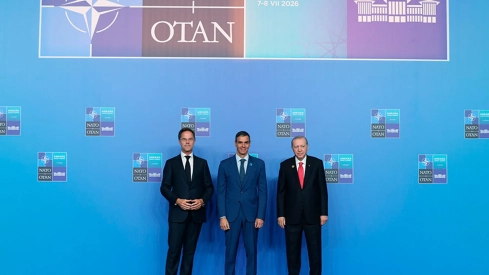
Pedro Sánchez did not travel to Ankara for a comfortable summit. He arrived with Donald Trump pushing for 5% of GDP in military spending, with the Iran war reopened by Washington and with Spain singled out for not bending to the US president's script. He left with 2.1% intact, a new mission in Finland and Brussels reminding that commercial threats against a single Member State have little traction within the European Union.
The NATO summit provides a useful photo opportunity for Moncloa. Spain has not accepted the jump to 5%, but it has not been left out of the allied photo either. Sánchez has argued that the country complies through capabilities, deployments, support for Ukraine and real investment in defense. The final declaration from Ankara once again includes the commitment to collective defense and to Ukraine, although the Spanish government has placed the emphasis where it wanted to for months: less naked percentage and more concrete contribution.
Sánchez summarized it with an idea that Moncloa wants to establish as the framework for the week. Spain arrived at the summit with "homework done". The president defended that defense spending has increased from 0.9% of GDP in 2018 to 2.1% in 2026, that Spain is among the allies with the highest degree of compliance with objectives and that it maintains nearly 3,000 troops in Alliance missions and operations.
The 2.1% ceases to be just a figure
The great political battle in Ankara has not only been budgetary. It has been about narrative. Trump wanted to make 5% the sole proof of loyalty. Sánchez has tried to shift the focus to the capabilities that each country makes available to NATO.
This is where the announcement that Spain will join the mission of Advanced Land Forces in Finland fits in, aimed at strengthening surveillance and deterrence in the Arctic and the High North. The specific participation will be defined in September, but the message has already been sent. A country from Southern Europe joins a mission in the North to demonstrate that its commitment is not limited to the Mediterranean flank.
The Government has also asserted Spain's role in naval, air, and land operations, as well as the training of Ukrainian military personnel and support for the eastern flank. In the Ankara room, according to Sánchez, several leaders thanked Spain's contribution. The Turkish Recep Tayyip Erdogan did so for the Patriot battery deployed in his territory.
The Spanish position has a technical part and a political one. The technical part involves meeting the objectives assigned by the Alliance. The political part consists of defending that rearmament cannot empty the welfare state or subject European security to Washington's industrial agenda.
Trump shouts, Brussels sets the limit
Trump again harshly attacked Spain. He called it a “lost cause,” a “terrible ally,” and called for cutting trade, including visits. He did so because of military spending and also because of Spain's lack of support for his new offensive against Iran, including the refusal to facilitate certain operations from bases in Spanish territory.
Moncloa chose not to get into the mud. Sánchez said he spoke with Trump about football and the World Cup, without tension and with cordiality, and that they face the words of the American leader with "calm and patience". Furthermore, he stressed that despite Trump, Spain maintains an excellent relationship with the United States and called for calm among companies, investors, and citizens. The anecdote may seem minor, but it explains the Government's strategy. Not to fuel the quarrel, not to personalize the clash, and to let European institutions respond where they should respond.
Brussels did so. The European Commission recalled that trade policy is negotiated from the EU, not country by country, and asked Washington to respect the commitments of the transatlantic trade pact. It also made it clear that it would protect the interests of all Member States.
Furthermore, it is important to note that the United States maintains a trade surplus with Spain and a good part of the economic ties are sustained by private companies, investments, and chains that are not broken by a phrase from Ankara.
Mark Rutte also helped cool the blow. The NATO Secretary General spoke of a summit of unity, praised Trump's leadership in pushing European spending, but acknowledged that Spain has taken “a big step” by exceeding 2%. His role was the same as always since he arrived at the Alliance: to publicly support Trump enough to keep him in, without completely breaking internal balances.
Iran marks the uncomfortable background of the summit
The tension with Spain cannot be understood without Iran. Trump arrived in Ankara declaring the understanding with Tehran over and defending new US attacks. He also reproached several allies for their lack of military support. Spain appears in this clash due to its resistance to getting involved in an escalation that the Government considers alien to European security interests.
Sánchez has tried to occupy a difficult space. He maintains his leadership in the "no" to the Middle East war. The Government continues to be a bulwark against an increasingly unpredictable US foreign policy.
It is not a position without cost. Trump uses it to attack Spain and the right translates it into a loss of international weight. But it also has a clear political return for Sánchez. It reinforces his European profile, allows him to speak of strategic autonomy, and connects with a part of the electorate that rejects an arms race dictated from Washington.
The PP has tried to move carefully. Juan Bravo criticized Trump's "grandiloquent phrases" and defended that, between Spain and the US president, the Spanish people come first. Rafael Hernando called it "unacceptable" to attack a country for not doing what Trump demands. But the PP did not let go of Sánchez. Génova's reading continues to be that the Government has weakened Spain's international presence.
The far-right Vox was in a more uncomfortable position. Santiago Abascal attributed Trump's threats to the Government's lack of credibility and avoided a frontal condemnation of the US president. Spanish Trumpism once again has the same old problem when Trump attacks Spain: turning the external attack into internal ammunition and not inconveniencing its great ultra master.
Ukraine, industry, and a more European NATO
The Ankara summit did not close only with Trump's noise. NATO reaffirmed its commitment to Article 5, pointed to Russia as a long-term threat, and agreed to maintain military support for Ukraine with 70 billion euros in equipment, assistance, and training this year and a similar level for 2027.
There was also an industrial message. The allies announced more than 50 billion dollars in new acquisitions and focused on air defense, drones, long-range precision, intelligence, and common production. Rutte sold it as a stronger NATO and a Europe with more responsibility within the Alliance.
For Spain, that part matters as much as the clash with Trump. The Government wants to be in the distribution of capabilities, industry, and technology without accepting that the debate be reduced to an auction of percentages. That is why Sánchez insists on a NATO that is “stronger, more effective, and more European”.
The morning after Ankara leaves Moncloa with an idea that can be politically worked on: Spain has resisted Trump's hardest attack, has added military presence in the north, has maintained its budgetary limit, and has found in Brussels a legal and political shield against the commercial threat.
The PP once again takes the treaty with France to the Senate
Sánchez's foreign agenda will have another test this Thursday in Madrid. The Senate will vote on the request to the Constitutional Court promoted by the PP against the Treaty of Friendship and Cooperation between Spain and France, signed by Sánchez and Emmanuel Macron in Barcelona in January 2023.
The text was already approved by Congress in June and France ratified it in March 2025. The PP, with an absolute majority in the Upper House, questions the clause that provides for the rotating participation of ministers from one country in meetings of the other. The Government and Paris clarified through interpretative letters that this presence would be on the sidelines of the Council of Ministers, in separate meetings and without being part of the executive meeting.
Foreign Affairs accuses the PP of blocking a strategic agreement with Spain's main neighbor and one of its major economic partners. The calendar adds pressure. Sánchez will travel to Paris on July 14 as a guest to the events of the French National Day. If the Senate approves the request, the treaty will once again be frozen before the president sets foot in the Élysée.
