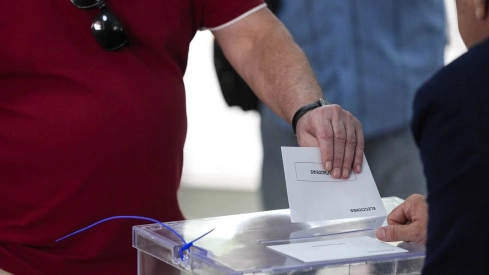
The PSOE includes in its electoral program the reduction of the voting age to 16 and the creation of a citizen seat without voting rights, a combination of reforms that, if successful, would require profound changes in the Constitution and the Organic Law of the General Electoral Regime (LOREG).
The socialist proposal, reported by Europa Press, also adds the partial suppression of privileges, a review of the functioning of the Senate, and the extension of the use of co-official languages in the Cortes and in the General State Administration in the territories where they are official.
The reduction of youth voting returns to the program, but remains tied to the Constitution
The most sensitive measure is suffrage from the age of 16. The change could not be applied without modifying the LOREG, which recognizes the right to vote for adult Spaniards, set at 18 years by Article 12 of the Constitution. It is not an unprecedented idea in Congress. In 2024, the Youth Commission approved an initiative by Sumar, agreed with the PSOE, to urge the Government to study within a year a reform of the LOREG that would allow voting from the age of 16, although the reduction was not approved.
In parallel, the socialists want to create the figure of the Defender of Future Generations, linked to the Youth Council of Spain, with the aim of introducing a long-term vision and intergenerational justice in public decisions.
Another of the program's commitments is a citizen seat in both chambers that would not have a vote, but would allow civil society to ask questions to the Government and present initiatives and amendments. The design seeks to open an institutional channel for participation, although its scope would be conditioned by the current parliamentary architecture.
Territorial Senate and more use of co-official languages
Today, citizens can already promote bills through a popular legislative initiative, but only on certain matters and with 500,000 signatures. The PSOE wants to reduce that number of endorsements, although it does not specify how much; to do so, it would be necessary to reform Article 87.3 of the Constitution. The party also proposes to suppress the privileges of public officials for crimes unrelated to the exercise of their functions. This limitation would require touching Articles 71.3 and 102.1 of the Constitution, a reform that was already promoted by Pedro Sánchez's Executive in 2018, without its processing being completed.
The institutional bloc is completed with a reform of the Senate to turn it into an "authentic Chamber of territorial representation", making its constituencies coincide with the autonomous scope. The change would require modifying article 69 of the Constitution, which today maintains the provincial and insular logic in the composition of the Upper House.
The program also advocates consolidating the use of co-official languages in the Cortes and extending it to the attention of the General State Administration in the territories where these languages are official, a measure that would broaden the scope of a practice already present in parliamentary activity.
Contact
We are listening. Get in touch.
