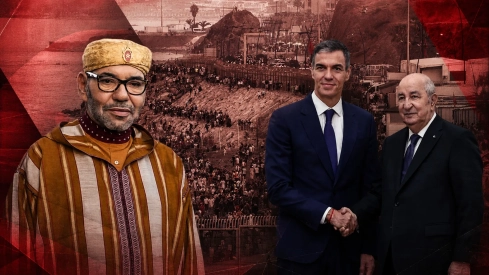
An entry of more than 50,000 people into Ceuta in just over a day requires thousands of young people willing to leave, a message capable of mobilizing them, and a huge failure in the controls located on the other side of the border. The first two elements are accredited. The third keeps open a question that the Spanish Government has preferred to avoid until now.
The Ministry of Interior has counted more than 50,000 arrivals since Thursday morning. By six in the afternoon this Friday, around 48,300 people had returned to Morocco and the Spanish authorities had recovered 57 bodies. Some victims drowned and others were trapped in the breakwater area while thousands of people tried to reach the autonomous city.
The Executive attributes the avalanche to networks dedicated to human trafficking. According to the explanation provided by Pedro Sánchez, these organizations disseminated a self-serving interpretation of the recent Supreme Court ruling on swimming entries into Ceuta and Melilla. Moncloa maintains that this information spread through social media and caused the concentration of tens of thousands of people in the vicinity of Castillejos.
The version describes a real trigger. Videos of people who had managed to enter, messages about a supposed impossibility of being returned, and favorable sea conditions fueled the exodus. Young people interviewed in Ceuta have admitted that they decided to try after seeing these publications. Social unrest was also present. A quarter of Moroccans between 15 and 24 years old are out of employment, education, and training.
The explanation of the mafias clarifies why thousands of people wanted to leave at the same time. It remains to be explained how they managed to approach the border in such numbers without the Moroccan security forces being able to contain them during the first hours.
The ruling explains the timing, but not the full magnitude
The Supreme Court ruling has been used as an appeal, although its content is far from the promise spread on social media. The resolution establishes that people who access Ceuta or Melilla by sea cannot be subjected to the immediate rejection provided for those who cross border fences.
That does not prevent their return to Morocco. It requires each case to be processed through the ordinary procedure, with legal assistance, an interpreter, and an individual assessment of the affected person's circumstances. The General Council of the Judiciary itself explained on July 8 that the decision is limited to the so-called "hot" returns by sea.
Criminal networks turned that legal difference into a much simpler message. Reaching Ceuta by swimming was equivalent, according to rumors, to staying in Spain. The possibility of a subsequent return disappeared from the narrative that circulated among young people.
The problem is that a social media campaign does not by itself deactivate a State's controls. Morocco has police forces, beach surveillance, the capacity to close access to Castillejos, and extensive experience dismantling concentrations before they reach the Tarajal breakwater.
For several hours, thousands of people were able to advance towards the border without encountering the usual deployment. Rabat later reinforced the area, used riot police, tear gas and water cannons, cut off approaches, and began to accept the return of those who had entered Ceuta. The subsequent closure has allowed for the recovery of bilateral cooperation, but it has also left an image difficult to ignore. When Morocco deployed all its means, the mass exodus stopped.
Moroccan MP Lahcen Haddad has rejected any political intervention and has also pointed to disinformation about the ruling. Pedro Sánchez's government has publicly thanked Rabat for its collaboration in repatriations, and the Ministry of Foreign Affairs maintains that relations are "excellent."
That subsequent cooperation makes it more difficult to argue that there is a complete rupture between both governments. Nor does it resolve what happened during the beginning of the crisis. The lack of surveillance could have been due to a too rapid concentration, operational errors, or a temporary relaxation of controls. The possibility of a deliberate decision currently lacks public evidence.
The 2021 precedent weighs on Rabat
The current suspicions have a too recent precedent. In May 2021, around 8,000 people entered Ceuta over two days after Moroccan authorities lowered border surveillance. Among them were numerous minors.
The crisis erupted weeks after Spain authorized the hospital admission of Brahim Ghali, secretary general of the Polisario Front, for medical treatment. Morocco considered the decision an affront for affecting the main leader of the organization that defends the independence of Western Sahara.
Rabat publicly linked the deterioration of relations to the Ghali case and raised its demands on Spain's position regarding the Sahara. The European response was then much more explicit than the one offered now. The European Parliament rejected the use of border control and child migrants as an instrument of political pressure against Spain.
The European Union Agency for Fundamental Rights has included that episode among the cases of instrumentalization of migration. The concept describes the use or facilitation of movements of people to impose a political cost on another State and condition its decisions.
Journalist Ignacio Cembrero has defined this way of acting as the "tantrum strategy". Morocco maintains cooperation as long as the relationship progresses according to its interests and recalls the extent of its border power when a significant disagreement arises.
Images of an overwhelmed border immediately wear down the Spanish Government. They convey loss of control, saturate the services of a city of about 85,000 inhabitants, awaken fear and fuel xenophobic discourses that present each arrival as a collective threat.
Rabat knows this effect. The pressure is effective precisely because migration divides the society that receives it and forces its Government to react under enormous public exposure. The precedent of 2021 does not prove that the same order has been repeated now, but it prevents treating the suspicion as an unfounded occurrence.
Algeria and the Sahara return to the center
The chosen moment has reinforced doubts. Pedro Sánchez traveled to Algiers on July 20, ten days before the outbreak of the crisis, to stage a new phase in relations between Spain and Algeria alongside Abdelmadjid Tebboune. Both governments agreed to hold a high-level meeting in October and deepen their political, economic, and energy cooperation.
Algeria is Morocco's great regional rival. The two countries broke off diplomatic relations in 2021 and have kept their land border closed since 1994. Western Sahara is at the center of their confrontation. Rabat claims sovereignty over the territory, while Algiers supports the Polisario Front and defends the right to self-determination of the Sahrawi population.
Spain aligned itself in 2022 with the Moroccan autonomy plan for the Sahara. The decision caused a serious crisis with Algeria, which suspended the Treaty of Friendship and blocked a large part of commercial relations. Madrid maintains that support for Rabat's proposal, but is now trying to recover its ties with Algiers and strengthen energy supply.
This move returns Algeria to a prominent place in Spanish policy in the Maghreb. It also reduces the privileged position that Morocco had achieved after the 2022 shift. Haizam Amirah-Fernández, director of the Center for Contemporary Arab Studies, explained that Sánchez's trip has not been well received in Rabat and that one way to manage this discomfort could be to send a not-so-subtle message to Madrid.
Added to the visit is the parliamentary processing of a proposal to facilitate Spanish nationality for Sahrawis born when the territory was under Spanish administration. The Justice Commission addressed its opinion on July 23, and had the support of the political parties of the Government of Spain. For Morocco, any gesture that grants its own political personality to the Sahrawi population affects a matter it considers essential.
The Moroccan claim over Ceuta and Melilla has also reappeared during the crisis. The media outlet 'Le360', close to the Moroccan power circles, has published an article in which it describes the two cities as "occupied" and presents their incorporation into Morocco as an inevitable outcome. The publication does not constitute an official statement, although it shows that the territorial claim remains alive within the discourse of the Makhzen.
Morocco also arrives at this crisis with a stronger international position. In December 2020, Donald Trump recognized Moroccan sovereignty over Western Sahara through a presidential proclamation. Rabat simultaneously normalized its relations with Israel and a year later signed a military cooperation agreement covering intelligence, weaponry, and joint training. Military rapprochement has continued, and both countries have agreed on a joint work plan for 2026. Morocco has thus become one of Washington and Tel Aviv's most valuable security partners in North Africa.
Spain's relations with the United States and Israel, meanwhile, are going through a period of tension. Trump even threatened on July 8 to cut trade with Spain over differences on defense and Iran, while the Spanish government maintains an open confrontation with Benjamin Netanyahu over Israeli operations in Palestine and the Middle East.
To link these tensions with a US or Israeli intervention in Ceuta would go much further than the known facts allow. There is no evidence that Washington or Tel Aviv promoted, coordinated, or supported the influx. Their alliances help to understand the confidence with which Rabat moves on the international stage and the reduced risk of being isolated when it pressures Madrid.
A border that Spain has left in the hands of Morocco
Rabat's capacity largely stems from the border model built by Spain and the European Union. For years, Brussels has shifted a decisive part of its migration policy to North Africa. Morocco receives funding, equipment, and cooperation in exchange for intercepting departures before they reach European territory.
Between 2015 and 2021, the European Emergency Trust Fund for Africa committed 234 million euros to migration programs for Morocco. The actions included border management, combating trafficking networks, returns, and migrant protection. The Council of the European Union itself recognizes that the reduction in arrivals via the Western route since 2019 is largely due to increased Moroccan efforts and close cooperation between Rabat, Madrid, and Brussels.
Spain controls the fence, the beaches of Ceuta, and the procedures applied to those who manage to enter. Morocco controls the roads leading there, the concentrations in Castillejos, and a good part of the coast from which the crossings begin.
The effective border therefore begins several kilometers inside Moroccan territory. This externalization has reduced arrivals during periods of cooperation but has given Rabat a lever very difficult to replace. Each crisis reminds Madrid that prevention depends on the decisions adopted by the security forces of the neighboring country.
Social causes, the Supreme Court ruling, and the actions of networks explain much of what happened. They could also have offered Morocco an opportunity to let the situation run for a few hours and remember the price of its collaboration.
The government has chosen to protect the relationship with Rabat while accelerating returns and trying to regain control of Ceuta. Morocco has again closed the passage and accepts the return of tens of thousands of its citizens. The political investigation begins precisely where the immediate emergency ends: who let the Moroccan device fail, for how long, and why.
Add ElConstitucional.es as a preferred Google source for free.
Stay informed about all the latest breaking news with the best information. Against disinformation, for democracy and social rights.
