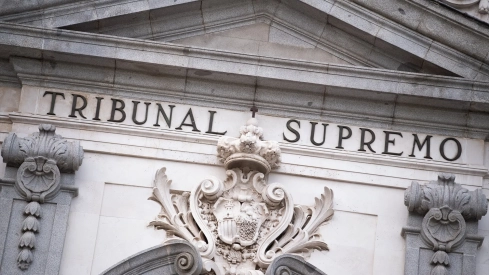
The Government has appealed this Monday the decision of the Supreme Court that prevents, as a precautionary measure, part of the naturalized Spaniards from voting through the so-called 'grandchildren's law'. The State Attorney's Office argues that the magistrates have overstepped by questioning an instruction from the Ministry of Justice that has been in force since 2022 and warns that the growth of the foreign census does not justify excluding these citizens from the polls.
The measure affects the descendants of Spaniards who left the country during the Civil War and the dictatorship and obtained nationality thanks to a presumption of exile. To be able to vote while the dispute is resolved, the Supreme Court requires them to documentarily prove that their parents or grandparents were persecuted or went into exile. Their Spanish nationality has not been annulled.
The origin of the dispute lies in the instruction approved by Justice in October 2022. The text presumes the status of exiles for Spaniards who left the country between July 18, 1936, and December 31, 1955, provided that their departure is accredited. The far-right Vox and Iustitia Europa went to the Supreme Court against an agreement of the Central Electoral Board, which had declared itself incompetent to review that instruction.
The Government accuses the court of going beyond the appeal
There the Attorney's Office places one of its main objections. According to the appeal filed this Monday, the Supreme Court has begun to assess the legality of an instruction that was not challenged in this procedure. The State's legal services add that the precautionary measure, in practice, anticipates part of what the appellants intended to achieve before a judgment is issued.
The Government also maintains that the lawsuit against the decision of the Electoral Board does not allow for a collective review of nationalities already granted. In its opinion, the Supreme Court's rulings go beyond what is necessary to resolve an electoral controversy and restrict the vote of people who remain Spanish for all purposes.
The magistrates justified their decision due to a "founded, real and serious danger" to the objectivity of the elections. In their rulings, they took into account that the census of Spaniards residing abroad had grown by 408,262 voters from the 2023 general elections to July 2026. The State Attorney's Office replies that this figure includes all registrations recorded in that period and does not equate to the number of people naturalized through the presumption of exile discussed in the case. That was the electoral risk alleged by the court.
The figures disputed by the State Attorney's Office
The appeal estimates that 168,896 people obtained nationality through this route. Based on historical participation in overseas voting, it calculates that about 14,120 could go to the polls, around 0.06% of the votes cast in a general election. This is an estimate by the State Attorney's Office, based on participation in previous elections.
The State's legal services reject that these figures can deduce a favorable vote for any party. "No one can predict the direction of the vote of the people incorporated into the census," states the document, which considers it disproportionate to limit a fundamental right due to an electoral risk that, in its opinion, has not been proven.
The motion for reconsideration must be resolved by the same Supreme Court chamber that agreed to the precautionary measure. Until there is a new decision, the affected descendants will need to prove the exile of their ancestors to be able to vote, while the court continues to examine the merits of the dispute.
Add ElConstitucional.es as a preferred Google source for free.
Stay informed about all the latest breaking news with the best information. Against disinformation, for democracy and social rights.
