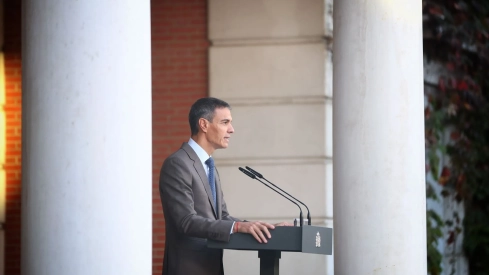
The Government faces this Tuesday a new attempt to recover the housing measures that PP, Vox and Junts overturned last Friday. The Council of Ministers plans to approve two royal decree-laws with technical modifications, maintaining the main protections agreed between PSOE and Sumar. After the early election on November 29, its validation will correspond to the Permanent Deputation of Congress, where Junts ceases to be essential and the Basque Nationalist Party (PNV) takes the decisive vote.
Housing thus concentrates the first major decision of the Executive after the call. Pedro Sánchez on Monday asked for a broader progressive majority to respond to the crisis and conveyed a message of electoral mobilization to his ministers. "We are going out to win and we are going to win!", he told them in the extraordinary Council that approved the dissolution of the Cortes, as reported by 'El País'. Today's ordinary meeting must specify which measures will come back into force and with what wording.
Sánchez goes out to win on 29N
The President of the Government decided to go to the polls after the parliamentary defeat of the decrees and a weekend of demonstrations for access to housing. In his Monday appearance, he defended the advances of the legislature and acknowledged errors, but demanded more support to continue with a progressive Government against the "far-right wave". The call comes with PP and the far-right Vox ahead in the polls and with the space to the left of the PSOE still pending to organize its candidacy.
Within the extraordinary Council, Sánchez raised the tone regarding his public statement. According to information from 'El País', the ministers intervened to express their willingness to fight the electoral battle, with special enthusiasm from Óscar Puente and Diana Morant. Yolanda Díaz and the Sumar ministers also participated in that political start, although the problem of the fragmentation of their space remains open.
The PSOE activated its Electoral Committee on Monday, with Rebeca Torró at the head of general coordination, María Jesús Montero of strategy and Cristina Narbona of the program. The Federal Executive set October 17 to ratify the lists. Sánchez insisted to the socialist leadership that the priority will be to mobilize the progressive electorate to revalidate the Government.
Sumar faces a different task, as it must close both its alliance and its leadership. Movimiento Sumar, Izquierda Unida, Más Madrid and Comuns are promoting the Frente Amplio, whose presentation is scheduled for October 17. Podemos has proposed open primaries on October 14 and 15, while Gabriel Rufián listens to the left before deciding his role and Ada Colau offers to help inside or outside the lists. The call forces the resolution in a few days of negotiations that still do not have a confirmed common candidacy.
Street pressure continues. Comisiones Obreras (CCOO) and the General Union of Workers (UGT) agreed on Monday to call a 24-hour general strike this autumn for decent wages and housing, pending ratification and setting the date with social movements and the Tenants' Union. The Puerta del Sol encampment maintains its mobilization despite the early election, which still does not offer an immediate response to those facing an eviction or the expiration of their rent.
The decrees return with the PNV as the key
The Minister of Culture and spokesperson for Sumar, Ernest Urtasun, confirmed on Monday that the two texts will return to the Council of Ministers with variations. He assured that none will mean a reduction in the agreed protection and that improvements will be studied in the opposite direction, to reinforce it. He also rejected reopening a negotiation of cuts with Junts after their vote against the decrees.
The reference remains the package approved on September 29, although the final wording of the new decrees will be known after the Council. The first, politically identified as 'Maricarmen decree', brought together protection against evictions, the extraordinary extension of rents and fiscal and supply measures. The second changed the rules for renewing contracts to give greater stability to tenants.
The Executive intends to recover these protections and supply measures.
- Protection against evictions until December 31, 2030 for vulnerable people without housing alternatives, with judicial intervention and rules according to the type of owner. The previous text established the suspension in regulated cases and required administrations to offer alternative accommodation.
- Extraordinary extensions of up to two years for certain current contracts expiring before the end of 2028, at the tenant's request and with payment requirements. The package also limited rent updates until the end of 2027, with a freeze above the reference price and, in other cases, a maximum of 2% if there was no new agreement.
- Regulation of seasonal and room rentals, to prevent them from being used to circumvent residential rental guarantees. The sum of rents for rooms could not exceed that corresponding to the entire dwelling, and the text reinforced controls in stressed areas and the taxation of tourist accommodation.
- Limits on certain speculative purchases until the end of 2028, referring to acquisitions by entities at prices below 70% of the appraisal value and with exceptions provided in the norm. The package also included tax incentives, financing for affordable housing, and interest-free loans of up to 50,000 euros to supplement the purchase of a first home.
The definitive scope will depend on the modifications approved this Tuesday; these are the main provisions of the repealed text that serves as the basis for the new proposal.
The second decree proposes a different reform of the two-year extension. The text rejected on Friday sought for rentals to continue through renewals and established compensation when the owner decided not to renew it, with exceptions such as the need to recover the home for personal or family use. The compensation could not be less than one month's rent for each year of residence. The PNV opposes this model, which it considers a path towards indefinite rentals.
The dissolution changes the place of voting. The Permanent Deputation is the body that maintains certain functions of Congress when the Chamber is dissolved, including the validation of decree-laws. The call does not yet turn the Government into an acting Executive. Each decree must be submitted for validation within the constitutional period of 30 days.
In that body, of 69 members, PSOE and Sumar gather 31 votes; with ERC, EH Bildu, and Podemos they reach 34. The PNV can provide the missing vote to reach 35, against the 34 of PP, Vox, and Junts. Validation requires more votes in favor than against, and that sum would allow the first text to be saved if Friday's positions are maintained. An abstention by the PNV would result in a tie; their rejection of the second decree would tip the vote towards repeal.
The Basque nationalists are inclined to support the first package, but they still demand clarifications and guarantees for small owners and have not finalized their definitive decision. Their willingness does not extend to the decree on contract renewal. That is why the Government needs to secure agreements on the modified texts again.
The formula also raises a legal debate. The Constitution attributes validation during dissolution to the Permanent Deputation, but several experts disagree on re-presenting measures rejected by the Plenary so soon. There is a housing precedent in 2019, although with different circumstances. The modifications and the justification of urgency will be relevant for the new attempt.
PP and the far-right Vox harden the pre-campaign with the ghost of 'electoral fraud'
The president of the PP, Alberto Núñez Feijóo, celebrated the call on Monday and attributed the early election to Sánchez's "fear" over corruption cases. From Génova, he presented the elections as a choice between "corruption and decency" and called for a new stage of "national reconstruction." The popular party maintained its rejection of the housing package that the Government wants to recover.
Before the Family Business Congress, Feijóo also announced measures with which he aspires to reach La Moncloa. He promised to build a million homes in one legislature and proposed tax cuts for those under 35. In labor matters, he proposed more control over sick leaves and is studying bonuses for companies with fewer sick leaves, while suggesting that their concentration on Mondays and Fridays is suspicious.
The leader of the far-right Vox, Santiago Abascal, set his demands for a possible government with the PP around "national priority," "deregulation," and "remigration." This program, based on giving preference by nationality and expanding expulsions, already conditions the negotiation of a potential right-wing majority. Abascal welcomed the elections, although he acknowledged they would be uncertain and recalled that in 2023 the majority announced by the polls was not met either.
The right's reaction included attacks on the electoral process. Isabel Díaz Ayuso asked citizens not to vote by mail and Abascal insinuated that Sánchez could manipulate the elections, without providing evidence of this alleged operation. The PSOE demanded that Feijóo disavow these statements and defended the guarantees of the system.
José María Aznar raised the tone on Monday night in Seville. The former president predicted the end of the constitutional system and the monarchy if Sánchez forms a government again, questioned the census, and ridiculed the housing strike as a protest against the opposition. He also acknowledged his doubts about a coalition in which Vox would have too much weight and compared a PP with 140 deputies and Vox with 60 with another distribution much more favorable to Feijóo.
