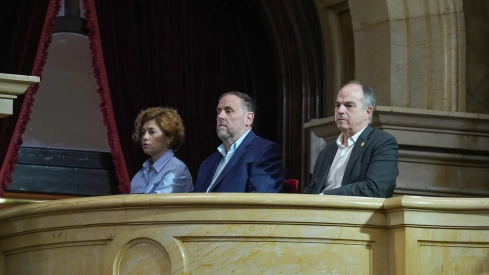
The Supreme Court has applied the amnesty law to the leader of ERC, Oriol Junqueras, and to former Catalan ministers Dolors Bassa, Jordi Turull, and Raül Romeva, convicted for the 2017 independence process. With this decision, the court complies with the ruling of the Constitutional Court that ordered the amnesty of the crime of embezzlement and nullifies the disqualification that still weighed on the four leaders.
The resolution means that Junqueras, Bassa, Turull, and Romeva will be able to run in elections again and hold public office. In addition, the Supreme Court has agreed to communicate its decision to the Ministry of Justice so that their criminal records are removed.
However, the order is not limited to applying the amnesty. The magistrates take advantage of the resolution to harshly criticize the Constitutional Court for the arguments it used to correct the interpretation that the Supreme Court had made of the law. The confrontation between both courts thus returns to the center of judicial news.
The Supreme Court abides by the decision, but criticizes the Constitutional Court
The Supreme Court has applied the amnesty after the Constitutional Court concluded that Dolors Bassa's right to effective judicial protection had been violated by rejecting the application of the law to the crime of embezzlement. The court of guarantees considered that the Supreme Court's interpretation did not conform to the purpose of the norm.
Despite complying with the resolution, the Criminal Chamber criticizes the tone used by the Constitutional Court and considers that some of its expressions were unnecessary. Specifically, the Supreme Court censures what it describes as "the unnecessary grandiloquence" of the judgment and argues that its arguments invade the powers corresponding to the high court in the interpretation of ordinary legislation.
The magistrates also question that the Constitutional Court has corrected the criterion that the Supreme Court had maintained on embezzlement. The resolution thus reflects a clash between two of the country's main judicial institutions: the Constitutional Court, responsible for guaranteeing compliance with the Magna Carta, and the Supreme Court, which interprets and applies ordinary legislation.
The four leaders regain the possibility of running in elections
The decision puts an end to the disqualification that still affected the four pro-independence leaders. Junqueras and Bassa were prohibited from holding public office until 2031, while the disqualifications of Turull and Romeva extended until 2030.
The four had been convicted in 2019 for their participation in the procés. Junqueras received a sentence of 13 years in prison and disqualification, while Bassa, Turull, and Romeva were sentenced to 12 years. In 2021, the Government granted partial pardons for the prison sentences, but the disqualifications remained in force.
Now, the application of the amnesty eliminates these restrictions and also opens the door to erase their criminal records. The political scope of the decision is important, as it allows the four leaders to run for election again.
Puigdemont still awaiting final judicial procedures
The decision regarding Junqueras, Bassa, Turull, and Romeva does not mean that Carles Puigdemont's situation is automatically resolved. The Supreme Court has not yet applied the amnesty to the former Catalan president in this order, although the procedure has advanced after Judge Pablo Llarena confirmed the annulment of the national arrest warrant against him and former ministers Toni Comín and Lluís Puig.
Several procedural steps must still be completed before the court can rule on Puigdemont's situation. These include the conclusion of the preliminary investigation, as well as the possibility of appeals being filed against the latest judicial decisions.
Meanwhile, the application of the amnesty to the four former leaders represents a new step in closing the judicial consequences of the procés. The case continues to be marked by the differences between the Supreme Court and the Constitutional Court on how the law approved to amnesty the events related to the independence process should be interpreted.
