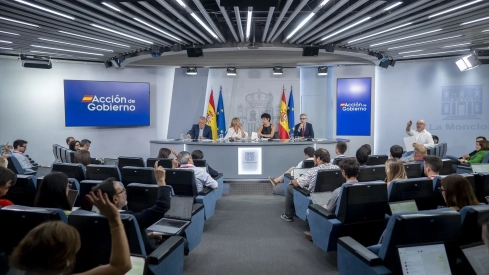
The Government begins to publish this Wednesday the 40 documents prepared before and during the massive entry of migrants into Ceuta to maintain that no police or intelligence service anticipated a mobilization of more than 70,000 people like the one registered on July 30 and 31. The declassification seeks to respond to the main accusation of the opposition, which has been stating for weeks that the Executive knew what was going to happen and decided to remain immobile.
The documentation covers the period between July 1 and August 1 and includes situation and alert reports from the National Intelligence Center (CNI), the Armed Forces Intelligence Center (CIFAS), the National Police, the Civil Guard and other organizations that participated in monitoring the border. La Moncloa will incorporate the files to its website throughout the day.
The Minister of Inclusion, Social Security and Migrations and Government spokesperson, Elma Saiz, defended after the Council of Ministers that the Executive publishes all the material it has in its hands and can be disseminated without compromising national security. "We have nothing to hide," she assured. If new relevant documents appear, they will also be disclosed or sent to the Congress's Official Secrets Commission when they contain sensitive information.
The step announced by Pedro Sánchez comes after a report from the National Immigration and Borders Center (CENIF), incorporated into the open case in the Audiencia Nacional, pointed to the existence of several previous alerts and attributed active participation to Moroccan security forces in the displacement of thousands of people towards Ceuta. The President of the Government maintains that there is still no conclusive evidence to directly hold Rabat responsible, although he has promised to act "forcefully" if the investigation demonstrates such involvement.
There were alerts, but none anticipated the dimension of the entry
The documents will now allow verifying the exact scope of the warnings that circulated during July. The Executive admits that the services detected a continuous increase in entries by swimming and that they recommended reinforcing surveillance after a Supreme Court ruling that limited immediate returns of those who entered by sea.
Among the declassified information are three notes from the CNI, a report from CIFAS, and communications maintained with the Government Delegation in Ceuta and the Civil Guard's intelligence services. One of the notes called for extreme caution at the border breakwater. The CIFAS document was more explicit and warned of a probable massive entry coinciding with the Moroccan Throne Day, although it reached the top echelons of the Ministry of Defense on July 30 itself, when the reaction capacity was already minimal.
This is the core of the dispute. The warnings existed and reflected a scenario of increasing pressure, but the Government maintains that none established the dimension, the precise moment, or the coordination capacity of a mobilization that ended up overwhelming border control. The publication may clarify what information each agency received, when it received it, and what decisions it made based on it.
The police report delivered to Judge María Tardón, for its part, includes an "extreme risk" alert issued on July 29 and describes a "clear and undeniable facilitating management" from Morocco. This assessment is part of an ongoing investigation and does not imply a definitive attribution of responsibilities to the Moroccan Government. Both the central Executive and the city of Ceuta have appeared as injured parties to access the procedure and request new proceedings.
The declassification also does not cover all available information in intelligence agencies. Documents with special protection or that incorporate data provided by allied services will remain outside public access. The Government has committed to facilitating their consultation to groups with representation in the Official Secrets Commission whenever it is compatible with the protection of sources and state security.
PP and the far-right Vox discredit the documents before knowing them
The president of the Popular Party, Alberto Núñez Feijóo, has declared the documentation invalid before its publication. "Those reports are cut", he stated on Tuesday in an interview on 'Antena 3'. The opposition leader assured that he trusts the investigation opened by the Audiencia Nacional more and again demanded the appearance of the director of the CNI, Esperanza Casteleiro, in Congress.
The PP spokesperson in the Senate, Alicia García, raised the tone during the first government control session of the term. García maintained that there were nine alerts, accused the Executive of having concealed the responsibility of the neighboring country, and declared that "Morocco planned it and your Government covered it up". She also demanded a date to return all people who entered irregularly and asked to extend the declassification to documents related to espionage using the 'Pegasus' program.
The far-right Vox has not waited to read the files either. Its parliamentary spokesperson, Pepa Millán, assured that the Interior Ministry ordered police forces to "omit all reference" to Morocco in their reports and presented the publication as a "smokescreen". Millán did not provide evidence to support the existence of these instructions and stated that one would have to be "very naive" to think that the Government would disseminate documents that could harm it.
Doubts have also come from the left. The general secretary of Podemos, Ione Belarra, believes that the Executive has little willingness to tell the truth and thinks that the documents will hardly shed light on what happened. Her party attributes the crisis to Morocco and its international alliance with the United States.
Sumar has received the declassification as a "positive" step, although its deputy spokesperson, Alberto Ibáñez, has warned that resignations will eventually occur due to the management. The coalition has also asked to unblock the reform of the Official Secrets Law and publish documentation on the Green March and the Spanish withdrawal from Western Sahara. The Basque Nationalist Party has also valued the exercise of transparency to clear up the doubts raised in recent weeks.
Saiz responded to Feijóo by demanding that he act as a "statesman" and abandon "conspiracy theories". In the Senate, the first vice-president, Carlos Cuerpo, accused the PP of proposing "impossible or even illegal" solutions, while ministers Elma Saiz, Mónica García, and Ana Redondo reproached the popular party for using the same language as the far-right Vox to refer to the migrant population.
The Government accelerates deployment while Vivas pressures from Brussels
The publication of the reports coincides with a new phase of the state operation in Ceuta. The Minister of Territorial Policy and Democratic Memory, Ángel Víctor Torres, has put the number of minors located at 2,004 and has updated the figure for voluntary returns to Morocco to 4,516 and expulsions carried out to 278. The Government maintains the objective of reaching 6,000 temporary places to remove from the streets those who are still waiting to be identified.
The main institutional clash remains concentrated in the port plots chosen to install a reception area for about a thousand people. Vivas supported its use in the situation committee and in the National Security Council, according to the minutes of both meetings, but the Board of Directors of the Port Authority later rejected the project by eleven votes to four. The central government took functional control of the land to continue the works and Óscar Puente accused the PP of acting with "permanent disloyalty".
The Minister of Interior, Fernando Grande-Marlaska, visited the Tarajal border on Tuesday and announced a new Temporary Foreigner Care Center with capacity for 800 people. The facility will double the 400 places of the provisional enclosure already operating in the city. According to data offered by Marlaska, 1,120 adults have gone through the identification and triage process.
Interior has deployed 78 national police officers, eleven officials specialized in asylum and refuge, and more than 550 reinforcement agents from both the National Police and the Civil Guard. It has also requested 32 million euros from the European Union to extend the breakwaters, modernize technological means, and erect permanent facilities in Ceuta and Melilla. Marlaska trusts that the evolution will allow the single command directed by Torres to be lifted by the end of the year.
The return to classrooms has proceeded without serious incidents. The Ministry of Education, Vocational Training and Sports has placed student attendance at 74.85% during the first day, while Minister Milagros Tolón has highlighted the complete incorporation of teaching staff in the city's 35 public and subsidized centers.
From Brussels, the president of Ceuta, Juan Jesús Vivas, has described Ceuta as a "pressure cooker" and has demanded a "forceful" European response to Morocco. The popular leader calls for a specific status for Ceuta and Melilla, permanent presence of Frontex and the European Asylum Agency, more funding, and a plan with dates for returns.
The Minister of Foreign Affairs, José Manuel Albares, has also advocated in the community capital for greater integration of the two autonomous cities into European institutions and programs. A technical mission from the European Commission will travel to Ceuta at the end of this week to evaluate on the ground the reinforcement of community agencies and the emergency aid requested by Spain.
